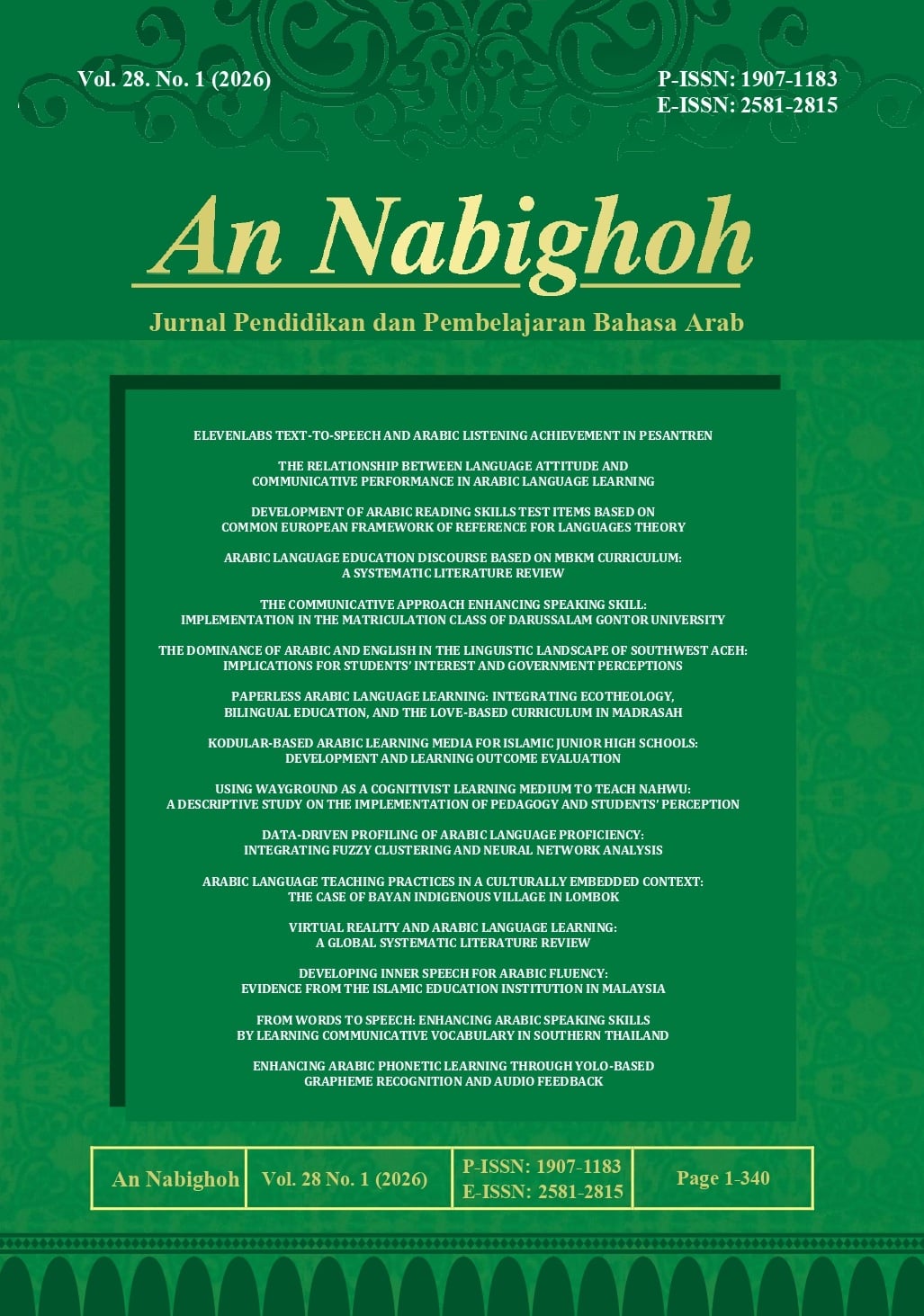
Data-Driven Profiling of Arabic Language Proficiency: Integrating Fuzzy Clustering and Neural Network Analysis
DOI:
https://doi.org/10.32332/an-nabighoh.v28i1.211-232Keywords:
Arabic Language Assessment, Competency Profiling, Fuzzy C-Means Clustering, Neural Network, Educational Data MiningAbstract
Introduction: Evaluating multidimensional language competencies in tertiary-level Arabic education poses persistent methodological difficulties, as conventional scoring systems frequently reduce complex proficiency dimensions to single aggregated values that conceal underlying skill structures and diminish the instructional utility of assessment feedback. Research Objectives: The present study constructs an empirically grounded competency profiling framework by combining clustering algorithms with predictive modeling techniques to uncover latent proficiency patterns among Arabic language learners. Methodology: A cross-sectional quantitative design was adopted using data from 128 students in the Arabic Language Education program at Universitas Negeri Jakarta, whose scores across listening, speaking, reading, and writing skills were analyzed through Fuzzy C-Means (FCM) clustering to identify latent proficiency groupings, followed by the use of a feedforward neural network to model predictive relationships between individual skill domains and overall academic performance. Results: Three learner profiles emerged: low, moderate, and high proficiency each showing statistically significant inter-group differences across all skills (p < 0.001), with effect size estimates (η² = 0.20–0.25) confirming moderate to substantial cluster-level variance, while the neural network attained 93.33% accuracy with a minimal mean squared error (MSE = 2e⁻⁰⁶). Unique Contribution: This study offers an empirically validated hybrid framework synthesizing exploratory clustering with predictive analytics to advance language competency assessment methodology. Conclusion: Arabic language proficiency appears to be organized along a clearly delineated continuum that is statistically distinguishable and reliably predictable. Recommendations: Future research should incorporate broader learner-level variables and apply this framework across diverse educational settings to strengthen generalizability and instructional relevance.
Downloads
References
Aladeemy, Amani A., Ali Alzahrani, Mohammad H. Algarni, et al. “Advancements and Challenges in Arabic Sentiment Analysis: A Decade of Methodologies, Applications, and Resource Development.” Heliyon 10, no. 21 (2024): e39786. https://doi.org/10.1016/j.heliyon.2024.e39786. DOI: https://doi.org/10.1016/j.heliyon.2024.e39786
Amira, Turki. “Implementing Digital Learning: Evaluating the Effect of Data-Driven Factors on Student Engagement and Performance in BAIS Courses.” Frontiers in Education 11 (February 2026): 1727497. https://doi.org/10.3389/feduc.2026.1727497. DOI: https://doi.org/10.3389/feduc.2026.1727497
Ayanwale, Musa Adekunle, Rethabile Rosemary Molefi, and Saheed Oyeniran. “Analyzing the Evolution of Machine Learning Integration in Educational Research: A Bibliometric Perspective.” Discover Education 3, no. 1 (2024): 47. https://doi.org/10.1007/s44217-024-00119-5. DOI: https://doi.org/10.1007/s44217-024-00119-5
Begimbetova, Guldana A., Heri Retnawati, Bruri Moch. Triyono, Haryanto Haryanto, Gulzhaina K. Kassymova, and Slamet Suyanto. “Applying Unsupervised Possibilistic Fuzzy C-Means to Cluster Teachers’ Online Practices.” Journal of Innovation in Educational and Cultural Research 6, no. 3 (2025): 558–66. https://doi.org/10.46843/jiecr.v6i3.2297. DOI: https://doi.org/10.46843/jiecr.v6i3.2297
Bressane, Adriano, Daniel Zwirn, Alexei Essiptchouk, et al. “Understanding the Role of Study Strategies and Learning Disabilities on Student Academic Performance to Enhance Educational Approaches: A Proposal Using Artificial Intelligence.” Computers and Education: Artificial Intelligence 6 (June 2024): 100196. https://doi.org/10.1016/j.caeai.2023.100196. DOI: https://doi.org/10.1016/j.caeai.2023.100196
Çetinkaya, Ali, and Ömer Kaan Baykan. “Prediction of Middle School Students’ Programming Talent Using Artificial Neural Networks.” Engineering Science and Technology, an International Journal 23, no. 6 (2020): 1301–7. https://doi.org/10.1016/j.jestch.2020.07.005. DOI: https://doi.org/10.1016/j.jestch.2020.07.005
Chen, Yingyi, Lihua Song, Yeqi Liu, Ling Yang, and Daoliang Li. “A Review of the Artificial Neural Network Models for Water Quality Prediction.” Applied Sciences 10, no. 17 (2020): 5776. https://doi.org/10.3390/app10175776. DOI: https://doi.org/10.3390/app10175776
Fischer, Christian, Zachary A. Pardos, Ryan Shaun Baker, et al. “Mining Big Data in Education: Affordances and Challenges.” Review of Research in Education 44, no. 1 (2020): 130–60. https://doi.org/10.3102/0091732X20903304. DOI: https://doi.org/10.3102/0091732X20903304
Grant, Richard W., Jodi McCloskey, Meghan Hatfield, et al. “Use of Latent Class Analysis and K-Means Clustering to Identify Complex Patient Profiles.” JAMA Network Open 3, no. 12 (2020): e2029068. https://doi.org/10.1001/jamanetworkopen.2020.29068. DOI: https://doi.org/10.1001/jamanetworkopen.2020.29068
Huang, Zhiwen, Jianmin Zhu, Jingtao Lei, Xiaoru Li, and Fengqing Tian. “Tool Wear Predicting Based on Multi-Domain Feature Fusion by Deep Convolutional Neural Network in Milling Operations.” Journal of Intelligent Manufacturing 31, no. 4 (2020): 953–66. https://doi.org/10.1007/s10845-019-01488-7. DOI: https://doi.org/10.1007/s10845-019-01488-7
Hussain, Mushtaq, Wenhao Zhu, Wu Zhang, Syed Muhammad Raza Abidi, and Sadaqat Ali. “Using Machine Learning to Predict Student Difficulties from Learning Session Data.” Artificial Intelligence Review 52, no. 1 (2019): 381–407. https://doi.org/10.1007/s10462-018-9620-8. DOI: https://doi.org/10.1007/s10462-018-9620-8
Ikotun, Abiodun M., Absalom E. Ezugwu, Laith Abualigah, Belal Abuhaija, and Jia Heming. “K-Means Clustering Algorithms: A Comprehensive Review, Variants Analysis, and Advances in the Era of Big Data.” Information Sciences 622 (April 2023): 178–210. https://doi.org/10.1016/j.ins.2022.11.139. DOI: https://doi.org/10.1016/j.ins.2022.11.139
Jayasree, R., and N. A. Sheela Selvakumari. “Analyzing Student Performance Using Fuzzy Possibilistic C-Means Clustering Algorithm.” Indian Journal Of Science And Technology 16, no. 38 (2023): 3230–35. https://doi.org/10.17485/IJST/v16i38.226. DOI: https://doi.org/10.17485/IJST/v16i38.226
Kastorff, Tamara, Michael Sailer, Johanna Vejvoda, et al. “Context-Specificity to Reduce Bias in Self-Assessments: Comparing Teachers’ Scenario-Based Self-Assessment and Objective Assessment of Technological Knowledge.” Journal of Research on Technology in Education 55, no. 6 (2023): 917–30. https://doi.org/10.1080/15391523.2022.2062498. DOI: https://doi.org/10.1080/15391523.2022.2062498
Kim, Youngjoo, Alexandru C. Telea, Scott C. Trager, and Jos Btm Roerdink. “Visual Cluster Separation Using High-Dimensional Sharpened Dimensionality Reduction.” Information Visualization 21, no. 3 (2022): 197–219. https://doi.org/10.1177/14738716221086589. DOI: https://doi.org/10.1177/14738716221086589
Kocher, Geeta, and Gulshan Kumar. “Machine Learning and Deep Learning Methods for Intrusion Detection Systems: Recent Developments and Challenges.” Soft Computing 25, no. 15 (2021): 9731–63. https://doi.org/10.1007/s00500-021-05893-0. DOI: https://doi.org/10.1007/s00500-021-05893-0
Li, Guang, Fangfang Liu, Ashutosh Sharma, et al. “Research on the Natural Language Recognition Method Based on Cluster Analysis Using Neural Network.” Mathematical Problems in Engineering 2021 (May 2021): 1–13. https://doi.org/10.1155/2021/9982305. DOI: https://doi.org/10.1155/2021/9982305
Li, Yu, Jin Gou, and Zongwen Fan. “Educational Data Mining for Students’ Performance Based on Fuzzy C‐means Clustering.” The Journal of Engineering 2019, no. 11 (2019): 8245–50. https://doi.org/10.1049/joe.2019.0938. DOI: https://doi.org/10.1049/joe.2019.0938
Liu, Na, Yongxia Li, and Yuxiu Guo. “Optimization of Online Learning Resource Adaptation in Higher Education through Neural Network Approaches.” International Journal of Interactive Mobile Technologies (iJIM) 18, no. 11 (2024): 92–107. https://doi.org/10.3991/ijim.v18i11.49779. DOI: https://doi.org/10.3991/ijim.v18i11.49779
Malik, Saleem, Chandrakanta Mahanty, Jnanaranjan Mohanty, et al. “Enhancing Education Quality with Hybrid Clustering and Evolutionary Neural Networks in a Multi Phase Framework.” Scientific Reports 15, no. 1 (2025): 21323. https://doi.org/10.1038/s41598-025-04622-z. DOI: https://doi.org/10.1038/s41598-025-04622-z
Mehrabi, Amirreza, Jason W. Morphew, and Breejha S. Quezada. “Enhancing Performance Factor Analysis through Skill Profile and Item Similarity Integration via an Attention Mechanism of Artificial Intelligence.” Frontiers in Education 9 (November 2024): 1454319. https://doi.org/10.3389/feduc.2024.1454319. DOI: https://doi.org/10.3389/feduc.2024.1454319
Okewu, Emmanuel, Phillip Adewole, Sanjay Misra, Rytis Maskeliunas, and Robertas Damasevicius. “Artificial Neural Networks for Educational Data Mining in Higher Education: A Systematic Literature Review.” Applied Artificial Intelligence 35, no. 13 (2021): 983–1021. https://doi.org/10.1080/08839514.2021.1922847. DOI: https://doi.org/10.1080/08839514.2021.1922847
Ouyang, Fan, Mian Wu, Luyi Zheng, Liyin Zhang, and Pengcheng Jiao. “Integration of Artificial Intelligence Performance Prediction and Learning Analytics to Improve Student Learning in Online Engineering Course.” International Journal of Educational Technology in Higher Education 20, no. 1 (2023): 4. https://doi.org/10.1186/s41239-022-00372-4. DOI: https://doi.org/10.1186/s41239-022-00372-4
Oyelade, Jelili, Itunuoluwa Isewon, Olufunke Oladipupo, et al. “Data Clustering: Algorithms and Its Applications.” 2019 19th International Conference on Computational Science and Its Applications (ICCSA), July 2019, 71–81. https://doi.org/10.1109/ICCSA.2019.000-1. DOI: https://doi.org/10.1109/ICCSA.2019.000-1
Pacifico, Antonio. “Fuzzy Clustering with Robust Learning Models for Soccer Player Profiling and Resilience Analysis.” Journal of Big Data 12, no. 1 (2025): 263. https://doi.org/10.1186/s40537-025-01297-1. DOI: https://doi.org/10.1186/s40537-025-01297-1
Palm, Torulf. Performance Assessment and Authentic Assessment: A Conceptual Analysis of the Literature. n.d. https://doi.org/10.7275/0QPC-WS45.
Reddy Yanamala, Kiran Kumar. “Integrating Machine Learning and Human Feedback for Employee Performance Evaluation.” Journal of Advanced Computing Systems 2, no. 1 (2024): 1–10. https://doi.org/10.69987/JACS.2022.20101. DOI: https://doi.org/10.69987/JACS.2022.20101
Ritonga, Mahyudin, Rosniati Hakim, Talqis Nurdianto, and Apri Wardana Ritonga. “Learning for Early Childhood Using the IcanDO Platform: Breakthroughs for Golden Age Education in Arabic Learning.” Education and Information Technologies 28, no. 7 (2023): 9171–88. https://doi.org/10.1007/s10639-022-11575-7. DOI: https://doi.org/10.1007/s10639-022-11575-7
Rustam, Rustam, and Koredianto Usman. “An Explainable Fuzzy Clustering Framework for Modeling Learning Trajectories in Outcome-Based Education.” BAREKENG: Jurnal Ilmu Matematika Dan Terapan 20, no. 3 (2026): 1949–66. https://doi.org/10.30598/barekengvol20iss3pp1949-1966. DOI: https://doi.org/10.30598/barekengvol20iss3pp1949-1966
Sari, Indah Purnama, Al-Khowarizmi Al-Khowarizmi, and Ismail Hanif Batubara. “Cluster Analysis Using K-Means Algorithm and Fuzzy C- Means Clustering For Grouping Students’ Abilities In Online Learning Process.” Journal of Computer Science, Information Technology and Telecommunication Engineering 2, no. 1 (2021). https://jurnal.umsu.ac.id/index.php/jcositte/article/view/6504.
Sarker, Iqbal H. “Machine Learning: Algorithms, Real-World Applications and Research Directions.” SN Computer Science 2, no. 3 (2021): 160. https://doi.org/10.1007/s42979-021-00592-x. DOI: https://doi.org/10.1007/s42979-021-00592-x
Shawaqfeh, Adawiya Taleb, Yusra jadallah abed Khasawneh, A. J. Khasawneh, and Mohamad Ahmad Saleem Khasawneh. “Data-Driven Language Assessment in Multilingual Educational Settings: Tools and Techniques for Proficiency Evaluation.” Migration Letters 21, no. 2 (2024). https://migrationletters.com/index.php/ml/article/view/6215.
Sorgog, Kiyan, and Masashi Kamo. “Quantifying the Precision of Ecological Risk: Conventional Assessment Factor Method vs. Species Sensitivity Distribution Method.” Ecotoxicology and Environmental Safety 183 (November 2019): 109494. https://doi.org/10.1016/j.ecoenv.2019.109494. DOI: https://doi.org/10.1016/j.ecoenv.2019.109494
Supena, Ilyas, Agus Darmuki, and Ahmad Hariyadi. “The Influence of 4C (Constructive, Critical, Creativity, Collaborative) Learning Model on Students’ Learning Outcomes.” International Journal of Instruction 14, no. 3 (2021): 873–92. https://doi.org/10.29333/iji.2021.14351a. DOI: https://doi.org/10.29333/iji.2021.14351a
Teng, Fei. “Fuzzy Association Rule Mining for Personalized Chinese Language and Literature Teaching from Higher Education.” International Journal of Computational Intelligence Systems 17, no. 1 (2024): 266. https://doi.org/10.1007/s44196-024-00676-5. DOI: https://doi.org/10.1007/s44196-024-00676-5
Wang, Yu-Jie, Chang-Lei Gao, and Xin-Dong Ye. “A Data-Driven Precision Teaching Intervention Mechanism to Improve Secondary School Students’ Learning Effectiveness.” Education and Information Technologies 29, no. 9 (2024): 11645–73. https://doi.org/10.1007/s10639-023-12238-x. DOI: https://doi.org/10.1007/s10639-023-12238-x
Yu, Hao, and Yunyun Guo. “Generative Artificial Intelligence Empowers Educational Reform: Current Status, Issues, and Prospects.” Frontiers in Education 8 (June 2023): 1183162. https://doi.org/10.3389/feduc.2023.1183162. DOI: https://doi.org/10.3389/feduc.2023.1183162
Zareef, Muhammad, Quansheng Chen, Md Mehedi Hassan, et al. “An Overview on the Applications of Typical Non-Linear Algorithms Coupled With NIR Spectroscopy in Food Analysis.” Food Engineering Reviews 12, no. 2 (2020): 173–90. https://doi.org/10.1007/s12393-020-09210-7. DOI: https://doi.org/10.1007/s12393-020-09210-7
Zhang, Li, and Xueying Gu. “A Novel Career Prediction Method Based on Fuzzy Model—Fuzzy Clustering Approach.” Acta Psychologica 259 (September 2025): 105475. https://doi.org/10.1016/j.actpsy.2025.105475. DOI: https://doi.org/10.1016/j.actpsy.2025.105475
Zhao, XiuHua. “A Hybrid Deep Learning and Fuzzy Logic Framework for Feature-Based Evaluation of English Language Learners.” Scientific Reports 15, no. 1 (2025): 33657. https://doi.org/10.1038/s41598-025-17738-z. DOI: https://doi.org/10.1038/s41598-025-17738-z
Downloads
Published
Issue
Section
License
Copyright (c) 2026 Atikah Marwa, Danial Hilmi, Syaiful Mustofa, Ayu Desrani, Apri Wardana Ritonga

This work is licensed under a Creative Commons Attribution-ShareAlike 4.0 International License.