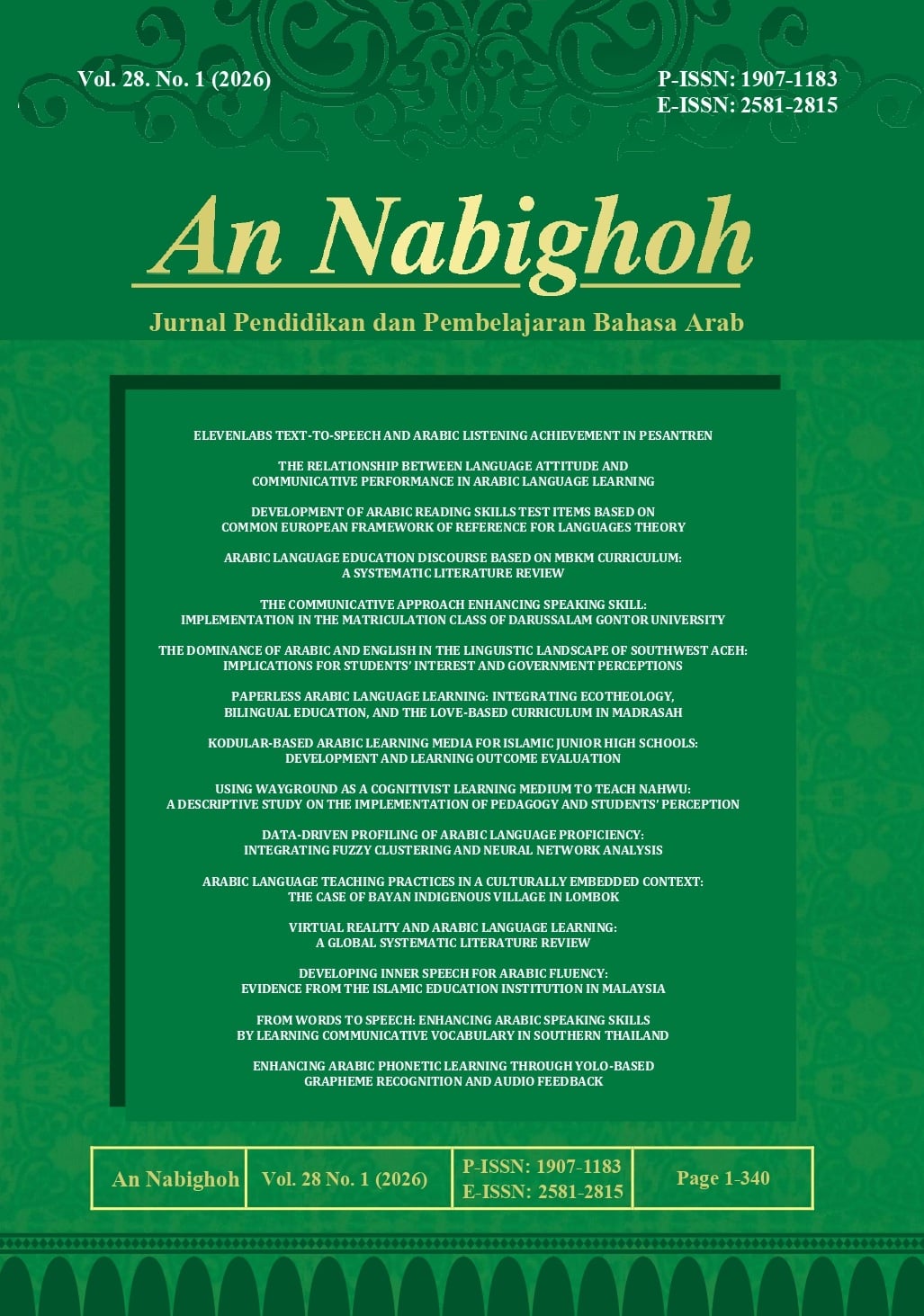
Using Wayground as a Cognitivist Learning Medium to Teach Nahwu: A Descriptive Study on the Implementation of Pedagogy and Students’ Perception
DOI:
https://doi.org/10.32332/an-nabighoh.v28i1.189-210Keywords:
Cognivism Theory, Digital Learning Media, Nahwu Learning, Wayground, Student PerceptionAbstract
Background: Nahwu learning often faces challenges due to students’ low motivation and difficulties in understanding abstract grammatical concepts. These challenges are frequently intensified by traditional teaching approaches that lack interactivity and provide limited opportunities for active practice with grammatical rules. Research Objectives: This study aims to describe the implementation of Wayground in nahwu learning based on cognitivist theory and to examine students’ attitudes toward its use. Methodology: This study employed a qualitative approach supplemented by quantitative descriptive data on student perceptions. Conducted at Madrasah Aliyah Darul Qiyam Kerinci, it involved 40 twelfth-grade students selected through total sampling. Data were collected through observation, documentation, and a four-point Likert-scale questionnaire, and analyzed descriptively and thematically using frequencies, percentages, means, and standard deviations. Results: The implementation of Wayground-based nahwu learning consisted of five stages: (1) preparation of materials and quizzes, (2) activation of prior knowledge, (3) guided use of Wayground, (4) interactive quizzes, and (5) feedback through discussion. These stages reflected cognitivist principles, including schema activation, information processing, repetition, reinforcement, and immediate feedback. Students responded positively, reporting that Wayground helped them understand nahwu concepts, organize grammatical information, connect new knowledge with prior knowledge, and increase motivation and confidence. Unique Contribution: This study contributes to technology-supported nahwu learning by demonstrating the pedagogical integration of Wayground with cognitivist theory and offering a theoretically grounded instructional approach that does not claim causal effectiveness. Conclusion: Wayground can function as a useful supplementary tool for cognition-based Nahwu learning when supported by structured instructional stages, carefully designed questions, teacher facilitation, and follow-up discussions. However, positive student perceptions should not be interpreted as direct evidence of improved learning outcomes. Recommendations: Future research should involve larger samples, different nahwu topics, and more rigorous designs, such as pretest/posttest or comparative studies, to more directly assess its impact on students’ achievement and cognitive development.
Downloads
References
Alexander, Kaitlin, Jeff Cain, and Rahul Nohria. “Adoption, Preferences, and Barriers of Using AI-Generated Podcasts in Pharmacy Education.” American Journal of Pharmaceutical Education 90, no. 2 (2026): 101925. https://doi.org/10.1016/j.ajpe.2025.101925. DOI: https://doi.org/10.1016/j.ajpe.2025.101925
Al-Qatawneh, Sami. “The Impact of Flipped Learning on Secondary Students’ Achievement in Arabic Grammar and Their Attitudes: An Experimental Study in Jordan.” Educational Process International Journal 17, no. 1 (2025). https://doi.org/10.22521/edupij.2025.17.363. DOI: https://doi.org/10.22521/edupij.2025.17.363
Andriyanto, Octo Dendy, Suhartono Suhartono, Didik Nurhadi, Diding Wahyudin Rohaedi, Meilita Hardika, and Nisachon Chuchai. “Cultural Immersion in BIPA Learning: Innovative Strategy for Developing Speaking Skills through Local Wisdom.” Educational Process International Journal 17, no. 1 (2025). https://doi.org/10.22521/edupij.2025.17.354. DOI: https://doi.org/10.22521/edupij.2025.17.354
Baharudin, Harun, Khairulaizam Abdul Rahman, and Nurazizah Maarup. “The Size and Depth of Arabic Vocabulary among Students in Malaysia’s Selangor Religious Secondary Schools.” International Journal of Academic Research in Business and Social Sciences 13, no. 7 (2023): Pages 345-361. https://doi.org/10.6007/IJARBSS/v13-i7/17709. DOI: https://doi.org/10.6007/IJARBSS/v13-i7/17709
Biggs, John. “Enhancing Teaching through Constructive Alignment.” Higher Education 32, no. 3 (1996): 347–64. https://doi.org/10.1007/BF00138871. DOI: https://doi.org/10.1007/BF00138871
Bonatti, Michelle, Carla Erismann, Ayna Askhabalieva, et al. “Social Learning as an Underlying Mechanism for Sustainability in Neglected Communities: The Brazilian Case of the Bucket Revolution Project.” Environment, Development and Sustainability 27, no. 9 (2022): 20433–51. https://doi.org/10.1007/s10668-022-02167-z. DOI: https://doi.org/10.1007/s10668-022-02167-z
Bonwell, Charles C., and James A. Eison. Active Learning: Creating Excitement in the Classroom. ERIC Clearinghouse on Higher Education, 1991.
Creswell, John W., and J. David Creswell. Research Design: Qualitative, Quantitative, and Mixed Methods Approaches. SAGE Publications, 2018.
Delima, Dianne G. “Learning from Each Other’s Lives: First-Generation College Students of Color Engaging with Diversity Course Content.” Active Learning in Higher Education 26, no. 1 (2025): 77–89. https://doi.org/10.1177/14697874231196529. DOI: https://doi.org/10.1177/14697874231196529
Estelami, Hooman. “The Effects of Survey Timing on Student Evaluation of Teaching Measures Obtained Using Online Surveys.” Journal of Marketing Education 37, no. 1 (2015): 54–64. https://doi.org/10.1177/0273475314552324. DOI: https://doi.org/10.1177/0273475314552324
Fitri, Natasya Ayu, Muhammad Ilham, and Triana Susanti. “Quizizz Application as a Medium for Evaluating Tarjamah Learning.” Proceeding of International Conference of Islamic Education 2 (September 2024). https://jurnal.iimsurakarta.ac.id/index.php/icie/article/view/511.
Fitriyah, M., Suratno, T. D. Prastiti, Dafik, and Hobri. “The Effectiveness of the Combined of Inquiry and Experimental Learning Models on Student Cognitive Learning Outcomes about the Properties of Light.” Journal of Physics: Conference Series 1563, no. 1 (2020): 012057. https://doi.org/10.1088/1742-6596/1563/1/012057. DOI: https://doi.org/10.1088/1742-6596/1563/1/012057
Fredricks, Jennifer A., Michael Filsecker, and Michael A. Lawson. “Student Engagement, Context, and Adjustment: Addressing Definitional, Measurement, and Methodological Issues.” Learning and Instruction 43 (June 2016): 1–4. https://doi.org/10.1016/j.learninstruc.2016.02.002. DOI: https://doi.org/10.1016/j.learninstruc.2016.02.002
Garris, Rosemary, Robert Ahlers, and James E. Driskell. “Games, Motivation, and Learning: A Research and Practice Model.” Simulation & Gaming 33, no. 4 (2002): 441–67. https://doi.org/10.1177/1046878102238607. DOI: https://doi.org/10.1177/1046878102238607
Ginting, Donny Adiatmana, and Syahrul Ramadhan. “The Impact of Interactive Learning Applications on EFL Students’ Preferences and Academic Achievement.” TEM Journal, May 28, 2024, 1362–70. https://doi.org/10.18421/TEM132-50. DOI: https://doi.org/10.18421/TEM132-50
Groß-Mlynek, Lena, Tanja Graf, Marius Harring, Katrin Gabriel-Busse, and Tobias Feldhoff. “Cognitive Activation in a Close-Up View: Triggers of High Cognitive Activity in Students During Group Work Phases.” Frontiers in Education 7 (May 2022): 873340. https://doi.org/10.3389/feduc.2022.873340. DOI: https://doi.org/10.3389/feduc.2022.873340
Haris, Nurfazlina, Azlina Bujang, Sheela Faizura Nik Fauzi, and Sarehan Sadikin. “Investigation of Cognitive Engagement Theory in Supporting Visual Learners Using Multimedia Based Platforms.” 2022 International Conference on Computer and Drone Applications (IConDA), November 28, 2022, 142–47. https://doi.org/10.1109/ICONDA56696.2022.10000373. DOI: https://doi.org/10.1109/ICONDA56696.2022.10000373
Hernanz, Virginia, Cecilia Latorre-Cosculluela, and Cristina Suárez. “Comparing Engagement and Active Participation with Gamification in Quizizz Applications: Influences on the Teaching-Learning Process.” Technology, Pedagogy and Education 34, no. 5 (2025): 659–74. https://doi.org/10.1080/1475939X.2025.2488320. DOI: https://doi.org/10.1080/1475939X.2025.2488320
Hernanz, Virginia, Cecilia Latorre-Cosculluela, Cristina Suárez, and Elena Lanchares-Sancho. “Revitalising Learning in Three University Contexts: Unleashing the Power of the Quizizz App to Increase Self-Efficacy, Intrinsic Motivation, Satisfaction and Performance.” Education and Information Technologies 29, no. 17 (2024): 23917–35. https://doi.org/10.1007/s10639-024-12779-9. DOI: https://doi.org/10.1007/s10639-024-12779-9
Jenlink, Patrick M., ed. Multimedia Learning Theory: Preparing for the New Generation of Students. Rowman & Littlefield, 2019.
Kelly, By Rhea. “Quizizz Rebrands as Wayground, Announces New AI Features -.” THE Journal. Accessed June 10, 2026. https://thejournal.com/articles/2025/06/24/quizizz-rebrands-as-wayground-announces-new-ai-features.aspx.
Kim, Beaumie. “Social Constructivism.” Emerging Perspectives on Learning, Teaching, and Technology 1, no. 1 (2001): 16.
Lestari, Asti Tri, Anggia Suci Pratiwi, Taofik Muhammad, Meiliana Nurfitriani, and Juju Masunah. “Gamified Islamic Dance Learning Media for Pesantren: An Android-Based Development Study.” Online Learning In Educational Research (OLER) 6, no. 1 (2026): 199–210. https://doi.org/10.58524/oler.v6i1.1058. DOI: https://doi.org/10.58524/oler.v6i1.1058
Maraza-Quispe, Benjamín. “Impact of the Use of Gamified Online Tools: A Study with Kahoot and Quizizz in the Educational Context.” International Journal of Information and Education Technology 14, no. 1 (2024): 132–40. https://doi.org/10.18178/ijiet.2024.14.1.2033. DOI: https://doi.org/10.18178/ijiet.2024.14.1.2033
Mia, Miatin Rachmawati, Ahmad Rizki Nugrahawan, and Nurul Hidayati Rofi’ah. “The Quizizz Application Is an Arabic Online Learning Evaluation Tool at The University Level.” Izdihar : Journal of Arabic Language Teaching, Linguistics, and Literature 5, no. 1 (2022). https://doi.org/10.22219/jiz.v5i1.20647. DOI: https://doi.org/10.22219/jiz.v5i1.20647
Mohd Faizulamri Mohd Saad, Sabri Mohamad, Nur Syuhada Mohd Ataa, and Najah Nadiah Amran. “Enhancing Higher Order Thinking Skills (HOTs) in the Tahfiz Integrated Curriculum (KBT): A Qualitative Document Analysis.” Global Journal Al-Thaqafah, December 31, 2025, 1–13. https://doi.org/10.7187/GJATSI122025-1. DOI: https://doi.org/10.7187/GJATSI122025-1
Moleong, Lexy J. Metodologi Penelitian Kualitatif. Edited by Tjun Surjaman. Remaja Rosda Karya, 2014.
Narawati, Arlina Yuli, Didi Supriadi, and Rahmat Mulyanto. “Using Quizizz as an Interactive Learning Media to Improve Cognitive Values in Elementary School Students.” International Journal of Engineering, Science and Information Technology 5, no. 1 (2024). https://doi.org/10.52088/ijesty.v5i1.637. DOI: https://doi.org/10.52088/ijesty.v5i1.637
Parimala, Yuvarani Kandasamy, Roopali M. Sankeshwari, Mahantesh Siddibhavi, et al. “Social Media Usage among Dental Faculty and Students: An Assessment Using Bloom’s Taxonomy Framework.” Przeglad Epidemiologiczny, ahead of print, July 25, 2025. https://doi.org/10.32394/pe/208258. DOI: https://doi.org/10.32394/pe/208258
Passwater, Chelsea, and Matthew Passwater. “Educating With Edge: Aligning Bloom’s Revised Taxonomy With the Substitution, Augmentation, Modification, and Redefinition Model to Enhance Graduate Nursing Education for the Artificial Intelligence Era.” Journal of Doctoral Nursing Practice 18, no. 3 (2025): 173–80. https://doi.org/10.1891/JDNP-2025-0039. DOI: https://doi.org/10.1891/JDNP-2025-0039
Pham, Anh Tuan, Chau Thi Hong Thai, and Tham Van Nguyen. “Gamified Learning in Grammar Lessons: EFL Students’ Perceptions of Kahoot! And Quizizz.” Acta Psychologica 259 (September 2025): 105436. https://doi.org/10.1016/j.actpsy.2025.105436. DOI: https://doi.org/10.1016/j.actpsy.2025.105436
Pham, Duc Thuan. “Gamified Mobile Learning: EFL Students’ Attitudes Toward Quizizz for Grammar Instruction.” International Journal of Interactive Mobile Technologies (iJIM) 19, no. 12 (2025): 38–54. https://doi.org/10.3991/ijim.v19i12.54921. DOI: https://doi.org/10.3991/ijim.v19i12.54921
Pramudita, Rizqi Febrian. “Quizizz as Technology to Enhance EFL Students’ Active Participation in the Classroom.” Journal of English in Academic and Professional Communication 9, no. 1 (2023): 11–18. https://doi.org/10.25047/jeapco.v9i1.3755. DOI: https://doi.org/10.25047/jeapco.v9i1.3755
Ritonga, Mahyudin, Adam Mudinillah, Muhammad Zalnur, and Fauzul Fil Amri. “Learning Arabic for Kids Online Using Google Classroom.” In Kids Cybersecurity Using Computational Intelligence Techniques, vol. 1080, edited by Wael M. S. Yafooz, Hussain Al-Aqrabi, Arafat Al-Dhaqm, and Abdelhamid Emara. Studies in Computational Intelligence. Springer International Publishing, 2023. https://doi.org/10.1007/978-3-031-21199-7_11. DOI: https://doi.org/10.1007/978-3-031-21199-7_11
Romadhon, Kharisma, Lusi Oktavia, Irfan Irfan, Putri Jannati, and Anelda Ultavia. “Implementation of the Quizizz Application as a Media in Assessment of Online Learning to Grow Student Learning Motivation in Elementary Schools.” EduHumaniora | Jurnal Pendidikan Dasar Kampus Cibiru 15, no. 1 (2023): 19–28. https://doi.org/10.17509/eh.v15i1.47299. DOI: https://doi.org/10.17509/eh.v15i1.47299
Rozy, Fianico Sukmana. “Activating Prior Knowledge through KWL Strategy in Young EFL Learners’ Reading.” Journal of Early Childhood Education Studies 5, no. 1 (2025): 64–83. https://doi.org/10.54180/joeces.v5i1.470. DOI: https://doi.org/10.54180/joeces.v5i1.470
Sarangi, Prajnya, and M. Ramachandran. “Constructivist Approaches on Developing 4Cs of 21 Century Skills.” In Intelligent Computing and Optimization, vol. 1167, edited by Pandian Vasant, Vladimir Panchenko, Elias Munapo, et al. Lecture Notes in Networks and Systems. Springer Nature Switzerland, 2024. https://doi.org/10.1007/978-3-031-73318-5_39. DOI: https://doi.org/10.1007/978-3-031-73318-5_39
Silviyanti, Tgk Maya, Yunisrina Qismullah Yusuf, Iskandar Abdul Samad, and Amirul Mukminin. “The Implementation of English and Arabic Practices at an Islamic Bilingual Boarding School.” Jurnal Cakrawala Pendidikan 43, no. 3 (2024): 630–44. https://doi.org/10.21831/cp.v43i3.72204. DOI: https://doi.org/10.21831/cp.v43i3.72204
Smith Sockbeson, Caitlin E. “Using QuizizzTM in the Management Classroom.” Management Teaching Review 9, no. 1 (2024): 82–97. https://doi.org/10.1177/23792981221126504. DOI: https://doi.org/10.1177/23792981221126504
Sulaiman, Rizkariani, and Muhammad Affan Ramadhana. “Students’ Responses toward the Use of Quizizz in English Class.” Didaktika: Jurnal Kependidikan 11, no. 3 (2022): 135–42. https://doi.org/10.58230/27454312.150. DOI: https://doi.org/10.58230/27454312.150
Von Glasersfeld, Ernst. “An Interpretation of Piaget’s Constructivism.” Revue Internationale de Philosophie, 1982, 612–35.
Wahyuddin, Wahyuddin, Muhammad Nadir, and Zulfa Jamalie. “Functional Arabic Syntax Theory in Action: Developing Materials for Islamic Universities.” KARSA Journal of Social and Islamic Culture 33, no. 2 (2025). https://doi.org/10.19105/karsa.v33i2.21026. DOI: https://doi.org/10.19105/karsa.v33i2.21026
Wang, Ming-Te, and Jessica Degol. “Staying Engaged: Knowledge and Research Needs in Student Engagement.” Child Development Perspectives 8, no. 3 (2014): 137–43. https://doi.org/10.1111/cdep.12073. DOI: https://doi.org/10.1111/cdep.12073
Wassalwa, Almanna, and Ukhtul Iffah. “The Effectiveness of Game Quizizz Using Learning Media On Students’ Outcomes: The Effectiveness of Game Quizizz Using Learning Media On Students’ Outcomes.” JOEY: Journal of English Ibrahimy 1, no. 2 (2022): 10–17. https://doi.org/10.35316/joey.2022.v1i2.10-17. DOI: https://doi.org/10.35316/joey.2022.v1i2.10-17
Williamson, Manda, Leen-Kiat Soh, Debbie Minter, and Wayne Babchuk. “Assessing Arts and Sciences Faculty Learning Objectives and Practices: Using Bloom’s Taxonomy to Describe a Unique College Identity.” Journal of Assessment and Institutional Effectiveness 15, nos. 1–2 (2025): 126–54. https://doi.org/10.5325/jasseinsteffe.15.1-2.0126. DOI: https://doi.org/10.5325/jasseinsteffe.15.1-2.0126
Downloads
Published
Issue
Section
License
Copyright (c) 2026 Abdul Muid, Uril Bahruddin, Isnainiyah Isnainiyah, Miftahus Sa'diyah, Budi Santoso, Ahmad Fikri

This work is licensed under a Creative Commons Attribution-ShareAlike 4.0 International License.