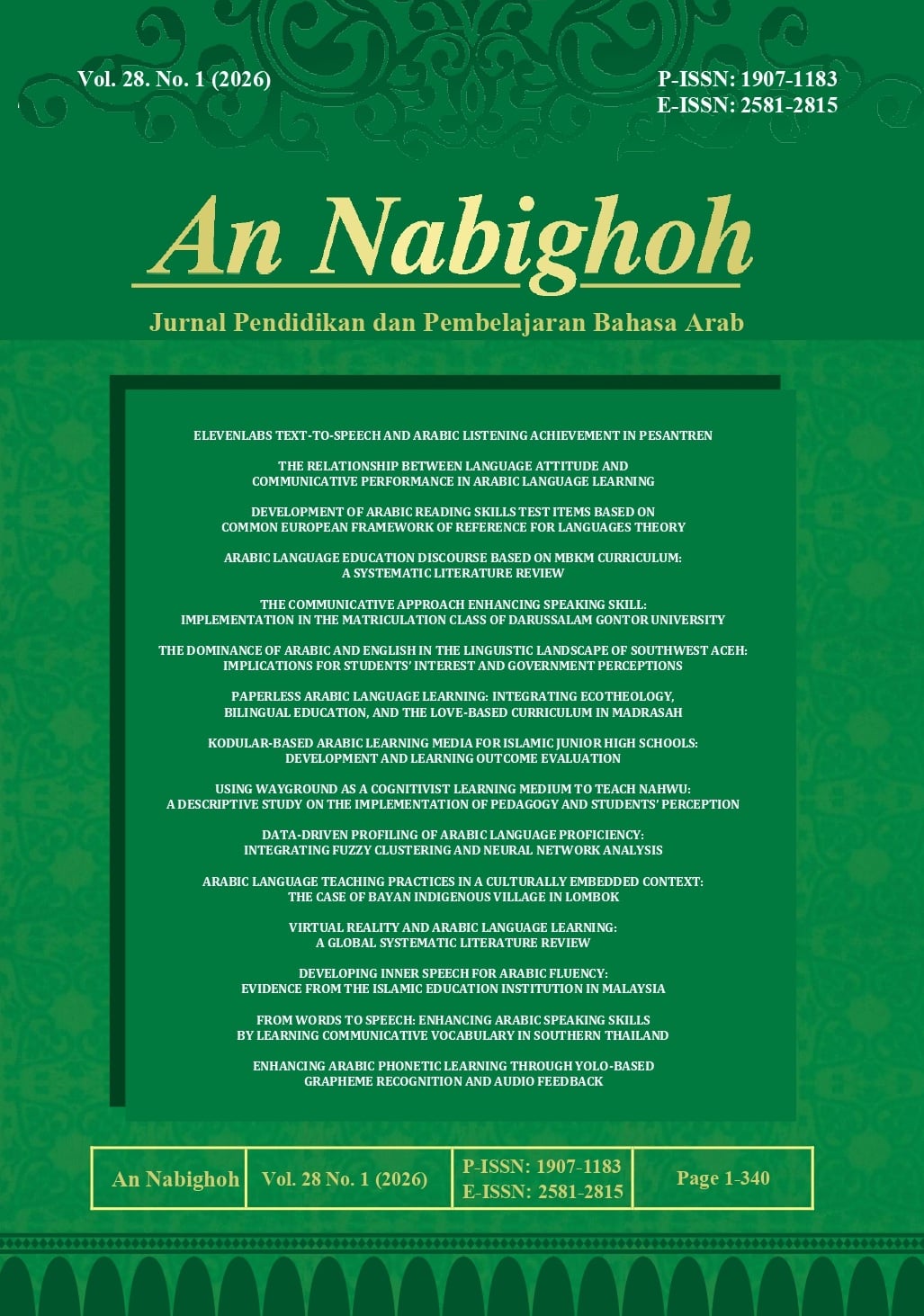
From Words to Speech: Enhancing Arabic Speaking Skills by Learning Communicative Vocabulary in Southern Thailand
DOI:
https://doi.org/10.32332/an-nabighoh.v28i1.299-318Keywords:
From words to speech, Enhancing, Speaking skills, Communicative vocabularyAbstract
Background: Arabic speaking skill (maharah kalam) is one of the most important competencies in foreign language learning, as it enables students to effectively communicate ideas, opinions, and information. Buranakarn Suksa Witya School, Southern Thailand, revealed that many students experienced difficulties in fluently and confidently speaking Arabic. These difficulties were largely because the instructional practices that emphasized vocabulary memorization and reading activities while providing limited opportunities for meaningful oral interaction. Students possessed basic vocabulary knowledge but struggled to use it in spontaneous communication. Research Objectives: This study aimed to improve the maharah kalam of students through the implementation of the From Words to Speech learning model, an instructional approach designed to gradually transform vocabulary. Methodology: Classroom Action Research (CAR) design consists of two cycles, with each cycle involving the stages of planning, action, observation, and reflection. The participants were students of Class 5/3 secondary. Data were collected through pretests and posttests, and observations were madeobservation administered before and after each cycle to measure the speaking performance of the students.students’ speaking performance. Results: The findings demonstrated a substantial improvement in the Arabic speaking skills of students following the implementation of the From Words to Speech model. The improvement was evident not only in speaking performance but also in vocabulary mastery, fluency, and confidence in communication ang suggest that the From Words to Speech model, as it integrates vocabulary learning with continuous communicative use and speaking practice, provides a more effective approach to developing students’ maharah kalam than traditional teaching practices. Unique Contribution: This study proposes the From Words to Speech model to improve Arabic speaking skills through learning communicative vocabulary. Conclusion: The improvement was evident not only in the speaking performance but also in the vocabulary mastery, fluency, and confidence in communication. These findings suggest that the From Words to Speech model offers a more effective approach to developing students’ maharah kalam by supporting both linguistic competence and communicative confidence. Recommendations: Teachers are encouraged to apply this model, and it should be tested in different learning contexts in future studies.
Downloads
References
Abahussain, Majed Othman. “Exploring Saudi English-Major Students’ Attitudes Towards English as an International Language: A Qualitative Perspective.” International Journal of Instruction 19, no. 1 (2026): 457–76. https://doi.org/10.29333/iji.2026.19123a. DOI: https://doi.org/10.29333/iji.2026.19123a
Abidah, Aniqah Laili, Agung Setiyawan, M. Naufal Al Qurthuby Fuady S, and Neisya Azaria Adinda Putri. “Teaching Maharah Al-Kalam Through Digital Media in Higher Education.” Arabiyatuna: Jurnal Bahasa Arab 10, no. 1 (2026): 187–206. https://doi.org/10.29240/jba.v10i1.13553. DOI: https://doi.org/10.29240/jba.v10i1.13553
Akla, Akla. “Pengajaran Bahasa Arab Dengan Pendekatan Behavioristik.” An Nabighoh 23, no. 1 (2021): 87. https://doi.org/10.32332/an-nabighoh.v23i1.3223. DOI: https://doi.org/10.32332/an-nabighoh.v23i1.3223
Ali, Asem Shehadeh, Mohammad Ali Mousa Ibnian, and Nur Sakinah Binti Zulkifli. “Teaching Arabic Vocabulary Through Dialogue and Its Procedures for Learners of Arabic as a Foreign Language.” Evolutionary Studies in Imaginative Culture, October 6, 2024, 1451–59. https://doi.org/10.70082/esiculture.vi.1624. DOI: https://doi.org/10.70082/esiculture.vi.1624
Al-Jamali, Sana, and Suliman Zakaria Suliman Abdalla. “Behavioral Determinants of AI-Driven Arabic Language Learning: Insights from the Extended UTAUT2 Model.” Educational Process International Journal 16, no. 1 (2025). https://doi.org/10.22521/edupij.2025.16.282. DOI: https://doi.org/10.22521/edupij.2025.16.282
Almelhes, Sultan A., and Hussain E. Alsaiari. “A Conceptual Framework for Teaching Arabic as a Second Language.” Theory and Practice in Language Studies 14, no. 7 (2024): 2110–18. https://doi.org/10.17507/tpls.1407.18. DOI: https://doi.org/10.17507/tpls.1407.18
Alnuzaili, Ehab Saleh, and Nasir Uddin. “Dealing with Anxiety in Foreign Language Learning Classroom.” Journal of Language Teaching and Research 11, no. 2 (2020): 269. https://doi.org/10.17507/jltr.1102.15. DOI: https://doi.org/10.17507/jltr.1102.15
Baharun, Segaf, Moh. Tohiri Habib, Nurul Azira, and Adham Hasif. “Repeat After Me: Affective Scaffolding for Arabic Speaking Fluency.” Journal of Arabic Language Learning and Teaching (JALLT) 4, no. 1 (2026): 25–40. https://doi.org/10.23971/jallt.v4i1.413. DOI: https://doi.org/10.23971/jallt.v4i1.413
Boonchom, Srisa-ard, Luanganggoon Nuchwana, and Malasi Amorn. “The Development of Standards, Factors, and Indicators for Evaluating the Quality of Classroom Action Research.” Procedia - Social and Behavioral Sciences 69 (December 2012): 220–26. https://doi.org/10.1016/j.sbspro.2012.11.402. DOI: https://doi.org/10.1016/j.sbspro.2012.11.402
Canale, Michael. “From Communicative Competence to Communicative Language Pedagogy.” In Language and Communication. Routledge, 1983.
Cojorn, Kanyarat, and Chaweewan Seesom. “Igniting Research Competency: Empowering Pre-Service Teachers through Communities of Practice plus Lesson Study.” Jurnal Cakrawala Pendidikan 45, no. 1 (2026). https://doi.org/10.21831/cp.v45i1.91392. DOI: https://doi.org/10.21831/cp.v45i1.91392
Damsing, Nursyuhadah, and Sueraya Che Haron. “Developing the Four Arabic Language Skills and Their Role in Enhancing Communicative Competence among Non-Native Learners.” International Journal of Modern Education 8, no. 29 (2026): 651. https://doi.org/10.35631/IJMOE.829039. DOI: https://doi.org/10.35631/IJMOE.829039
Doghonadze, Natela, Tamari Dolidze, and Natia Vasadze. “Face-to-Face, Hybrid and Online English as a Foreign Language Learning Efficiency in Higher Education (Georgian and Italian Students’ Views).” Journal of Education in Black Sea Region 7, no. 1 (2021): 120–43. https://doi.org/10.31578/jebs.v7i1.254. DOI: https://doi.org/10.31578/jebs.v7i1.254
Eleftheriou, Maria, Hussain Khadim, and Laurence Craven. “Tutoring across Languages: How Peer Tutors Navigate Arabic-English Interactions in the Writing Center.” Arab World English Journal 17, no. 1 (2026): 66–81. https://doi.org/10.24093/awej/vol17no1.5. DOI: https://doi.org/10.24093/awej/vol17no1.5
Farouq Abdullah, Achmad, Sofwan Manaf, Tutik Lestari, and Nesa Novrizal. “Integrating Wordwall and Problem-Based Learning in Arabic Language Instruction at Modern Islamic Boarding Schools.” Diwan: Jurnal Bahasa Dan Sastra Arab 11, no. 2 (2025): 158–77. https://doi.org/10.24252/diwan.v11i2.61857. DOI: https://doi.org/10.24252/diwan.v11i2.61857
Fauzi, Moh. Fery, and Irma Anindiati. “Improving the Motivation of Students in Arabic Language Learning through Learning Management System.” Izdihar : Journal of Arabic Language Teaching, Linguistics, and Literature 4, no. 3 (2021): 257–74. https://doi.org/10.22219/jiz.v4i3.19110. DOI: https://doi.org/10.22219/jiz.v4i3.19110
Habib, Moh. Tohiri. “Classroom Action Research on Digital Interactive Learning for Arabic Speaking Development in Islamic Junior High Schools.” Al-Muhawaroh: Jurnal Pendidikan Bahasa Arab 1, no. 1 (2025): 12–22. https://doi.org/10.38073/almuhawaroh.v1i1.2495. DOI: https://doi.org/10.38073/almuhawaroh.v1i1.2495
Hasyim, Muhamad. “The Use of Flashcard Media to Improve Arabic Vocabulary Mastery of Fifth Grade Students at MI Tiwu Lekong.” Journal of Education, Teaching, and Learning 2, no. 2 (2025): 249–56. https://doi.org/10.67028/edutecle.v2i2.121. DOI: https://doi.org/10.67028/edutecle.v2i2.121
Hayyan, Jaber bin, and Farqad Malik Jumaah. “Exploring Constructivist Learning Theory and Its Applications in Teaching English.” The American Journal of Social Science and Education Innovations 6, no. 8 (2024): 7–19. https://doi.org/10.37547/tajssei/Volume06Issue08-02. DOI: https://doi.org/10.37547/tajssei/Volume06Issue08-02
Hidayanti, Primasti Nur Yusrin, Siti Alfi Aliyah, Nabila Nailil Amalia, Mirwan Akhmad Taufiq, Faris Maturedy, and Mohammed Jassim Mohammed Rady. “Analysis of Non-Linguistic Obstacles in Learning Arabic Speaking Skills at Khairunnas Islamic Senior High School, Surabaya.” Arabiyatuna: Jurnal Bahasa Arab 9, no. 2 (2025): 591–612. https://doi.org/10.29240/jba.v9i2.14709. DOI: https://doi.org/10.29240/jba.v9i2.14709
Jusczyk, Peter W. “How Infants Begin to Extract Words from Speech.” Trends in Cognitive Sciences 3, no. 9 (1999): 323–28. https://doi.org/10.1016/S1364-6613(99)01363-7. DOI: https://doi.org/10.1016/S1364-6613(99)01363-7
Kadyrova, Mashkhura. “Theoretical Foundations of Developing Oral Communicative Competence in Foreign Language Teaching (with Reference to Arabic).” The Journal of Interdisciplinary Human Studies 1, no. 3 (2025): 47–54. https://doi.org/10.57033//mijournals-2025-1-0013. DOI: https://doi.org/10.57033//mijournals-2025-1-0013
Kemmis, Stephen, Robin McTaggart, and Rhonda Nixon. The Action Research Planner: Doing Critical Participatory Action Research. Springer Singapore, 2014. https://doi.org/10.1007/978-981-4560-67-2. DOI: https://doi.org/10.1007/978-981-4560-67-2
Koizumi, Rie, and Yo In’nami. “Vocabulary Knowledge and Speaking Proficiency among Second Language Learners from Novice to Intermediate Levels.” Journal of Language Teaching and Research 4, no. 5 (2013): 900–913. https://doi.org/10.4304/jltr.4.5.900-913. DOI: https://doi.org/10.4304/jltr.4.5.900-913
Kosim, Nanang, Ade Arip Ardiansyah, Hilda Saripatul Hikmah, and Yusuf Ali Shaleh Atha. “The Use of The Task-Base Language Teaching (TBLT) Method to Improve Learning Outcomes of Arabic Language Skills.” Alibbaa’: Jurnal Pendidikan Bahasa Arab 5, no. 2 (2024): 144–65. https://doi.org/10.19105/ajpba.v5i2.14804. DOI: https://doi.org/10.19105/ajpba.v5i2.14804
Kyle, Kristopher, and Masaki Eguchi. “Assessing Spoken Lexical and Lexicogrammatical Proficiency Using Features of Word, Bigram, and Dependency Bigram Use.” The Modern Language Journal 107, no. 2 (2023): 531–64. https://doi.org/10.1111/modl.12845. DOI: https://doi.org/10.1111/modl.12845
Marlius, Yoni, Bambang Bambang, and Metsra Wirman. “The Efforts to Improve Students’ Arabic Speaking Skills Through Language Environment Activation: A Study of Phenomenology.” Al-Ta’rib : Jurnal Ilmiah Program Studi Pendidikan Bahasa Arab IAIN Palangka Raya 9, no. 1 (2021): 35–48. https://doi.org/10.23971/altarib.v9i1.2585. DOI: https://doi.org/10.23971/altarib.v9i1.2585
Masnun, Masnun, Ahmad Durrun Nafis, and Syaza Auni Irdyna. “‘Pretending to Be Cikgu’: Role Reversal Pedagogy in Peer-Led Arabic Vocabulary Learning in Malaysia.” Journal of Arabic Language Learning and Teaching (JALLT) 4, no. 1 (2026): 53–68. https://doi.org/10.23971/jallt.v4i1.506. DOI: https://doi.org/10.23971/jallt.v4i1.506
Mishra, Nirmal Raj. “Constructivist Approach to Learning: An Analysis of Pedagogical Models of Social Constructivist Learning Theory.” Journal of Research and Development 6, no. 01 (2023): 22–29. https://doi.org/10.3126/jrdn.v6i01.55227. DOI: https://doi.org/10.3126/jrdn.v6i01.55227
Novita, Az-Zahwa Tri, Farida Yumna Nabilah, Salma Aulia Rahmadizkra, Muhammad Royyan, Muhammad Alghifari Binadibu, and Ahmad Fu’adin. “Peran Program Lisan Arab Dalam Mengembangkan Kemampuan Berbahasa Arab Bagi Mahasiswa Baru Pendidikan Bahasa Arab UPI.” Jurnal Bima : Pusat Publikasi Ilmu Pendidikan Bahasa Dan Sastra 2, no. 1 (2024): 54–60. https://doi.org/10.61132/bima.v2i1.541. DOI: https://doi.org/10.61132/bima.v2i1.541
Nyström, Fredrika. “Opportunities for Speaking: The If, How and When of Students’ Spoken Target Language in the Second Foreign Language Classroom.” Moderna Språk 119, no. 2 (2025): 194–215. https://doi.org/10.58221/mosp.v119i2.24076. DOI: https://doi.org/10.58221/mosp.v119i2.24076
Oliver, Regina M., Joseph H. Wehby, and Daniel J. Reschly. “Teacher Classroom Management Practices: Effects on Disruptive or Aggressive Student Behavior.” Campbell Systematic Reviews 7, no. 1 (2011): 1–55. https://doi.org/10.4073/csr.2011.4. DOI: https://doi.org/10.4073/csr.2011.4
Qian, David D., and Linda H. F. Lin. “The Relationship Between Vocabulary Knowledge and Language Proficiency.” In The Routledge Handbook of Vocabulary Studies, 1st ed., edited by Stuart Webb. Routledge, 2019. https://doi.org/10.4324/9780429291586-5. DOI: https://doi.org/10.4324/9780429291586-5
Refardo, Nonciar B., and Joa H. Jao. “Pointing System Intervention for Non-Participative Students in Technology and Livelihood Education (TLE) Class: A Classroom-Based Action Research.” European Journal of Education Studies 11, no. 2 (2024). https://doi.org/10.46827/ejes.v11i2.5194. DOI: https://doi.org/10.46827/ejes.v11i2.5194
Ruby Syahira and Zukhaira. “Development of Kalam Flipbook Media for Arabic Speaking Skills of Students Grade X Madrasah Aliyah in Semarang City.” Arabiyatuna: Jurnal Bahasa Arab 10, no. 1 (2026): 123–44. https://doi.org/10.29240/jba.v10i1.15817. DOI: https://doi.org/10.29240/jba.v10i1.15817
Samaalee, Abdunrorma, Ead Hamed, and Ahmadi. “Exploring the Significance of Arabic Language Proficiency in Contemporary Education: Insights from Indonesian Students in Tunisia.” IJCRE - International Journal of Culture, Religion, and Education 1, no. 1 (2025): 53–62. https://doi.org/10.52640/1fzkz304. DOI: https://doi.org/10.52640/1fzkz304
Siregar, Torang. “Classroom Action Research-Based Learning Innovations: Kemmis and McTaggart Models.” Preprint, Social Sciences, October 20, 2025. https://doi.org/10.20944/preprints202510.1440.v1. DOI: https://doi.org/10.20944/preprints202510.1440.v1
Solhi, Mehdi. “Do L2 Teacher Support and Peer Support Predict L2 Speaking Motivation in Online Classes?” The Asia-Pacific Education Researcher 33, no. 4 (2024): 829–42. https://doi.org/10.1007/s40299-023-00767-5. DOI: https://doi.org/10.1007/s40299-023-00767-5
Sugirma, Sugirma, M. Abdul Hamid, and Agustang K. “Analysis of Speaking Skill Learning Difficulties in Students of the Arabic Language Education Study Program at State Islamic Institute.” Arabiyatuna: Jurnal Bahasa Arab 8, no. 2 (2024): 579–96. https://doi.org/10.29240/jba.v8i2.10903. DOI: https://doi.org/10.29240/jba.v8i2.10903
Suhardi, Reza Fachrial and J. Sutarjo. “Mastery of Arabic Speaking Skills among Students: A Study on the Influence of the Linguistic Environment.” An Nabighoh 26, no. 1 (2024): 133–42. https://doi.org/10.32332/annabighoh.v26i1.133-142. DOI: https://doi.org/10.32332/annabighoh.v26i1.133-142
Sutaman, Sutaman, and Suci Ramadhanti Febriani. “Optimizing Arabic Speaking Skills Based on Integration of Learning Theory Framework in Higher Education.” Arabiyat : Jurnal Pendidikan Bahasa Arab Dan Kebahasaaraban 8, no. 1 (2021): 75–89. https://doi.org/10.15408/a.v8i1.20423. DOI: https://doi.org/10.15408/a.v8i1.20423
Taufiq, Ahmad, Arrum Wijaya, Ahmad Ubaedi Fathuddin, and Mujeeb Khan Saqafi. “Characteristics of Teaching Material Development Based on Constructivism Learning Theory in Arabic Language Learning.” Jurnal Al Bayan: Jurnal Jurusan Pendidikan Bahasa Arab 17, no. 2 (2025): 349–66. https://doi.org/10.24042/prz2s203. DOI: https://doi.org/10.24042/prz2s203
Thohir, Muhammad, and Mochammad Indra Yumanto. “Insights from Madrosatul Alsun: A Communicative Vocabulary Learning in Non-Formal Education | Nadzaraat Min Madrasah Alsun: Ta’liim Al-Mufradaat Al-Ittishaaliy Fiy Ta’liim Ghair Al-Rasmiyy.” Al-Ta’rib : Jurnal Ilmiah Program Studi Pendidikan Bahasa Arab IAIN Palangka Raya 11, no. 2 (2023): 321–38. https://doi.org/10.23971/altarib.v11i2.7026. DOI: https://doi.org/10.23971/altarib.v11i2.7026
Uchihara, Takumi, and Jon Clenton. “Investigating the Role of Vocabulary Size in Second Language Speaking Ability.” Language Teaching Research 24, no. 4 (2020): 540–56. https://doi.org/10.1177/1362168818799371. DOI: https://doi.org/10.1177/1362168818799371
Vetiana, Gautama Veri, Umi Machmudah, Dewi Chamidah, Moh. Buny Andaru Bahy, Bakri Muhammad Bakheet, and Umma Fatayati. “The Communicative Approach Enhancing Speaking Skill: Implementation in the Matriculation Class of Darussalam Gontor University.” An Nabighoh 28, no. 1 (2026): 99–126. https://doi.org/10.32332/an-nabighoh.v28i1.99-126. DOI: https://doi.org/10.32332/an-nabighoh.v28i1.99-126
Wu, Sumei, and Hui-Wen Huang. “Review of Telecollaboration Applications in Foreign Language Classrooms.” Language Learning & Technology 30, no. 1 (2026): 1–5. https://doi.org/10.64152/10125/73666. DOI: https://doi.org/10.64152/10125/73666
Xia, Saihua. “Developing Awareness of Questioning Strategies for Second Language Learner Teachers.” Journal of Language Teaching and Research 11, no. 6 (2020): 853. https://doi.org/10.17507/jltr.1106.01. DOI: https://doi.org/10.17507/jltr.1106.01
Downloads
Published
Issue
Section
License
Copyright (c) 2026 Nurul Zuhriyah, Sri Wahyuningsih, Nabilla Khaufiz Zahra, Miftahul Jannah, Fateemoh Chapakiya

This work is licensed under a Creative Commons Attribution-ShareAlike 4.0 International License.