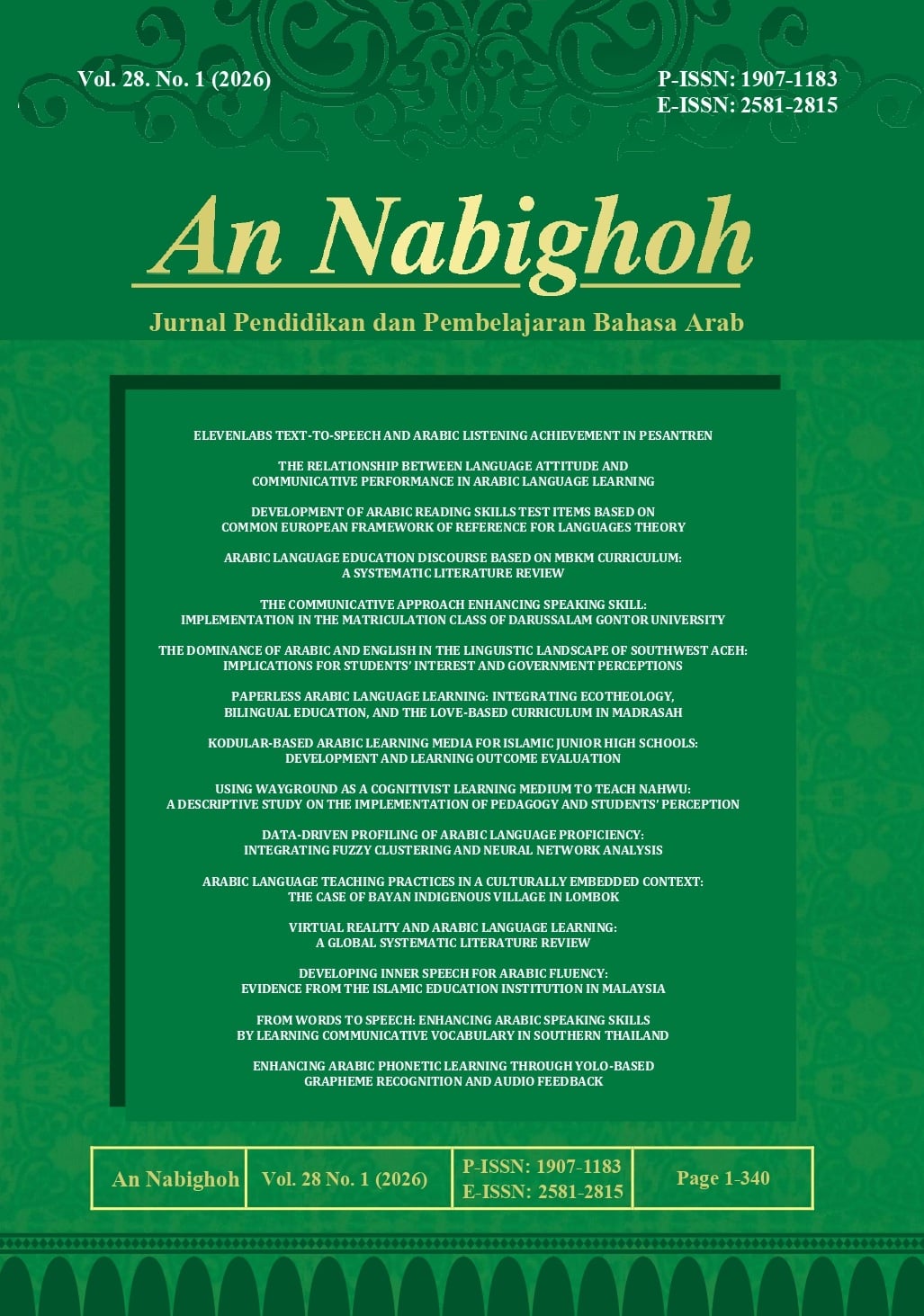
Arabic Language Education Discourse Based on MBKM Curriculum: A Systematic Literature Review
DOI:
https://doi.org/10.32332/an-nabighoh.v28i1.71-98Keywords:
Arabic Language Education, Curriculum Analysis, Gender Equity, MBKM Curriculum, Systematic Literature ReviewAbstract
Background: Arabic Language Education (ALE) in Indonesia is undergoing a paradigm shift under the Merdeka Belajar–Kampus Merdeka (MBKM) framework, which emphasizes flexible, outcome-oriented, and collaborative learning. However, scholarly discourse on its interpretation and implementation remains fragmented, especially regarding pedagogical adaptation, stakeholder readiness, and inclusivity. Research Objectives: This study aims to analyze the dominant discourse of ALE within the MBKM curriculum framework and to identify gaps that require further scholarly attention. Methodology: The study employed a Systematic Literature Review (SLR) design, selecting total of 25 peer-reviewed journal articles published by Indonesian domestic publishers between 2020 and 2024 based on rogorous inclusion and exclusion criteria. The review process followed the Preferred Reporting Items for Systematic Reviews and Meta-Analyses (PRISMA) framework and involved digital library searches through Open Journal Systems, keyword identification, and keyword operationalization. Data were analyzed through quality assessment, relevance screening, and thematic classification to ensure consistency, validity, and reliability in article selection and interpretation. Results: The findings reveal that the dominant discourse on MBKM-based Arabic Language Education centers on opportunities and challenges, as well as teacher and student competencies. These themes are closely related to curriculum document analysis, stakeholder perceptions, students’ knowledge development, and the acceleration of MBKM implementation in both higher education and Islamic boarding schools. Gender equity, however, remains underexplored. Unique Contribution: This study maps the evolving landscape of MBKM-based ALE while highlighting the limited integration of gender-responsive perspectives, an issue rarely foregrounded in previous reviews. Conclusion: MBKM has broadened the orientation of Arabic Language Education toward more adaptive and collaborative learning, yet its discourse remains concentrated on implementation and competency issues. Recommendations: Future studies should develop empirical and policy-oriented investigations on gender-responsive MBKM practices through inclusive learning materials, character education, diverse learning activities, and stronger collaboration with governmental and educational institutions.
Downloads
References
Agung, Nur. “Kurikulum Pembelajaran Bahasa Arab Perguruan Tinggi: Analisis Komparatif Kurikulum Pembelajaran Bahasa Arab.” Al-Waraqah Jurnal Pendidikan Bahasa Arab 3, no. 2 (2022): 1–18. https://doi.org/10.30863/awrq.v3i2.2945. DOI: https://doi.org/10.30863/awrq.v3i2.2945
Ali, Ridwan, and Hanifuddin Jamin. “Curriculum Development Strategy Based on Outcome Based Education (OBE) to Improve the Quality of Education in Higher Education.” Journal of Education and Religious Studies 5, no. 02 (2025): 103–9. https://doi.org/10.57060/jers.s9w3x850. DOI: https://doi.org/10.57060/jers.s9w3x850
Ananda, Ria Rizki, Ahmad Suradi, and Dwi Ratnasari. “Pengembangan Kurikulum Merdeka Belajar – Kampus Merdeka (MBKM) Pada Perguruan Tinggi Keagamaan Islam (PTKI).” Islamika 4, no. 3 (2022): 224–36. https://doi.org/10.36088/islamika.v4i3.1868. DOI: https://doi.org/10.36088/islamika.v4i3.1868
Asy’ari, Hasyim, Naifah, and Cahya Edi Setyawan. “Arabic Curriculum Design in the Merdeka Curriculum from the Perspective of the American Council on the Teaching of Foreign Languages (ACTFL).” Mantiqu Tayr: Journal of Arabic Language 4, no. 1 (2024): 213–31. https://doi.org/10.25217/mantiqutayr.v4i1.4001. DOI: https://doi.org/10.25217/mantiqutayr.v4i1.4001
Azzahra, Tasha Ayu, and M. Muhajir. “Implementation of the Kurikulum Merdeka in Arabic Language Learning.” Inovasi Kurikulum 20, no. 2 (2023): 261–74. https://doi.org/10.17509/jik.v20i2.59793. DOI: https://doi.org/10.17509/jik.v20i2.59793
Baharuddin, Muhammad Rusli. “Adaptasi Kurikulum Merdeka Belajar Kampus Merdeka (Fokus: Model MBKM Program Studi).” Jurnal Studi Guru Dan Pembelajaran 4, no. 1 (2021). https://e-journal.my.id/jsgp/article/view/591. DOI: https://doi.org/10.30605/jsgp.4.1.2021.591
Cooper, Harris. Research Synthesis and Meta-Analysis: A Step-by-Step Approach. SAGE Publications, Inc, 2017. https://doi.org/10.4135/9781071878644. DOI: https://doi.org/10.4135/9781071878644
Desrani, Ayu, Zainul Arifin, Suci Ramadhanti Febriani, and Bedra Guettaoi. “Development of Arabic Language Learning Curriculum during the COVID-19 Pandemic.” Ekspose: Jurnal Penelitian Hukum Dan Pendidikan 21, no. 1 (2022): 1289–98. https://doi.org/10.30863/ekspose.v21i1.1383. DOI: https://doi.org/10.30863/ekspose.v21i1.1383
Djafri, Novianty, Isnanto Isnanto, Nina Lamatenggo, Meiskyarti Luma, and Lukman Samatowa. “The Implementation of The Freedom to Learn-Independent Campus (MBKM) Curriculum Guidelines Based on Cultural and Local Wisdom in The Local Subject (Mulok) At the Elementary Level in The Province of Gorontalo.” In Proceedings of the 8th International Conference on Education Innovation (ICEI 2024), vol. 888. Advances in Social Science, Education and Humanities Research. Atlantis Press SARL, 2025. https://doi.org/10.2991/978-2-38476-360-3_39. DOI: https://doi.org/10.2991/978-2-38476-360-3_39
Hambali, Hm. Ridlwan, Dadan Rusmana, Siti Saodah Susanti, Khermarinah Khermarinah, and Fakhrurrazi Fakhrurrazi. “Islamic Religious Education Teachers’ Strategies in Fostering Students’ Religious Values in Madrasah.” AL-ISHLAH: Jurnal Pendidikan 14, no. 4 (2022): 6511–16. https://doi.org/10.35445/alishlah.v14i4.2612. DOI: https://doi.org/10.35445/alishlah.v14i4.2612
Hattab, Muhammad, and Munirul Abidin. “Development of Arabic Language Curriculum With Integration-Interconnection Paradigm Referring KKNI and SN-DIKTI.” Sustainable Jurnal Kajian Mutu Pendidikan 6, no. 2 (2023): 421–31. https://doi.org/10.32923/kjmp.v6i2.3412. DOI: https://doi.org/10.32923/kjmp.v6i2.3412
Hilmi, Danial, Nur Toifah, and Halimatus Sa`diyah. “Curriculum Development Strategy for Independent Learning in Arabic Language Learning at PTKIN in East Java.” LISANIA: Journal of Arabic Education and Literature 7, no. 2 (2023): 159–77. https://doi.org/10.18326/lisania.v7i2.159-177. DOI: https://doi.org/10.18326/lisania.v7i2.159-177
Ihsan, Muhammad, M. Abdul Hamid, Nur Hasan, and Syarifaturrahmatullah. “Exploring the Implementation of Project-Based Learning in Arabic Language Education under the ‘Kurikulum Merdeka.’” Alibbaa’: Jurnal Pendidikan Bahasa Arab 6, no. 2 (2025): 283–308. https://doi.org/10.19105/ajpba.v6i2.19059. DOI: https://doi.org/10.19105/ajpba.v6i2.19059
Iryani, Eva, Muhammad Sobri, and Friscilla Wulan Tersta. “Autonomous Learning: Manifestasi Merdeka Belajar Bahasa Di Prodi Pendidikan Bahasa Arab.” Arabia 12, no. 2 (2020): 79. https://doi.org/10.21043/arabia.v12i2.8392. DOI: https://doi.org/10.21043/arabia.v12i2.8392
Isnaniah, Siti, and Kurniawan Kurniawan. “Freedom to Learn – Independent Campus (MBKM) Curriculum Management at the Indonesian Language Tadris Degree Program (TBI) of Islamic Religious Higher Education Institutions (PTKI).” Jurnal Pendidikan Islam 11, no. 1 (2022): 51–60. https://doi.org/10.14421/jpi.2022.111.51-60. DOI: https://doi.org/10.14421/jpi.2022.111.51-60
Khitom, Khusnul, and Taufik Taufik. “Kurikulum Pembelajaran Bahasa Arab Di Perguruan Tinggi Keislaman Islam Negeri (PTKIN).” Tadris Al-Arabiyat: Jurnal Kajian Ilmu Pendidikan Bahasa Arab 3, no. 1 (2023): 28–44. https://doi.org/10.30739/arabiyat.v3i1.1766. DOI: https://doi.org/10.30739/arabiyat.v3i1.1766
Kolb, David A. Experiential Learning: Experience as the Source of Learning and Development. Pearson Education, Incorporated, 2015.
Levine, Eliot, and Susan Patrick. What Is Competency-Based Education? An Updated Definition. Aurora Institute, 2019.
Mahliatussikah, Hanik, and Singgih Kuswardono. “Merdeka Belajar Kampus Merdeka (MBKM) Curriculum Design in Arabic Language Education Study Program.” In Proceedings of the Unima International Conference on Social Sciences and Humanities (UNICSSH 2022), vol. 698. Advances in Social Science, Education and Humanities Research. Atlantis Press SARL, 2023. https://doi.org/10.2991/978-2-494069-35-0_72. DOI: https://doi.org/10.2991/978-2-494069-35-0_72
Maqbool, Baila, Arshia Jahangir, Murtaza Hassan, Muhammad Taha Nasim, Shaikh Saif Ur Rehman, and Muhammad Uzair. “The Growing Momentum of Leadership Education in General Surgery Training: A Systematic Review.” Journal of Surgical Education 83, no. 3 (2026): 103854. https://doi.org/10.1016/j.jsurg.2025.103854. DOI: https://doi.org/10.1016/j.jsurg.2025.103854
Masturoh, Fitri, and Ihwan Mahmudi. “Implementasi Kurikulum Merdeka Belajar Dalam Pembelajaran Bahasa Arab.” Kalamuna: Jurnal Pendidikan Bahasa Arab Dan Kebahasaaraban 4, no. 2 (2023): 207–32. https://doi.org/10.52593/klm.04.2.07. DOI: https://doi.org/10.52593/klm.04.2.07
Muid, Abdul, Rosita Ilhami, and Suci Ramadhanti Febriani. “MBKM (Merdeka Belajar Kampus Merdeka) Under Jambi University’s Arabic Education Program during the Industrial Revolution: Implementation, Supporting and Inhibiting Factors (Version 4.0).” Arabiyatuna : Jurnal Bahasa Arab 6, no. 1 (2022): 85. https://doi.org/10.29240/jba.v6i1.3606. DOI: https://doi.org/10.29240/jba.v6i1.3606
Munirah, Munirah, Syahruddin Syahruddin, and Akram Budiman Yusuf. “The Development of Cultural Integrated Indonesian Speaking E-Module for Higher Education Students in Indonesia.” Indonesian Journal of Applied Linguistics 13, no. 1 (2023): 191–203. https://doi.org/10.17509/ijal.v13i1.58266. DOI: https://doi.org/10.17509/ijal.v13i1.58266
Nasrudin, Ega, Saepul Anwar, Edi Suresman, Utami Qonita Rahmi, Deden Syarif Hidayatulloh, and Fatimah Ezzahrah Binti Ahmad Lokman. “Integration of Sustainable Development Goals in Islamic Teaching Materials in Higher Education.” Tafkir: Interdisciplinary Journal of Islamic Education 6, no. 1 (2025): 17–39. https://doi.org/10.31538/tijie.v6i1.1266. DOI: https://doi.org/10.31538/tijie.v6i1.1266
Nurullah, Nurullah, and Asrorudin Asrorudin. “Konsep Pendidikan Karakter Dalam Kitab Ta`Limul Muta`Aallim Karya Imam Az-Zarnuji Dan Relevansinya Terhadap Kurikulum Merdeka Belajar.” Khulasah : Islamic Studies Journal 4, no. 2 (2023): 45–63. https://doi.org/10.55656/kisj.v4i2.104. DOI: https://doi.org/10.55656/kisj.v4i2.104
Pahrudin, Agus, Listiyani Siti Romlah, and Murtando Murtando. “Pengembangan Kurikulum Pendidikan Tinggi Berbasis KKNI SN-Dikti Dan Kurikulum Merdeka Dan OBE (Outcome Based Education).” Tarbawi: Jurnal Keilmuan Manajemen Pendidikan 10, no. 01 (2024): 161–68. https://doi.org/10.32678/tarbawi.v10i01.9971. DOI: https://doi.org/10.32678/tarbawi.v10i01.9971
Piaget, Jean. The Psychology of Intelligence. Routledge, 2003. DOI: https://doi.org/10.4324/9780203164730
Priola, Edward J. “Managerial Communication Competencies That Enhance Employee Performance: A Systematic Review.” Dissertation, University of Maryland University College, 2016.
Putra, Wahyu Hanafi, Mahmudah Mahmudah, Ibnu Burdah, and Yayan Nurbayan. “Eklektisme Nilai-Nilai Dalam Keluarga Sebagai Fondasi Pengembangan Kurikulum Pendidikan Bahasa Arab.” Edusia: Jurnal Ilmiah Pendidikan Asia 3, no. 1 (2023): 1–15. https://doi.org/10.53754/edusia.v3i1.643. DOI: https://doi.org/10.53754/edusia.v3i1.643
Putra, Wahyu Hanafi, and Maragustam Siregar. “Nalar Kritis Pemikiran Omar Mohammad Al-Toumy Al-Syaibany Dan Relevansinya Dengan Pendidikan Bahasa Arab Berbasis MBKM.” An Nabighoh 25, no. 1 (2023): 129. https://doi.org/10.32332/an-nabighoh.v25i1.6843. DOI: https://doi.org/10.32332/an-nabighoh.v25i1.6843
Rachman, Fazlur, Zaqiatul Mardiah, and Nur Hizbullah. “Persepsi Mahasiswa Prodi Bahasa Dan Kebudayaan Arab Universitas Al Azhar Indonesia Terhadap Urgensi Program Merdeka Belajar Kampus Merdeka.” Jurnal Al-Azhar Indonesia Seri Humaniora 7, no. 2 (2022): 116. https://doi.org/10.36722/sh.v7i2.1005. DOI: https://doi.org/10.36722/sh.v7i2.1005
Rahman, Rifqi Aulia, Miftahul Huda, Chairani Astina, and Farah Faida. “Adaptasi Kurikulum Merdeka Belajar Mata Pelajaran Bahasa Arab Di SMP Takhassus Al-Qur’an Wonosobo.” Lisanan Arabiya: Jurnal Pendidikan Bahasa Arab 6, no. 2 (2023): 265–84. https://doi.org/10.32699/liar.v6i2.3707. DOI: https://doi.org/10.32699/liar.v6i2.3707
Rahman, Rifqi Aulia, and Indah Kumalasari. “The Dynamics of Arabic Language Curriculum at Arabic Education Department of UIN Sunan Kalijaga Yogyakarta.” LISANIA: Journal of Arabic Education and Literature 4, no. 2 (2020). https://lisania.iainsalatiga.ac.id/index.php/lisania/article/view/4258. DOI: https://doi.org/10.18326/lisania.v4i2.140-162
Rizki, Dimas Prayana, Suparmanto Suparmanto, Fatimatuz Zahrah Isdianti, Santika Santika, and Nurlinda Adrianti. “Tantangan Dan Peluang Implementasi Kurikulum Merdeka Jurusan Pendidikan Bahasa Arab Universitas Islam Negeri Mataram.” Al-Wazan: Journal of Arabic Education 2, no. 1 (2024): 35–47. https://doi.org/10.58223/al-wazan.v2i1.160. DOI: https://doi.org/10.58223/al-wazan.v2i1.160
Rohimah, Umniatur, Imiatus Sholikha, and Isnainiyah. “The Challenges of Implementing the Merdeka Curriculum in Arabic Language Learning: Perspectives from Indonesian Lecturers and Students.” Journal of Arabic Language Learning and Teaching (JALLT) 1, no. 2 (2024): 85–92. https://doi.org/10.23971/jallt.v1i2.142. DOI: https://doi.org/10.23971/jallt.v1i2.142
Sahreebanu, Dhea Syahzana, Ahmad Nurcholis, Syaikhu Ihsan Hidayatullah, and Muhammad Nur Rois. “Implementasi Kurikulum Merdeka Belajar Kampus Merdeka (MBKM) Di Program Studi Pendidikan Bahasa Arab UIN Sayyid Ali Rahmatullah Tulungagung.” Al Mi’yar: Jurnal Ilmiah Pembelajaran Bahasa Arab Dan Kebahasaaraban 5, no. 2 (2022): 195. https://doi.org/10.35931/am.v5i2.1346. DOI: https://doi.org/10.35931/am.v5i2.1346
Siregar, Amy Fitriani, Muhammad Ja’far Shodiq, Ananda Zalfa Firdaus, Lalu Rahmat Sugiara, Dina Ayu Wulandari, and Nurul Zhafirah Muslim. “Comparative Analysis of Arabic Language Learning in Higher Education Institutions in Malaysia and Indonesia.” Lughawiyyat: Jurnal Pendidikan Bahasa Dan Sastra Arab 8, no. 1 (2025): 1–16. https://doi.org/10.38073/lughawiyyat.v8i1.2291. DOI: https://doi.org/10.38073/lughawiyyat.v8i1.2291
Sohrabi, Catrin, Thomas Franchi, Ginimol Mathew, et al. “PRISMA 2020 Statement: What’s New and the Importance of Reporting Guidelines.” International Journal of Surgery 88 (April 2021): 105918. https://doi.org/10.1016/j.ijsu.2021.105918. DOI: https://doi.org/10.1016/j.ijsu.2021.105918
Sujatna, Yayat, Yulianti Muthmainnah, Ilham Mundzir, Dzikri Rahmat Romadhon, Ahmad Qisa’i, and Fadliya Kadir. “Integrating the Muamalah Curriculum for Anti-Corruption Education: The Role of Islamic Law, Gender, and SDG 16.” In Towards Resilient Societies: The Synergy of Religion, Education, Health, Science, and Technology, by Maila D. H. Rahiem. CRC Press, 2025. https://doi.org/10.1201/9781003645542-66. DOI: https://doi.org/10.1201/9781003645542-66
Supardi, Supardi, and Noor Malihah. “MBKM: Connected Curriculum of Arabic Departments in Indonesia.” Ijaz Arabi Journal of Arabic Learning 5, no. 3 (2022). https://doi.org/10.18860/ijazarabi.v5i3.16231. DOI: https://doi.org/10.18860/ijazarabi.v5i3.16231
Sya’bani, Muhammad Zaky, and Khairil Anwar. “Development of a Learning Management System Using Moodle in the Arabic Language Education Study Program.” Loghat Arabi : Jurnal Bahasa Arab Dan Pendidikan Bahasa Arab 4, no. 2 (2023): 245. https://doi.org/10.36915/la.v4i2.136. DOI: https://doi.org/10.36915/la.v4i2.136
Taba, Hilda. Curriculum Development; Theory and Practice. Harcourt, Brace & World, 1962.
Tampio, Nicholas, ed. “Introduction: Dewey’s Vision in Democracy and Education.” In Democracy and Education, by John Dewey. Columbia University Press, 2024. https://doi.org/10.7312/dewe21010-003. DOI: https://doi.org/10.7312/dewe21010-003
Tatar, Berivan. “Synthesizing the Meta-Synthesis Research in Management and Organization Studies: Where Are We? Where Should We Go?” Yildiz Social Science Review, ahead of print, December 21, 2023. https://doi.org/10.51803/yssr.1390636. DOI: https://doi.org/10.51803/yssr.1390636
Tolinggi, Syindi Oktaviani R. “Pengembangan Kurikulum Bahasa Arab Berparadigma Integrasi-Interkoneksi Mengacu KKNI Dan SN-DIKTI.” Al-Ta’rib : Jurnal Ilmiah Program Studi Pendidikan Bahasa Arab IAIN Palangka Raya 8, no. 2 (2020): 177–200. https://doi.org/10.23971/altarib.v8i2.2104. DOI: https://doi.org/10.23971/altarib.v8i2.2104
Umar, Ibrahim, and Siddik Faruk Tilli. “The Role of Islamic Education in Building Collaborative Cultures within Nigerian Schools.” Journal of Learning and Educational Policy, no. 46 (October 2024): 1–11. https://doi.org/10.55529/jlep.46.1.11. DOI: https://doi.org/10.55529/jlep.46.1.11
Ward, Spencer A., and Linda J. Reed. Knowledge Structure and Use: Implications for Synthesis and Interpretation. Temple University Press, 1983.
Widodo, Sembodo Ardi. “Development and Maintenance of Arabic through Education in Islamic Education Institutions in Indonesia.” Al Mahāra: Jurnal Pendidikan Bahasa Arab 6, no. 2 (2020): 195–216. https://doi.org/10.14421/almahara.2020.062.03. DOI: https://doi.org/10.14421/almahara.2020.062.03
Yahya, Amri, Mohammad Ahsanuddin, Irhamni, Hasan Syukur, and Muhammad Nur Iman. “Implementation and Strategies Differentiated Learning for Arabic Language Learning at Islamic High School.” Mantiqu Tayr: Journal of Arabic Language 5, no. 2 (2025): 364–80. https://doi.org/10.25217/mantiqutayr.v5i2.6203. DOI: https://doi.org/10.25217/mantiqutayr.v5i2.6203
Yusuf, Muhamad, M. Syukri Nawir, Afan Garamatan, Suparto Iribaram, and Rachmad Surya Muhandy. “Portrait of Damar Tradition in Welcoming the Arrival of Lailatul Qadar Night in the Community of Patipi Island Village.” Potret Pemikiran 27, no. 1 (2023): 75. https://doi.org/10.30984/pp.v27i1.2453. DOI: https://doi.org/10.30984/pp.v27i1.2453
Downloads
Published
Issue
Section
License
Copyright (c) 2026 Wahyu Hanafi Putra, Haruna Abubakar Haruna, Kunti Nadiyah Salma, Anisatu Thoyyibah

This work is licensed under a Creative Commons Attribution-ShareAlike 4.0 International License.