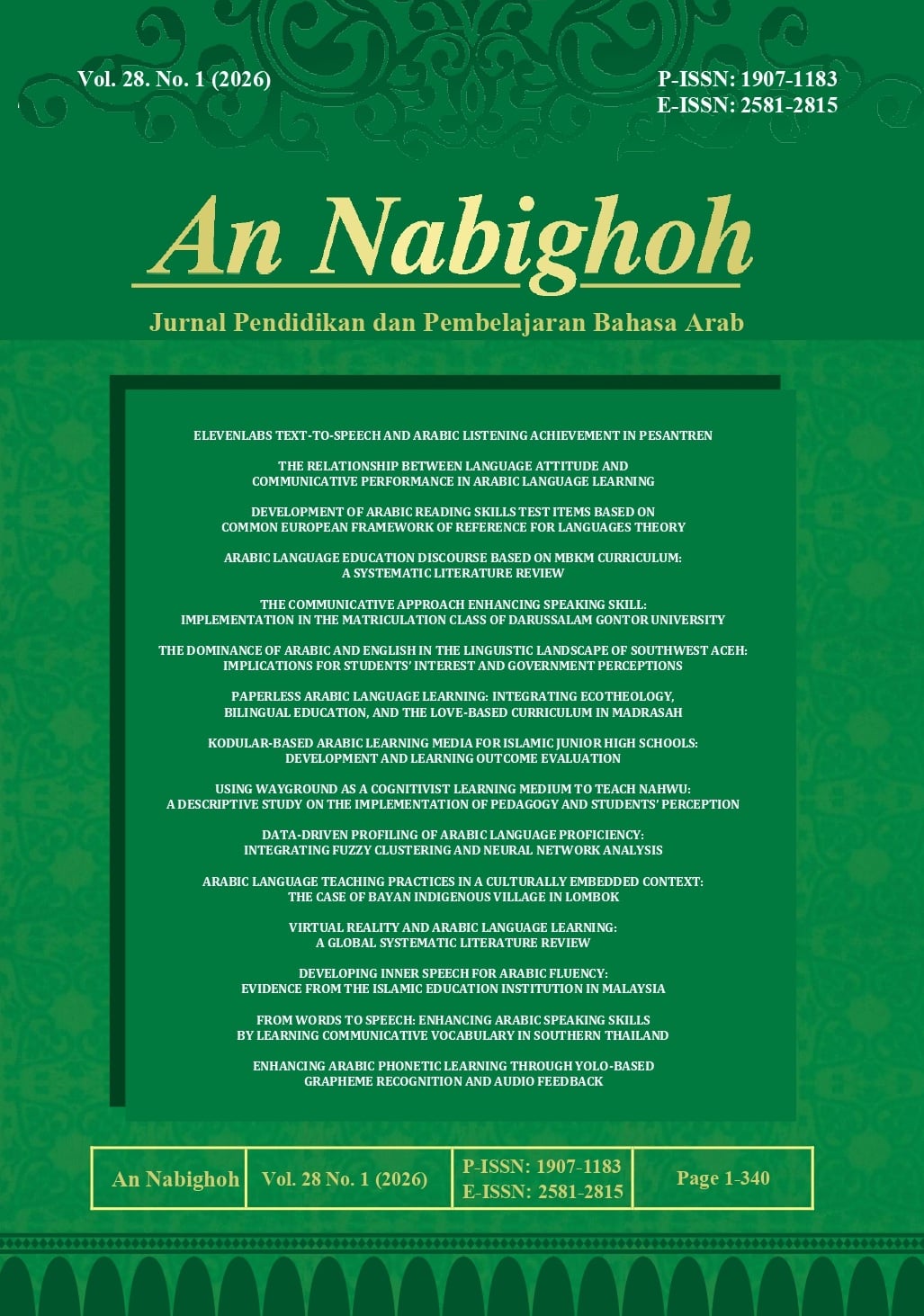
The Communicative Approach Enhancing Speaking Skill: Implementation in the Matriculation Class of Darussalam Gontor University
DOI:
https://doi.org/10.32332/an-nabighoh.v28i1.99-126Keywords:
Communicative Approach, Speaking Skill, Matriculation Class, Darussalam Gontor UniversityAbstract
Background: Arabic learning at Islamic Religious Colleges focuses on speaking proficiency, but matriculation students often face obstacles when adapting. To overcome this, communicative methods are needed that emphasize active interaction and practical language practice, both in the classroom and in the dormitory. Research Objectives: This study aims to reveal the effectiveness of applying communicative methods in improving Arabic speaking skills among matriculation class students at Darussalam Gontor University. Methodology: This research employs a qualitative approach with a case study design. Data were collected through observation and semi-structured interviews. Informants were selected purposively and consisted of the language development directorate, lecturers, tutors, students, and dormitory managers. The data were analyzed systematically to understand the implementation process and its impact on students’ speaking abilities. Results: The findings indicate that the application of communicative methods improves students’ Arabic speaking skills and encourages active participation throughout the learning process. Students become more confident in using Arabic in classroom interaction and daily communication. Supporting elements such as the language environment, daily vocabulary programs, and learning motivation strengthen the effectiveness of the method. However, several challenges appear, particularly the heterogeneous educational backgrounds of students which influence their initial language proficiency. Unique Contribution: This study provides empirical insight into how communicative methods function in an intensive language environment that integrates classroom learning with dormitory-based language practice. The research highlights the role of institutional language policies and daily vocabulary programs in supporting communicative language learning. Conclusion: The study confirms that a consistently implemented communicative approach can increase students’ confidence and improve Arabic speaking skills naturally. Continuous interaction and contextual language use play a central role in developing students’ oral proficiency. Recommendations: Educational institutions should design Arabic language curricula that integrate communicative learning strategies with a structured language environment. Institutions should also provide consistent speaking practice, vocabulary enrichment programs, and motivational support to accommodate students with diverse educational backgrounds.
Downloads
References
Afrida, Nina, Shafrida Waty, and Nurul Hidayani. “The Role of ‘Matriculation’ as Influential Factor Contributing to the Students’ English Performance.” ELITE Journal 1, no. 2 (2019). https://elitejournal.org/index.php/ELITE/article/view/24.
Al Ghozali, M. Dzikrul Hakim, Mustamim, Uril Bahrudin, and Syuhadak. “Developing a Model for Teaching Speaking Skills Based on Cooperative and Contextual Learning.” IJ-ATL (International Journal of Arabic Teaching and Learning) 7, no. 2 (2023). https://doi.org/10.33650/ijatl.v7i2.6740. DOI: https://doi.org/10.33650/ijatl.v7i2.6740
Al-khresheh, Mohammad H., Ahmad Khaerurrozikin, and Abdul Hafidz Zaid. “The Efficiency of Using Pictures in Teaching Speaking Skills of Non-Native Arabic Beginner Students.” Universal Journal of Educational Research 8, no. 3 (2020): 872–78. https://doi.org/10.13189/ujer.2020.080318. DOI: https://doi.org/10.13189/ujer.2020.080318
Artikmashrabovna, Ibragimova Iroda. “Functions of Language Tools.” World Bulletin of Social Sciences 9 (April 2022). https://scholarexpress.net/index.php/wbss/article/view/812.
Attruk, Muhammad Fariq Heemal. “The Development of Speaking Skills in Arabic Language Learning in Indonesia: A Literature Review.” EDUCATUM: Scientific Journal of Education 3, no. 3 (2025): 104–11. https://doi.org/10.59165/educatum.v3i3.193. DOI: https://doi.org/10.59165/educatum.v3i3.193
Babayeva, Arzu. “Successfully Overcoming Challenges in the Process of Implementing Communicative Approach to Teaching English Language.” Ancient Land 5, no. 6 (2023): 11–16. https://doi.org/10.36719/2706-6185/24/11-16. DOI: https://doi.org/10.36719/2706-6185/24/11-16
Basir, Achmad. “Students’ Speaking Skills through Communicative Language Teaching.” BATARA DIDI : English Language Journal 3, no. 1 (2024): 1–12. https://doi.org/10.56209/badi.v3i1.97. DOI: https://doi.org/10.56209/badi.v3i1.97
Canale, M., and M. Swain. “Theoretical Bases of Communicative Approaches to Second Language Teaching and Testing.” Applied Linguistics I, no. 1 (1980): 1–47. https://doi.org/10.1093/applin/I.1.1. DOI: https://doi.org/10.1093/applin/I.1.1
Candadila, Radinsa Yola, and Desi Puspitasari. “Communicative Language Teaching (CLT): A Strategy to Enhance Students’ Speaking Skills and Motivation.” Aisyah Journal of English Language Teaching (AIJELT) 4, no. 1 (2025). https://journal.aisyahuniversity.ac.id/index.php/AIJELT/article/view/1995.
Caparida, Angelie, Jodessa Capuno, Joy Mendoza, and Eduardo Omana. “Evaluating the Challenges and Opportunities in Implementing Communicative Language Teaching (CLT) in Filipino Primary Schools: A Paper Review.” International Multidisciplinary Journal of Research for Innovation, Sustainability, and Excellence (IMJRISE) 2, no. 4 (2025). https://risejournals.org/index.php/imjrise/article/view/1069.
Christou, Prokopis A. “How to Use Thematic Analysis in Qualitative Research.” Journal of Qualitative Research in Tourism 3, no. 2 (2022): 79–95. https://doi.org/10.4337/jqrt.2023.0006. DOI: https://doi.org/10.4337/jqrt.2023.0006
Dewi, Dita Puspita, Sri Yulia Yuliani, Gita Putri Ramadhani, and Maman Abdurahman. “Analysis of Arab-Islamic Cultural Integration in Arabic Language Teaching Materials Based on Book Iḍāʾāt Li Mu’allimi Al-Lughah Al-ʿarabīyah Li Ghayr Al-Nāṭiqīn Bihā.” Abjadia : International Journal of Education 10, no. 3 (2025): 595–610. https://doi.org/10.18860/abj.v10i3.33399. DOI: https://doi.org/10.18860/abj.v10i3.33399
Djavairovna, Approach Akhmedjanova Farida. “Communicative Language Teaching.” Oriental Renaissance: Innovative, Educational, Natural and Social Sciences 2, no. 1 (2022). https://oriens.uz/en/journal/article/communicative-language-teaching-approach/.
Dueñas Vinuesa, María. “Diane Larsen-Freeman. 2000. Techniques and Principles in Language Teaching. Second Edition. Oxford: Oxford University Press. 189 Pp.” Journal of English Studies, May 29, 2002, 277–81. https://doi.org/10.18172/jes.83. DOI: https://doi.org/10.18172/jes.83
Eisenring, Mohammad Abraham Akbar, and Margana Margana. “The Importance of Teacher – Students Interaction in Communicative Language Teaching (CLT).” PRASASTI: Journal of Linguistics 4, no. 1 (2019): 46. https://doi.org/10.20961/prasasti.v4i1.17052. DOI: https://doi.org/10.20961/prasasti.v4i1.17052
Faryat, Amar. “Developing Speaking Skills in Arabic Learners Who Are Non-Native Speakers: A Descriptive and Analytical Study.” Journal of Arabic Language Learning and Teaching (JALLT) 3, no. 1 (2025): 69–88. https://doi.org/10.23971/jallt.v3i1.290. DOI: https://doi.org/10.23971/jallt.v3i1.290
Firdaus, Sulton. “Arabic Speaking Skill Learning Using the Experiential Learning Theory-Based Learning Model and Its Role in Learning Model Development | Taʿlīm Mahārat al-Kalām ʿalā Ḍaw’ Naẓariyyat al-Taʿallum al-Tajrībī Wa-Tawẓīfuhā Fī Iʿdād Namūdhaj Taʿlīmihā.” Al-Ta’rib : Jurnal Ilmiah Program Studi Pendidikan Bahasa Arab IAIN Palangka Raya 12, no. 1 (2024): 189–202. https://doi.org/10.23971/altarib.v12i1.7353. DOI: https://doi.org/10.23971/altarib.v12i1.7353
Furidha, Brylialfi Wahyu. “Comprehension of the Descriptive Qualitative Research Method: A Critical Assessment of the Literature.” Journal of Multidisciplinary Research, January 12, 2024, 1–8. https://doi.org/10.56943/jmr.v2i4.443. DOI: https://doi.org/10.56943/jmr.v2i4.443
G. Mordaunt, Owen, Anthony Naprstek, and Matthew McGuire. “The Communicative Method as a Model for Language Teaching.” International Journal of Language & Literature 7, no. 2 (2019). https://doi.org/10.15640/ijll.v7n2a12. DOI: https://doi.org/10.15640/ijll.v7n2a12
Guo, Junyan, and Martin East. “The Role of Vocabulary in Speaking: Voices from Learners and Raters.” Language Assessment Quarterly 21, nos. 4–5 (2024): 452–72. https://doi.org/10.1080/15434303.2024.2440887. DOI: https://doi.org/10.1080/15434303.2024.2440887
Hasibuan, Selamat Husni, Heridayani, and Imelda Darmayanti Manurung. “Communicative Language Teaching: Improving EFL Students’ Speaking Skills in an Indonesian Islamic Boarding School Context.” Journal of Communication in Scientific Inquiry (JCSI) 3, no. 2 (2021). https://ejournal.unimap.edu.my/index.php/jcsi/article/view/1073.
Hidayat, Rahmat, Fera Favirotus Siyam, Muhammad Wahyudi, and Annisa Avilya. “Effectiveness of the Station Rotation Blended Learning Model in Mastering Mufradat.” Arabiyatuna: Jurnal Bahasa Arab 9, no. 1 (2025): 133–48. https://doi.org/10.29240/jba.v9i1.12431. DOI: https://doi.org/10.29240/jba.v9i1.12431
Ibrahim, Moh, and Abbas Mansur Tamam. “Arabic Language Matriculation Program for High School Tenth Grade Students Based on Boarding School (A Case Study of Ummul Quro al-Islamy Islamic Boarding School).” Intiqad: Jurnal Agama Dan Pendidikan Islam 15, no. 2 (2023): 444–62. https://doi.org/10.30596/17550. DOI: https://doi.org/10.30596/17550
Inayah, Inayah, Alis Asikin, Rokhani Rokhani, Alvian Varihul Mustavid, and Dzaky Hamid Abdillah. “Public Speaking Training For Students of International Class Program State Islamic University Walisongo to Improve The Ability of Maharah Kalam.” Asalibuna 7, no. 01 (2023): 14–33. https://doi.org/10.30762/asalibuna.v7i01.848. DOI: https://doi.org/10.30762/asalibuna.v7i01.848
Irfan, Nuriana. “Literature Study of Communicative Approaches in Arabic Learning.” Al-Lughah: Jurnal Bahasa 11, no. 1 (2022): 16. https://doi.org/10.29300/lughah.v11i1.6448. DOI: https://doi.org/10.29300/lughah.v11i1.6448
Ishak, Suaibatul Aslamiah, and Azlina Abdul Aziz. “Role Play to Improve ESL Learners’ Communication Skills: A Systematic Review.” International Journal of Academic Research in Business and Social Sciences 12, no. 10 (2022): Pages 884-892. https://doi.org/10.6007/IJARBSS/v12-i10/14851. DOI: https://doi.org/10.6007/IJARBSS/v12-i10/14851
Jauharoh, Ervin, Wahidul Anam, and Mokhammad Miftakhul Huda. “The Use of Expressions in Improving Kalam Skill in Learning Arabic for MTSN 2 Kediri Students.” Asalibuna 5, no. 02 (2021): 53–61. https://doi.org/10.30762/asalibuna.v5i02.586. DOI: https://doi.org/10.30762/asalibuna.v5i02.586
Jundi, Muhammad, and Renni Hasibuan. “Enhancing Arabic Language Proficiency among Students: A Case Study of Language Matriculation Strategies at Al-Hasyimiyah Darul Ulum Sipaho Islamic Boarding School.” Kilmatuna: Journal Of Arabic Education 3, no. 2 (2023): 114–29. https://doi.org/10.55352/pba.v3i2.619. DOI: https://doi.org/10.55352/pba.v3i2.619
Kamaliah, Nurul and Rahmati. “The Effect of Communicative Language Teaching on Students’ Speaking Skills: A Systematic Literature Review.” Jurnal Eksperimental : Media Ilmiah Pendidikan 14, no. 2 (2025). https://journal.stitalhilalsigli.ac.id/index.php/eksperimental/article/view/725.
Kholifia, Nanda Intan Kholifiana, Abdul Basith, M. Alaika Nasrulloh, and Ahmad Mufarih Hasan Fadly. “Enhancing Arabic Speaking Skills: The Potential of Gamification in Reducing Language Anxiety.” Arabiyatuna: Jurnal Bahasa Arab 9, no. 1 (2025): 289–306. https://doi.org/10.29240/jba.v9i1.12217. DOI: https://doi.org/10.29240/jba.v9i1.12217
Khowatim, Lely Khusnul, Achmad Farid, and Muhammad Saifuddin. “The Effectiveness of Using Communicative Language Teaching (CLT) Techniques on Students’ Speaking Skill.” Journal of Research in Foreign Language Teaching (JRFLT) 3, no. 2 (2022). https://journal.unipdu.ac.id/index.php/jr/article/view/3310.
Lim, Weng Marc. “What Is Qualitative Research? An Overview and Guidelines.” Australasian Marketing Journal 33, no. 2 (2025): 199–229. https://doi.org/10.1177/14413582241264619. DOI: https://doi.org/10.1177/14413582241264619
Mislawiyadi, Mislawiyadi. “Using a Communicative Approach to Teaching Speaking Skills at Ibrahimy University.” Jurnal Multidisiplin Ibrahimy 1, no. 1 (2023): 36–52. https://doi.org/10.35316/jummy.v1i1.3536. DOI: https://doi.org/10.35316/jummy.v1i1.3536
Muammar, Muammar, Suhardi Suhardi, and Ali Mustadi. “Developing Communicative-Based Instructional Model Of Speaking Skill In Elementary School.” Al-Bidayah: Jurnal Pendidikan Dasar Islam 12, no. 2 (2021): 199–220. https://doi.org/10.14421/al-bidayah.v12i2.588. DOI: https://doi.org/10.14421/al-bidayah.v12i2.588
Mu’awanah, Elyatul, Ahmad Ashfia, and Fikri Huzaifi. “Analyzing the Historical Traces of Arabic Language Education as a Basis for Developing Innovative Learning Approaches in the Era of Society 5.0.” Al-Lisan 10, no. 1 (2025): 85–100. https://doi.org/10.30603/al.v10i1.5822. DOI: https://doi.org/10.30603/al.v10i1.5822
Nggawu, La Ode, and Nguyen Thi Phuong Thao. “The Impact of Communicative Language Teaching (CLT) Approach on Students’ Speaking Ability in a Public Indonesian University: Comparison between Introverts and Extrovert Groups.” International Journal of Language Education 7, no. 3 (2023). https://doi.org/10.26858/ijole.v7i3.50617. DOI: https://doi.org/10.26858/ijole.v7i3.50617
Nunan, David. Task-Based Language Teaching. 1st ed. Cambridge University Press, 2004. https://doi.org/10.1017/CBO9780511667336. DOI: https://doi.org/10.1017/CBO9780511667336
Qinghong MA. “Key Elements in Conducting Communicative Approach to Language Teaching.” Canadian Social Science 5, no. 02 (2009). https://doi.org/10.3968/j.css.1923669720090502.007.
Qoriah, Desi, and Ghaida Farisya. “Communicative Language Teaching (Clt) Method Combined with Total Physical Response (Tpr) Method on Upgrading Communication Skill on English Laboratory.” Journal Civics and Social Studies 6, no. 2 (2022): 120–29. https://doi.org/10.31980/civicos.v6i2.2319. DOI: https://doi.org/10.31980/civicos.v6i2.2319
Reich-Stiebert, Natalia, Jan-Bennet Voltmer, Jennifer Raimann, and Stefan Stürmer. “The Role of First-Language Heterogeneity in the Acquisition of Online Interaction Self-Efficacy in CSCL.” International Journal of Computer-Supported Collaborative Learning 18, no. 4 (2023): 513–30. https://doi.org/10.1007/s11412-023-09411-2. DOI: https://doi.org/10.1007/s11412-023-09411-2
Richards, Jack C. Communicative Language Teaching Today. Cambridge University Press, 2006.
Richards, Jack C., and Theodore S. Rodgers. Approaches and Methods in Language Teaching. Cambridge University Press, 2014. DOI: https://doi.org/10.1017/9781009024532
Roziqi, Muhammad Ainur, Murdiono Murdiono, Nur Fuadi Rahman, and Muhammad Arif. “Mapping Of Strategies And Methods For Learning Arabic Speaking Skills.” Ijaz Arabi Journal of Arabic Learning 8, no. 1 (2025). https://doi.org/10.18860/ijazarabi.v8i1.26939. DOI: https://doi.org/10.18860/ijazarabi.v8i1.26939
Salam, Muhammad Yusuf, and Yovan Luksfinanto. “A Comprehensive Review of Communicative Language Teaching (CLT) in Modern Classrooms.” Lingeduca: Journal of Language and Education Studies 3, no. 1 (2024): 58–70. https://doi.org/10.70177/lingeduca.v3i1.1338. DOI: https://doi.org/10.70177/lingeduca.v3i1.1338
Sarbaini, Albarra, and Novita Rahmi. “Enhancing Arabic Speaking Skills: A Study on Instructional Design, Implementation, and Assessment.” Arabiyatuna: Jurnal Bahasa Arab 8, no. 2 (2024): 641–62. https://doi.org/10.29240/jba.v8i2.10828. DOI: https://doi.org/10.29240/jba.v8i2.10828
Seha, Ivan Nur. “Achieving a Holistic and Inclusive Pedagogy for Students with Various Linguistic Backgrounds.” Journal of Language Instruction and Applied Linguistics 1, no. 02 (2025). https://ejournal.unkafa.ac.id/index.php/j-langua/article/view/1282.
Sourani, Maha, Faisal AbdulFattah, and Inaad Sayer. “Exploring the Challenges of the Communicative Language Teaching Approach in the EFL Context of Arab Learners.” Teaching English Language (IR) 17, no. 2 (2023). https://doi.org/10.22132/tel.2024.427424.1535.
Sugirma, Sugirma, M. Abdul Hamid, and Agustang K. “Analysis of Speaking Skill Learning Difficulties in Students of the Arabic Language Education Study Program at State Islamic Institute.” Arabiyatuna: Jurnal Bahasa Arab 8, no. 2 (2024): 579–96. https://doi.org/10.29240/jba.v8i2.10903. DOI: https://doi.org/10.29240/jba.v8i2.10903
Suryadarma, Yoke, Moh. Ismail, and Muhammad FahrulRozi. “Musykilah At-Thulab Fi Ta’alum Al-Lughah Al-Arabiyah Li al-Fashl At-Tahdiri Bi Jamiah Darussalam Gontor / Student Problems in Learning Arabic In the Matriculation Class at Darussalam Gontor University.” Loghat Arabi : Jurnal Bahasa Arab Dan Pendidikan Bahasa Arab 4, no. 2 (2023): 189. https://doi.org/10.36915/la.v4i2.123. DOI: https://doi.org/10.36915/la.v4i2.123
Syafei, Isop, Ade Arip Ardiansyah, and Dadan Nugraha. “The Communicative Approach in Arabic Language Learning (Theoretical and Practical Perspectives).” Gunung Djati Conference Series 55, no. 1 (2025). https://conferences.uinsgd.ac.id/index.php/gdcs/article/view/2906.
Takal, Ghazi Mohammad, Noor Mala Ibrahim, and Mujtaba Jamal. “Communicative Language Teaching in Public Universities in Afghanistan: Perceptions and Challenges.” Theory and Practice in Language Studies 11, no. 11 (2021): 1434–44. https://doi.org/10.17507/tpls.1111.11. DOI: https://doi.org/10.17507/tpls.1111.11
Taufiqurrochman, Raden. “Linking Environmental Education and Arabic Language Teaching: Curriculum Analysis of Madrasa and Pesantren in Indonesia.” Studia Ecologiae et Bioethicae 23, no. 2 (2025): 73–85. https://doi.org/10.21697/seb.5845. DOI: https://doi.org/10.21697/seb.5845
Thoriq, Muhammad Ahsan, Novita Kusumadewi, and Mohammad Ahsanuddin. “The Development of Innovative Arabic Matriculation Learning Media Based on Google Sites to Improve The Arabic Proficiency of MAN 1 Pasuruan Students.” Jurnal Al-Azhar Indonesia Seri Humaniora 8, no. 2 (2023): 154. https://doi.org/10.36722/sh.v8i2.1898. DOI: https://doi.org/10.36722/sh.v8i2.1898
Vetiana, Gautama Veri. “The Role of the Center for Language Improvement in Enhanching Speaking Skills of The Class One of The Modern Islamic Boarding School Darussalam Gontor at The Girls’ Second Campuss (Ar).” Al-Ta’rib : Jurnal Ilmiah Program Studi Pendidikan Bahasa Arab IAIN Palangka Raya 7, no. 2 (2019): 111–20. https://doi.org/10.23971/altarib.v7i2.1518. DOI: https://doi.org/10.23971/altarib.v7i2.1518
Wang, Sijia. “The Evaluation of Communicative Language Teaching.” Scientific Journal of Technology 7, no. 3 (2025): 289–93. https://doi.org/10.54691/h7g4e498. DOI: https://doi.org/10.54691/h7g4e498
Zhao, Yuyan. “An Analysis of Communicative Language Teaching Approach Based on the International Researches:” Paper presented at 2022 3rd International Conference on Language, Art and Cultural Exchange(ICLACE 2022). 2022. https://doi.org/10.2991/assehr.k.220706.010. DOI: https://doi.org/10.2991/assehr.k.220706.010
Downloads
Published
Issue
Section
License
Copyright (c) 2026 Gautama Veri Vetiana, Umi Machmudah, Dewi Chamidah, Moh. Buny Andaru Bahy, Bakri Muhammad Bakheet, Umma Fatayati

This work is licensed under a Creative Commons Attribution-ShareAlike 4.0 International License.