





About the Journal
| Journal title | Multazam : Jurnal Manajemen Haji dan Umrah |
| Initials | Multazam |
| Abbreviation | JMHU |
| Accreditation | By Ministry of Research, Technology, and Higher Education of the Republic of Indonesia |
| Frequency | 2 issues per year (June and December) |
| DOI | prefix 10.32332 by Crossref |
| Online ISSN | 2961-9084 |
| Print ISSN | 2809-2430 |
| Editor-in-chief | Hanna Hilyati Aulia |
| Publisher | Universitas Islam Negeri Jurai Siwo Lampung |
| Citation Analysis | Google Scholar |
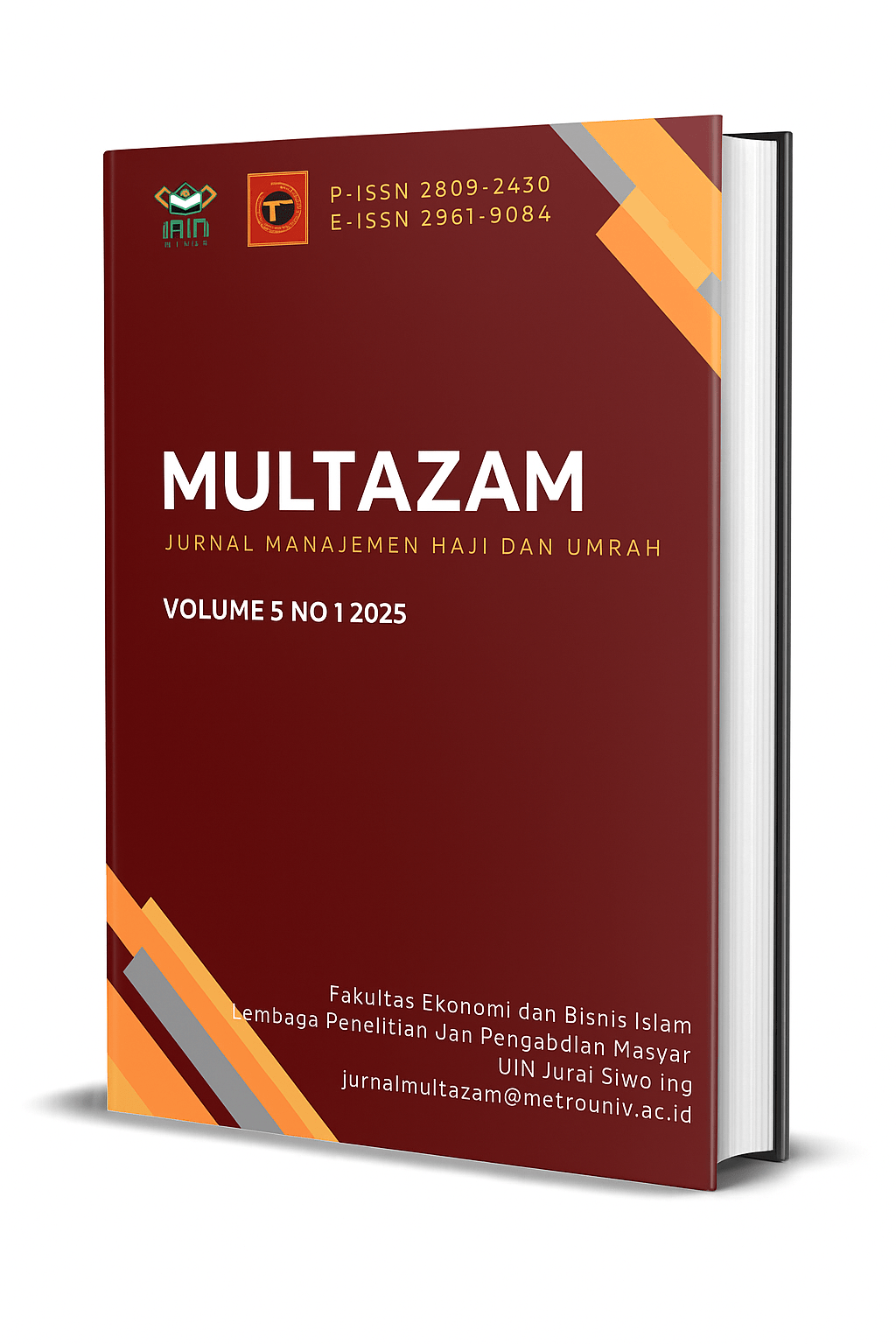
Multazam Journal of Hajj and Umrah Management is nationally accredited with Print International Standard Serial Number (P-ISSN) 2809-2430 and Electronic International Standard Serial Number (E-ISSN) 2961-9084 published by the Faculty of Economics and Islamic Business UIN Jurai Siwo Lampung as a vehicle for scientific exploration of Hajj and Umrah Management. Published twice a year in the period January-June and July-December. Editors accept manuscripts and writings with terms and conditions:
- In accordance with the Scope of the Multazam Journal;
- Original work and research results are prioritized;
- Groups of 2-5 people;
- The work is original, not plagiarized, and has never been published/published in any form in this format;
- Writing according to a predetermined format (see template);
- Manuscripts are recommended to cit a minimum of 15 accredited journals;
- Manuscripts are required to use Zotero, Mendeley or other supporting citation software;
- Submit your manuscript by Logging in for those who already have a Multazam account, or Register for those who do not have an account;
- Manuscripts can be submitted online every 24-hour day.
Announcements
Current Issue
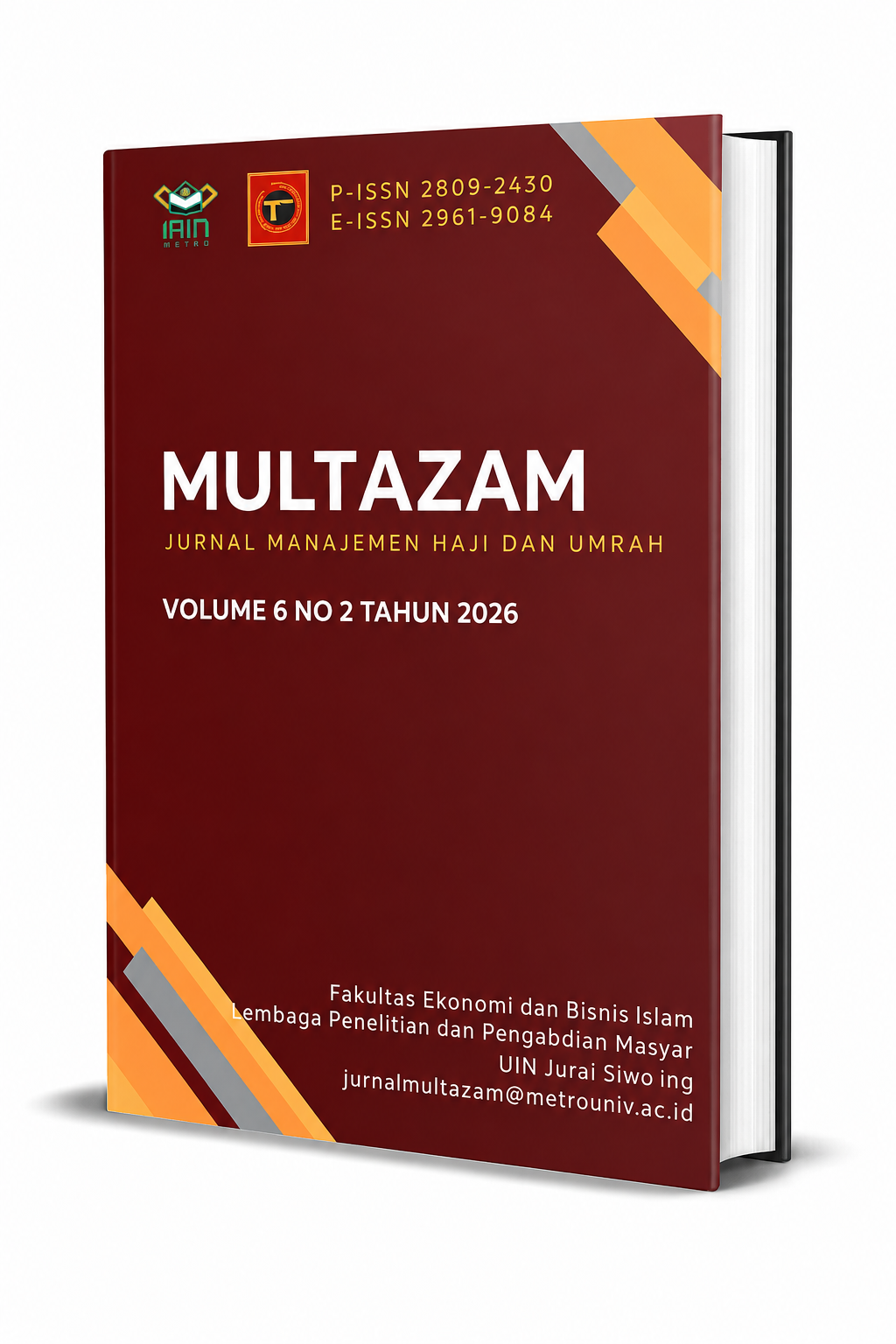
This issue of Multazam: Journal of Hajj and Umrah Management (Vol. 6, No. 1, January–June 2026) presents a collection of scholarly articles that explore contemporary issues, challenges, and innovations in the field of Hajj and Umrah management. The published studies reflect the growing complexity of pilgrimage services in the modern era, encompassing organizational management, service quality, digital transformation, governance, human resources, financial management, and the socio-religious dimensions of Hajj and Umrah.
The articles in this issue contribute to the advancement of knowledge by offering empirical findings, conceptual analyses, and practical recommendations for policymakers, practitioners, travel operators, and academics. Several studies highlight the importance of technology adoption, accountability, service excellence, pilgrim satisfaction, and institutional development in enhancing the overall pilgrimage experience. Other contributions examine broader social, cultural, and economic aspects that influence the management and sustainability of Hajj and Umrah services.
As a platform dedicated to the development of Hajj and Umrah studies, Multazam continues to encourage interdisciplinary research and critical discussion on issues related to pilgrimage management in Indonesia and the global Muslim community. We hope that the articles published in this issue will provide valuable insights and serve as references for future research, policy formulation, and professional practice in the field of Hajj and Umrah management.