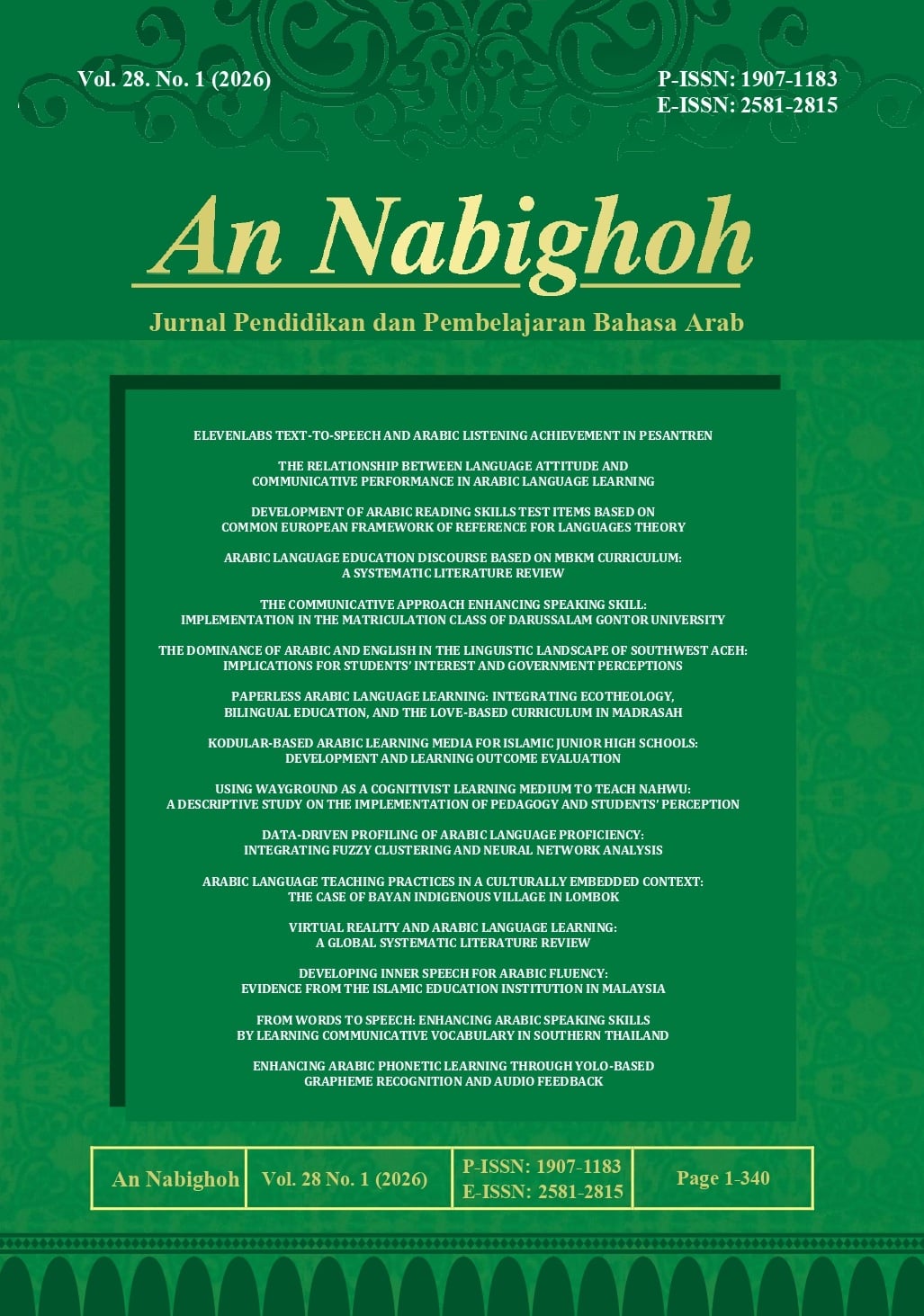
Arabic Language Teaching Practices in a Culturally Embedded Context: The Case of Bayan Indigenous Village in Lombok
DOI:
https://doi.org/10.32332/an-nabighoh.v28i1.233-252Keywords:
Arabic Language Learning, Audiolingual Method, Direct Method, Socio Cultural Context, Indigenous Community of BayanAbstract
Background: As the language used in the Quran and the Hadith, Arabic holds a crucial position in Islamic education. The success of Arabic language learning is determined by selecting Arabic language teaching methods that are appropriate to the students’ sociocultural context. Therefore, understanding the Arabic language teaching methods used at the madrasah tsanawiyyah in the traditional village of Bayan and their relevance to the local culture is of considerable importance. Research Objectives: This study aims to analyze the Arabic language teaching methods used at a madrasah located in the traditional village of Bayan and to examine the contextual factors that influence their implementation. Methodology: This study employed a descriptive qualitative approach with teachers and learners as the research subjects. Semi-structured interviews, observations, and documentation were used to collect data. The research instruments included interview guidelines and observation sheets. The data were analyzed using the Miles and Huberman model, and data validity was assessed through triangulation. Results: The research findings indicate that the sam’iyyah wa syafahiyyah (audiolingual/audio-oral) method was used, even though the teacher claimed to be using the mubasyarah (direct) method. This is evident in the learning process, which focuses on repetition and dialogue. In addition, the limited facilities and infrastructure resulted in a lack of variety in the teaching methods employed. Unique Contribution: This study contributes to the literature by providing an empirical description of Arabic language teaching practices at a madrasah located within an indigenous community and highlighting the role of local sociocultural conditions in shaping teaching adaptations. Conclusion: The implementation of the audiolingual method in the study conducted at the madrasah was shaped primarily by pedagogical practices and institutional conditions. Although the sociocultural context of the traditional village of Bayan did not directly determine the teaching methods used, it did influence the adaptation of learning objectives and priorities. Therefore, efforts to improve Arabic language learning in indigenous communities must combine pedagogical development with sensitivity to local sociocultural conditions. Recommendations: Enhancing teachers’ pedagogical competencies through regular professional development is necessary. In addition, various teaching methods that integrate listening, speaking, reading, and writing should be balanced and supported by adequate learning resources.
Downloads
References
Al-Athwary, Anwar A. H., and Nada M. Lasloum. “Second Language Listening Comprehension Gain From Aural vs. Audio-Visual Inputs: The Case of EFL Arab Learners.” Journal of Language Teaching and Research 12, no. 6 (2021): 911–21. https://doi.org/10.17507/jltr.1206.07. DOI: https://doi.org/10.17507/jltr.1206.07
Almelhes, Sultan. “Enhancing Arabic Language Acquisition: Effective Strategies for Addressing Non-Native Learners’ Challenges.” Education Sciences 14, no. 10 (2024): 1116. https://doi.org/10.3390/educsci14101116. DOI: https://doi.org/10.3390/educsci14101116
Almohawes, Monera. “Second Language Acquisition Theories and How They Contribute to Language Learning.” World Journal of English Language 14, no. 3 (2024): 181. https://doi.org/10.5430/wjel.v14n3p181. DOI: https://doi.org/10.5430/wjel.v14n3p181
Aybek, Birsel, and Osman Oğuz. “Sustainable and Inclusive Education Reform in Türkiye: A Cipp Evaluation of the Primary Turkish Language Curriculum.” Sustainability 17, no. 19 (2025): 8659. https://doi.org/10.3390/su17198659. DOI: https://doi.org/10.3390/su17198659
Creswell, John W., and Cheryl N. Poth. Qualitative Inquiry and Research Design: Choosing Among Five Approaches. SAGE Publications, 2017.
Fedorenko, Evelina, Steven T. Piantadosi, and Edward A. F. Gibson. “Language Is Primarily a Tool for Communication Rather than Thought.” Nature 630, no. 8017 (2024): 575–86. https://doi.org/10.1038/s41586-024-07522-w. DOI: https://doi.org/10.1038/s41586-024-07522-w
Fidayani, Eka Fitria, and Farikh Marzuki Ammar. “The Use of Azhari Curriculum in Arabic Language Learning at Islamic Boarding School.” Nazhruna: Jurnal Pendidikan Islam 6, no. 1 (2023): 25–45. https://doi.org/10.31538/nzh.v6i1.2866. DOI: https://doi.org/10.31538/nzh.v6i1.2866
Finelli, Cynthia J., Matthew DeMonbron, Prateek Shekhar, et al. “A Classroom Observation Instrument to Assess Student Response to Active Learning.” 2014 IEEE Frontiers in Education Conference (FIE) Proceedings, October 2014, 1–4. https://doi.org/10.1109/FIE.2014.7044084. DOI: https://doi.org/10.1109/FIE.2014.7044084
Habib, Moh. Tohiri, Masnun Masnun, Menik Mahmudah, and Sultan Abdus Syakur. “A Psycholinguistic Approach to Enhancing Arabic Vocabulary and Morphology Mastery Through Inspirational Quotes.” An Nabighoh 27, no. 1 (2025): 1–24. https://doi.org/10.32332/an-nabighoh.v27i1.1-24. DOI: https://doi.org/10.32332/an-nabighoh.v27i1.1-24
Hanani, Nurul, Nur Ahid, and Sufirmansyah Sufirmansyah. “An Eclectic Approach to Arabic Language Education: Implementing Kitab Al-Amtsilah At-Tashrifiyah in Modern Indonesian Pesantrens.” Jurnal Pendidikan Islam 10, no. 2 (2024): 192–206. https://doi.org/10.15575/jpi.v10i2.38651. DOI: https://doi.org/10.15575/jpi.v10i2.38651
Jaya, Khairul Huda, and Zawawi Ismail. “Fuzzy Delphi Method For Developing Arabic Speaking Learning Module for Nursing Students/ Metode Fuzzy Delphi Untuk Pengembangan Modul Pembelajaran Berbicara Bahasa Arab Bagi Mahasiswa Keperawatan.” Ijaz Arabi Journal of Arabic Learning 5, no. 3 (2022). https://doi.org/10.18860/ijazarabi.v5i3.17322. DOI: https://doi.org/10.18860/ijazarabi.v5i3.17322
Kennedy, Catriona, and Aoife McLoughlin. “Developing the Emergent Literacy Skills of English Language Learners Through Dialogic Reading: A Systematic Review.” Early Childhood Education Journal 51, no. 2 (2023): 317–32. https://doi.org/10.1007/s10643-021-01291-1. DOI: https://doi.org/10.1007/s10643-021-01291-1
Khan, Afzal. “Transformative Impacts of Explicit Morphological Instruction on Irregular Inflectional Acquisition in Saudi EFL Learners.” Humanities and Social Sciences Communications 11, no. 1 (2024): 1342. https://doi.org/10.1057/s41599-024-03610-4. DOI: https://doi.org/10.1057/s41599-024-03610-4
Kim, Deoksoon. “Learning Language, Learning Culture: Teaching Language to the Whole Student.” ECNU Review of Education 3, no. 3 (2020): 519–41. https://doi.org/10.1177/2096531120936693. DOI: https://doi.org/10.1177/2096531120936693
Lim, Weng Marc. “What Is Qualitative Research? An Overview and Guidelines.” Australasian Marketing Journal 33, no. 2 (2025): 199–229. https://doi.org/10.1177/14413582241264619. DOI: https://doi.org/10.1177/14413582241264619
Magnaye, Jr., Louiesito. “Teaching Indigenous Science through Culturally Responsive Pedagogy: Shaping Environmental Perception and Cultural Resilience in Science Education.” Environment and Social Psychology 10, no. 5 (2025). https://doi.org/10.59429/esp.v10i5.3683. DOI: https://doi.org/10.59429/esp.v10i5.3683
Mastrokoukou, Sofia, Andronikos Kaliris, Vincent Donche, et al. “Rediscovering Teaching in University: A Scoping Review of Teacher Effectiveness in Higher Education.” Frontiers in Education 7 (March 2022): 861458. https://doi.org/10.3389/feduc.2022.861458. DOI: https://doi.org/10.3389/feduc.2022.861458
Miles, Matthew B., A. Michael Huberman, and Johnny Saldana. Qualitative Data Analysis: A Methods Sourcebook. SAGE Publications, 2018.
Mubaligh, Ahmad, Risna Rianti Sari, and Elma Diana Novitasari. “Improving Arabic Speaking Skills Strategies for Islamic Boarding School Students.” Izdihar : Journal of Arabic Language Teaching, Linguistics, and Literature 5, no. 3 (2023). https://doi.org/10.22219/jiz.v5i3.21716. DOI: https://doi.org/10.22219/jiz.v5i3.21716
Mulyono, Herri, and Regitha Saskia. “Affective Variables Contributing to Indonesian EFL Students’ Willingness to Communicate within Face-to-Face and Digital Environments.” Cogent Education 8, no. 1 (2021): 1911282. https://doi.org/10.1080/2331186X.2021.1911282. DOI: https://doi.org/10.1080/2331186X.2021.1911282
Muzakki, Akhmad. “Reconstruction of Morphological (ʻIlmu Sharf) Learning Methods For Arabic Language and Literature Students/ Rekonstruksi Metode Pembelajaran Morfologi (`Ilmu Sharf) Bagi Mahasiswa Jurusan Bahasa Dan Sastra Arab.” Ijaz Arabi Journal of Arabic Learning 4, no. 1 (2020). https://doi.org/10.18860/ijazarabi.v4i1.9873. DOI: https://doi.org/10.18860/ijazarabi.v4i1.9873
Pawlak, Mirosław. “Teaching Foreign Language Grammar: New Solutions, Old Problems.” Foreign Language Annals 54, no. 4 (2021): 881–96. https://doi.org/10.1111/flan.12563. DOI: https://doi.org/10.1111/flan.12563
Rahim, Radziah Abdul, R. Sivabala Naidu, Mastura Badzis, Noor Fadhilah Mat Nayan, and Noor Hashima Abd Aziz. Qualitative Research: Data Collection & Data Analysis Techniques. UUM Press, 2008.
Rahman, Aulia, Bakri Muhammad Bakheet, Umi Machmudah, Moh. Buny Andaru Bahy, Nurhadi Nurhadi, and Muhammad Alfan. “Strategies for Shaping the Identity of Novice Arabic Teachers in a Professional Education Program.” An Nabighoh 27, no. 1 (2025): 179–200. https://doi.org/10.32332/an-nabighoh.v27i1.179-200. DOI: https://doi.org/10.32332/an-nabighoh.v27i1.179-200
Reisinger, Deborah S., and Joan Clifford. “Community‐based Language Learning as a Transformative Practice: An Exploration of the Modes of Communication.” Foreign Language Annals 55, no. 3 (2022): 668–83. https://doi.org/10.1111/flan.12629. DOI: https://doi.org/10.1111/flan.12629
Samir, Hossam El-Din, Nabeeha Bin Haidara, Fawzi Alghazali, and Mohamed Abouelfadl Badran. “The Impact of Language Immersion on Arabic Language Acquisition for Speakers of Other Languages: ‘Enhancing Arabic Language Skills for Speakers of Other Langugaes’ Program as a Model.” Journal of Posthumanism 5, no. 3 (2025). https://doi.org/10.63332/joph.v5i3.919. DOI: https://doi.org/10.63332/joph.v5i3.919
Sari, Ramadanita, Ita Rodiah, Ahmad Fauzi, and Lalu Pradipta Jaya Bahari. “An Examination of Talal Asad’s Thought in Anthropological Studies on the Islamic Community of the Sasak Tribe of Lombok.” Indonesian Journal of Islam and Muslim Societies 14, no. 1 (2024): 117–44. https://doi.org/10.18326/ijims.v14i1.117-144. DOI: https://doi.org/10.18326/ijims.v14i1.117-144
Setiyadi, Alif Cahya, Ahmad Farhan Rif’an Najib, Ihwan Mahmudi, and Muhammad Khoirul Malik. “Derivation and Inflection Inaccuracies: A Morphological Error Matrix for Improving Arabic Writing Competence in the Pesantren Context.” An Nabighoh 27, no. 2 (2025): 265–84. https://doi.org/10.32332/an-nabighoh.v27i2.265-284. DOI: https://doi.org/10.32332/an-nabighoh.v27i2.265-284
Syukriyah Mohd Suib, Nur, and Harun Baharudin. “Effective Strategies for Teaching Arabic Prosody in Oral Communication Skills.” Qubahan Academic Journal 5, no. 1 (2025). https://doi.org/10.48161/qaj.v5n1a855. DOI: https://doi.org/10.48161/qaj.v5n1a855
Toyama, Michiko, and Yoshitaka Yamazaki. “Classroom Interventions and Foreign Language Anxiety: A Systematic Review With Narrative Approach.” Frontiers in Psychology 12 (February 2021): 614184. https://doi.org/10.3389/fpsyg.2021.614184. DOI: https://doi.org/10.3389/fpsyg.2021.614184
Tracy, Sarah J. Qualitative Research Methods: Collecting Evidence, Crafting Analysis, Communicating Impact. John Wiley & Sons, 2024.
Valledor, Adrián, Alvaro Olmedo, Carlos J. Hellín, Abdelhamid Tayebi, Salvador Otón-Tortosa, and Josefa Gómez. “The Eclectic Approach in English Language Teaching Applications: A Qualitative Synthesis of the Literature.” Sustainability 15, no. 15 (2023): 11978. https://doi.org/10.3390/su151511978. DOI: https://doi.org/10.3390/su151511978
Wan Daud, Ab Aziz Wan, Mohammad Taufiq Abdul Ghani, Ahmad Abdul Rahman, Mohd Akashah Mohammad Yusof, Hadhrami Ab Ghani, and Zahazan Mohamed. “Exploring the Challenges and Strategies of Learning Arabic Language among Primary School Teachers.” Forum for Linguistic Studies 7, no. 2 (2025). https://doi.org/10.30564/fls.v7i2.8002. DOI: https://doi.org/10.30564/fls.v7i2.8002
Wen, Chua Hui, Lin Chia Ying, Ang Thiah Huat, Mohammad Affiq Bin Kamarul Azlan, Fan Pik Shy, and Shan Baoshun. “The Effects of Task-Based Language Teaching and Audio-Lingual Teaching Approach in Mandarin Learning Motivation.” International Journal of Language Education 5, no. 4 (2021): 396. https://doi.org/10.26858/ijole.v5i4.19898. DOI: https://doi.org/10.26858/ijole.v5i4.19898
West, Gillian, Arne Lervåg, Julia M. H. Birchenough, et al. “Oral Language Enrichment in Preschool Improves Children’s Language Skills: A Cluster Randomised Controlled Trial.” Journal of Child Psychology and Psychiatry 65, no. 8 (2024): 1087–97. https://doi.org/10.1111/jcpp.13947. DOI: https://doi.org/10.1111/jcpp.13947
Wijnia, Lisette, Gera Noordzij, Lidia R. Arends, Remigius M. J. P. Rikers, and Sofie M. M. Loyens. “The Effects of Problem-Based, Project-Based, and Case-Based Learning on Students’ Motivation: A Meta-Analysis.” Educational Psychology Review 36, no. 1 (2024): 29. https://doi.org/10.1007/s10648-024-09864-3. DOI: https://doi.org/10.1007/s10648-024-09864-3
Wutich, Amber, Melissa Beresford, Cindi SturtzSreetharan, Alexandra Brewis, Sarah Trainer, and Jessica Hardin. “Metatheme Analysis: A Qualitative Method for Cross-Cultural Research.” International Journal of Qualitative Methods 20 (January 2021): 16094069211019907. https://doi.org/10.1177/16094069211019907. DOI: https://doi.org/10.1177/16094069211019907
Zaki, Mohamad Fathie Mohamad, Ummi Syarah Ismail, Amizura Hanadi Mohd Radzi, and Nadhilah Abdul Pisal. “Teaching Methods of Arabic Language Grammar Lessons Among Arabic Teachers at Religious Secondary Schools in Malaysia.” Theory and Practice in Language Studies 14, no. 10 (2024): 3100–3108. https://doi.org/10.17507/tpls.1410.11. DOI: https://doi.org/10.17507/tpls.1410.11
Zhan, Liu, and Jie Cheng. “The Relationship between Multisensory Stimulus-Integrated Foreign Language Learning Models and Students’ Psychological States and Language Skill Development-an Empirical Analysis Using the Global Learning Assessment Database.” Frontiers in Psychology 16 (August 2025): 1639885. https://doi.org/10.3389/fpsyg.2025.1639885. DOI: https://doi.org/10.3389/fpsyg.2025.1639885
Zhang, Lawrence, and Donglan Zhang. “Dialogic Discussion as a Platform for Constructing Knowledge: Student-Teachers’ Interaction Patterns and Strategies in Learning to Teach English.” Preprint, In Review, October 8, 2020. https://doi.org/10.21203/rs.3.rs-86892/v1. DOI: https://doi.org/10.21203/rs.3.rs-86892/v1
Downloads
Published
Issue
Section
License
Copyright (c) 2026 Binti Syufiana Budairoh, Yusraini Yusraini, Irfan Irfan, Muhammad Qodri, Mustar Mustar, Mohamad Hussin

This work is licensed under a Creative Commons Attribution-ShareAlike 4.0 International License.