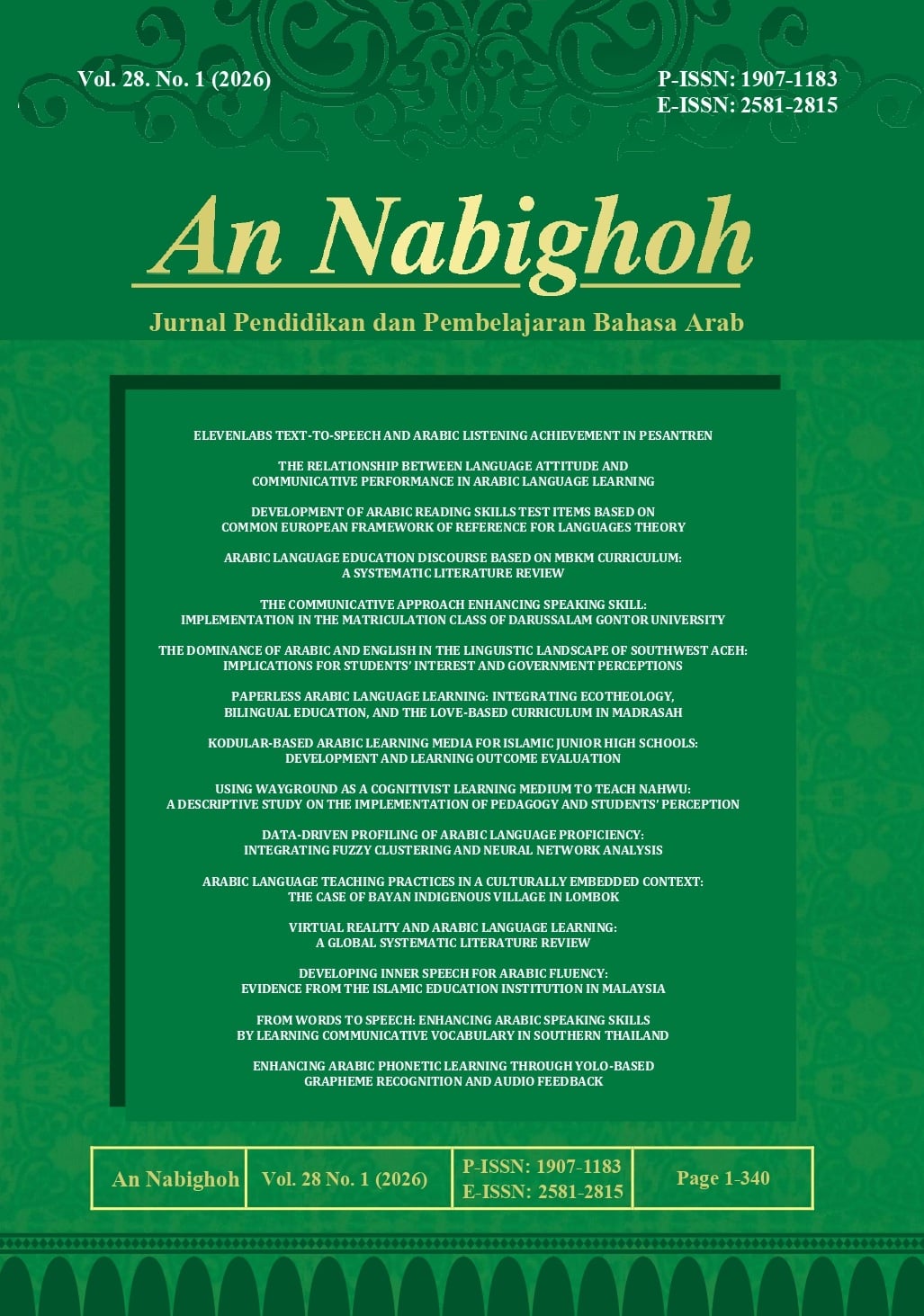
Paperless Arabic Language Learning: Integrating Ecotheology, Bilingual Education, and the Love-Based Curriculum in Madrasah
DOI:
https://doi.org/10.32332/an-nabighoh.v28i1.145-170Keywords:
Paperless Education, Bilingual Education, Eco-Theology, Love-Based Curriculum, Islamic Education, Educational Digital TransformationAbstract
Background: Deforestation and rising carbon emissions resulting from excessive paper use in education have encouraged the development of sustainable, technology-based, and environmentally friendly learning models. Research Objectives: This study aims to describe the implementation of paperless bilingual learning in Arabic at MTs Quranic Scientia, UIN Imam Bonjol Padang, analyze its alignment with eco-theological principles; examine the role of the Love-Based Curriculum (KBC); and identify its opportunities and challenges in supporting Arabic learning. Methodology: This study employed a qualitative approach with an instrinsic case study design. Data were collected through in-depth interviews, participant observation, and document analysis involving teachers, students, and school administrators. To ensure validity, the study applied triangulation and member checking, while data were analyzed iteratively through data reduction, display, and conclusion drawing. Results:. The findings reveal that paperless bilingual Arabic learning supported by iPads, smartboards, and the Cerdig e-learning platform enhances students’ Arabic proficiency, digital literacy, and classroom engagement. The integration of the Love-Based Curriculum fosters collaborative, caring, and confidence-building learning interaction, while ecotheological values strengthen students’ environmental awareness and responsibility. Despite challenges related to language proficiency, technical issues, and students’ self-confidence, the model demonstrates significant potential in promoting sustainable, technology-based Islamic education. Unique Contribution: The integration of the Love-Based Curriculum strengthens values of environmental responsibility, compassion, and respect within the learning process, offering an integrative model combining paperless learning, bilingual education, and eco-theological in Islamic education. Conclusion: This study concludes that the approach improves students’ Arabic proficiency, academic performance, and digital skills while fostering ecological awareness. Recommendations: This model is recommended for adaptation in other madrasahs with contextual adjustments.
Downloads
References
Alfianingsih, Yesika, Ahmad Riyadissolihin, Khaerul Muttakin, Muhajir, Dewi Atma Junira, and Helmi Najamudin. “Arabic Learning Model in a Kurikulum Berbasis Cinta in a Madrasah.” Curricula: Journal of Curriculum Development 5, no. 2 (2026). https://ejournal-education.upi.edu/curricula/article/view/204.
Arifin, Zainul, Torkis Lubis, Ahmad Muhammad Ath-Thukhi, Tareq Alsokari, Moh Ainin, and Muhammad Taufan. “Analyzing the Problems of Arabic Language Learning in Higher Education.” International Journal of Islamic Studies Higher Education 3, no. 3 (2024). https://insight.ppj.unp.ac.id/index.php/insight/article/view/193.
Bachtiyar, Machfud, M. Yunus Abu Bakar, and Evi Fatimatur Rusydiyah. “Innovations in Islamic Religious Education in Bilingual Madrasah Aliyah: A Systematic Literature Review.” AL-ISHLAH: Jurnal Pendidikan 17, no. 2 (2025): 2115–24. https://doi.org/10.35445/alishlah.v17i2.5453. DOI: https://doi.org/10.35445/alishlah.v17i2.5453
Bahtiar, Auliak, Syaiful Rizal, Hannani Roisyah, and Chumphon Angkananon. “Integrating Eco-Sufi Values into Environmental Education through the Adiwiyata Madrasah Program.” Journal of Islamic Education Research 6, no. 3 (2025): 261–74. https://doi.org/10.35719/jier.v6i3.486. DOI: https://doi.org/10.35719/jier.v6i3.486
Bialystok, Ellen, Fergus I. M. Craik, David W. Green, and Tamar H. Gollan. “Bilingual Minds.” Psychological Science in the Public Interest 10, no. 3 (2009): 89–129. https://doi.org/10.1177/1529100610387084. DOI: https://doi.org/10.1177/1529100610387084
British Educational Research Association [BERA]. Ethical Guidelines for Educational Research. Fourth edition. London, 2018. https://www.bera.ac.uk/researchers-resources/publications/ethical-guidelines-for-educational-research-2018.
Creswell, John W., and Cheryl N. Poth. Qualitative Inquiry and Research Design: Choosing Among Five Approaches. SAGE Publications, 2016.
Fitriyah, Nailiyatul, Didin Nuruddin Hidayat, and Nida Husna. “Teaching English in Pesantren: The Dynamics of Code-Switching in Multilingual Classrooms.” Tamaddun 24, no. 1 (2025). https://jurnal.fs.umi.ac.id/index.php/tamaddun-life/article/view/844.
Furszyfer Del Rio, Dylan D., Benjamin K. Sovacool, Steve Griffiths, et al. “Decarbonizing the Pulp and Paper Industry: A Critical and Systematic Review of Sociotechnical Developments and Policy Options.” Renewable and Sustainable Energy Reviews 167 (October 2022): 112706. https://doi.org/10.1016/j.rser.2022.112706. DOI: https://doi.org/10.1016/j.rser.2022.112706
García, Ofelia, and Li Wei. “Language, Bilingualism and Education.” In Translanguaging, by Ofelia García and Li Wei. Palgrave Macmillan UK, 2014. https://doi.org/10.1057/9781137385765_4. DOI: https://doi.org/10.1057/9781137385765_4
Gersalia, Angela, and Michael Estremera. “A Systematic Literature Review of Bilingual Education Models: :Approaches and Educational Outcomes.” International Journal of Language Teaching and Education 9, no. 2 (2025): 1–12. https://doi.org/10.22437/ijolte.v9i2.44428. DOI: https://doi.org/10.22437/ijolte.v9i2.44428
Hadi, Sholihul. “The Influence of Awareness of Consequences, Internal Locus of Control, and External Locus of Control on Pro-Environmental Behavior in Students.” International Journal of Current Science Research and Review 07, no. 08 (2024). https://doi.org/10.47191/ijcsrr/V7-i8-82. DOI: https://doi.org/10.47191/ijcsrr/V7-i8-82
Hidayat, Mansur. “Islamic Eco-Theology: Religious Narratives in the Climate Crisis in Indonesia.” Bulletin of Indonesian Islamic Studies 2, no. 2 (2023): 197–212. https://doi.org/10.51214/biis.v2i2.678. DOI: https://doi.org/10.51214/biis.v2i2.678
Hidayat, Wahidin Nur, Ahmad Nurrohim, and Suharjianto. “E-Learning Based Teaching Revolution of the Quran Interpretation at Universitas Muhammadiyah Surakarta.” In Proceedings of the International Conference on Islamic and Muhammadiyah Studies (ICIMS 2023), vol. 773. Advances in Social Science, Education and Humanities Research. Atlantis Press SARL, 2024. https://doi.org/10.2991/978-2-38476-102-9_17. DOI: https://doi.org/10.2991/978-2-38476-102-9_17
Hoerudin, Cecep Wahyu. “Optimizing Bilingual Teaching in Developing Students’ English Language Skills.” International Journal of Science and Society 6, no. 3 (2024): 336–47. https://doi.org/10.54783/ijsoc.v6i3.1248. DOI: https://doi.org/10.54783/ijsoc.v6i3.1248
Juliani, Humam Mahdi, Shofy Widya Sari, Suci Indah Sari, and Nadila Raihanun Nazwa. “Green Islamic School: Integrating Environmental Education in the Islamic Education Curriculum.” Cendekiawan : Jurnal Pendidikan Dan Studi Keislaman 3, no. 3 (2024): 565–74. https://doi.org/10.61253/cendekiawan.v3i3.270. DOI: https://doi.org/10.61253/cendekiawan.v3i3.270
Khafid, M., D. Suryandari, R. Hidayah, T. A. Dahlan, D. R. Husna, and I. N. Kayati. “Environmental Sustainability: Insight into Paperless Policy and Integrated Audit Internal System.” IOP Conference Series: Earth and Environmental Science 1248, no. 1 (2023): 012008. https://doi.org/10.1088/1755-1315/1248/1/012008. DOI: https://doi.org/10.1088/1755-1315/1248/1/012008
Khomisah, Soimatul, Husna Nashihin, Eri Twi Cahyanti, and Khailani Khumairoh. “Environmentally Conscious Islamic Education Curriculum Design (Eco-Theology).” Proceeding of International Conference of Islamic Education 3 (September 2025). https://jurnal.iimsurakarta.ac.id/index.php/icie/article/view/817.
Lavy, Shiri, and Eman Naama-Ghanayim. “Why Care about Caring? Linking Teachers’ Caring and Sense of Meaning at Work with Students’ Self-Esteem, Well-Being, and School Engagement.” Teaching and Teacher Education 91 (May 2020): 103046. https://doi.org/10.1016/j.tate.2020.103046. DOI: https://doi.org/10.1016/j.tate.2020.103046
Lazarinis, Fotis. “Descriptive Cataloguing Codes and the Anatomy of AACR2.” In Cataloguing and Classification. Elsevier, 2015. https://doi.org/10.1016/B978-0-08-100161-5.00002-6. DOI: https://doi.org/10.1016/B978-0-08-100161-5.00002-6
Maulana Bagus Rahmat, Masruchin, and Fauzan. “The Idea of Islamic Ecotheology in Responding to the Global Environmental Crisis: An Analysis of the Concepts of Khalifah, Mīzān, and Maṣlaḥah.” Indonesian Journal of Islamic Theology and Philosophy 7, no. 1 (2025): 93–110. https://doi.org/10.24042/ijitp.v7i1.27596.
Maulani, Nini, and Rizqiyah Ratu Balqis. “Zero Waste-Oriented Adiwiyata Program in Developing Environmental Care Character of Madrasah Ibtidaiyah Students.” IJCER (International Journal of Chemistry Education Research), April 30, 2026, 35–42. https://doi.org/10.20885/ijcer.vol10.iss1.art4. DOI: https://doi.org/10.20885/ijcer.vol10.iss1.art4
Maverengo, Hilton, Professor Freddie L. Inambao, and Samuel Ilupeju. “Pulp And Paper Industry: A Review.” Tuijin Jishu/Journal of Propulsion Technology 44, no. 5 (2023). https://www.propulsiontechjournal.com/index.php/journal/article/view/3356.
Nirmalasari, Putri, Kisman Salija, and Muhammad Basri Jafar. “Bilingual Education in Rural Islamic High Schools: Teachers’ and Students’ Perspectives and Experiences.” Tamaddun 22, no. 1 (2023): 11–19. https://doi.org/10.33096/tamaddun.v22i1.268. DOI: https://doi.org/10.33096/tamaddun.v22i1.268
Nortvig, Anne-Mette, Anne Kristine Petersen, Helle Helsinghof, and Birgit Brænder. “Digital Expansions of Physical Learning Spaces in Practice-Based Subjects - Blended Learning in Art and Craft & Design in Teacher Education.” Computers & Education 159 (December 2020): 104020. https://doi.org/10.1016/j.compedu.2020.104020. DOI: https://doi.org/10.1016/j.compedu.2020.104020
Nurohmah, Eka Yuliana, and Siti Ma’rifah. “From Paper-Based to Digital Assessment: Adoption and Challenges of Learning Evaluation Applications in Islamic Education.” Journal of Educational Research and Practice 3, no. 1 (2025): 107–22. https://doi.org/10.70376/jerp.v3i1.206. DOI: https://doi.org/10.70376/jerp.v3i1.206
Oropeza Abregú, Yoselin, and Hassan Aftab Sheikh. “A Dual-Workflow Framework for Evaluating Pulp and Paper Industry Impacts on Nature.” Environmental Impact Assessment Review 118 (April 2026): 108307. https://doi.org/10.1016/j.eiar.2025.108307. DOI: https://doi.org/10.1016/j.eiar.2025.108307
Rahman, Defri, Elfindri Elfindri, Henmaidi Henmaidi, and Hafiz Rahman. “Analysis of Government Policies in Padang City in Food Waste Management at the Household Level.” Jurnal Riset Multidisiplin Dan Inovasi Teknologi 2, no. 01 (2023): 26–36. https://doi.org/10.59653/jimat.v2i01.307. DOI: https://doi.org/10.59653/jimat.v2i01.307
Rahmat, Maulana Bagus, Masruchin, and Fauzan. “The Idea of Islamic Ecotheology in Responding to the Global Environmental Crisis: An Analysis of the Concepts of Khalifah, Mīzān, and Maṣlaḥah.” Indonesian Journal of Islamic Theology and Philosophy 7, no. 1 (2025): 93–110. https://doi.org/10.24042/ijitp.v7i1.27596. DOI: https://doi.org/10.24042/ijitp.v7i1.27596
Ratnasari, Dwi, Luqyana Azmiya Putri, Febri Widiandari, and Adhi Setiyawan. “The Integration of Eco-Theology in Sekolah Alam Yogyakarta: A Living Quran: Integrasi Eco-Theology Di Sekolah Alam Yogyakarta: Sebuah Living Quran.” Edulab : Majalah Ilmiah Laboratorium Pendidikan 9, no. 2 (2025): 283–96. https://doi.org/10.14421/edulab.2024.92.08. DOI: https://doi.org/10.14421/edulab.2024.92.08
Rifqi, Muhammad Ichsan, and Aria Saputra. “Love-Based Curriculum: Fostering Islamic Eco-Theology Education in Madrasah: Fostering Islamic Eco-Theology Education in Madrasah.” Ta’dibuna: Jurnal Pendidikan Islam 14, no. 5 (2025): 536–53. https://doi.org/10.32832/tadibuna.v14i5.21104. DOI: https://doi.org/10.32832/tadibuna.v14i5.21104
Rochmawan, Alfian Eko, Lailla Hidayatul Amiin, and Nur Hidayah. “Socialization of the Love-Based Curriculum in the Teachers Working Group and the Principals Working Group of Islamic Elementary Schools in Plupuh Sub-District.” Jurnal Al Basirah 5, no. 2 (2025). https://e-journal.staimaswonogiri.ac.id/index.php/albasirah/article/view/450.
Sapitri, Elfira Yunita, Tasman Hamami, and Khaerul Muttakin. “Integrating Ecotheology into Islamic Religious Education: A Systematic Literature Review on Students’ Spiritual, Social, and Cognitive Character Development.” DAYAH: Journal of Islamic Education 8, no. 2 (2025): 178–201. https://doi.org/10.22373/jie.v8i2.34136. DOI: https://doi.org/10.22373/jie.v8i2.34136
Sari, Septy Kumala, S. Ahmad Marjuki Mustofa, and Dian Arief Pradana. “Creating an Effective Multilingual Learning Curriculum for Bilingual Students in Indonesia, Fostering Language Proficiency.” Journal of Technology, Education & Teaching (J-Tech) 2, no. 1 (2025): 130–35. https://doi.org/10.62734/jtech.v2i1.451. DOI: https://doi.org/10.62734/jtech.v2i1.451
Söderholm, Patrik, Ann-Kristin Bergquist, and Kristina Söderholm. “Environmental Regulation in the Pulp and Paper Industry: Impacts and Challenges.” Current Forestry Reports 5, no. 4 (2019): 185–98. https://doi.org/10.1007/s40725-019-00097-0. DOI: https://doi.org/10.1007/s40725-019-00097-0
Sugito, Sugito. “Hybrid Learning in Pesantren: Integrating Digital Pedagogy and Islamic Values to Enhance 21st-Century Competencies.” Tafkir: Interdisciplinary Journal of Islamic Education 5, no. 4 (2024): 749–64. https://doi.org/10.31538/tijie.v5i4.2207. DOI: https://doi.org/10.31538/tijie.v5i4.2207
Sun, Mingxing, Yutao Wang, Lei Shi, and Jiří Jaromír Klemeš. “Uncovering Energy Use, Carbon Emissions and Environmental Burdens of Pulp and Paper Industry: A Systematic Review and Meta-Analysis.” Renewable and Sustainable Energy Reviews 92 (September 2018): 823–33. https://doi.org/10.1016/j.rser.2018.04.036. DOI: https://doi.org/10.1016/j.rser.2018.04.036
Surawy-Stepney, Nick, Fabien Provost, Shagufta Bhangu, and Carlo Caduff. “Introduction to Qualitative Research Methods: Part 2.” Perspectives in Clinical Research 14, no. 2 (2023): 95–99. https://doi.org/10.4103/picr.picr_37_23. DOI: https://doi.org/10.4103/picr.picr_37_23
Suryani, Yani, Wono Sulaeman, Yudha Bima Faqori, Yelmi Mawati, and Yanti Nur Ulfah. “Cooperative Learning with Reinforcement to Improve Student Motivation and Learning Outcomes on Praiseworthy Morals Material at MIS Ma’arif Salamal Huda.” Indonesian Journal of Education and Social Humanities 1, no. 2 (2024): 55–62. https://doi.org/10.62945/ijesh.v1i2.664. DOI: https://doi.org/10.62945/ijesh.v1i2.664
Syafaruddin, Baso. “Ecotheology in the Perspective of Islamic Education: A Conceptual Review.” ETDC: Indonesian Journal of Research and Educational Review 4, no. 3 (2025): 720–31. https://doi.org/10.51574/ijrer.v4i3.3253. DOI: https://doi.org/10.51574/ijrer.v4i3.3253
Taufikin, Taufikin. “Integrating Eco-Theology In Islamic Education: A Case Study On Fostering Ecological Awareness Through Religious Pedagogy.” El-Tarbawi 18, no. 1 (2025): 1–37. https://doi.org/10.20885/tarbawi.vol18.iss1.art1. DOI: https://doi.org/10.20885/tarbawi.vol18.iss1.art1
Thohri, Muhammad. “Development of Environmentally Conscious Islamic Religious Education Curriculum at Elementary, Secondary, and Tertiary Education Levels.” Journal of Advances in Education and Philosophy 8, no. 02 (2024): 76–87. https://doi.org/10.36348/jaep.2024.v08i02.005. DOI: https://doi.org/10.36348/jaep.2024.v08i02.005
Underwood, Julie. “Legal Talk: The Supreme Court and Schools.” Educational Horizons 90, no. 1 (2011). https://www.jstor.org/stable/42926574. DOI: https://doi.org/10.1177/0013175X1109000110
UNESCO. Education 2030: Incheon Declaration and Framework for Action for the Implementation of Sustainable Development Goal 4: Ensure Inclusive and Equitable Quality Education and Promote Lifelong Learning Opportunities for All. 2016. https://unesdoc.unesco.org/ark:/48223/pf0000245656.
Van Ewijk, Stijn, Julia A. Stegemann, and Paul Ekins. “Limited Climate Benefits of Global Recycling of Pulp and Paper.” Nature Sustainability 4, no. 2 (2020): 180–87. https://doi.org/10.1038/s41893-020-00624-z. DOI: https://doi.org/10.1038/s41893-020-00624-z
Yunus, Machmud, Deni Supriad, Nina Siti Kurniati, and Didin Solehudin. “Welcoming the Islamic Education Revolution: Adaptive Curriculum in Facing the Digital Era.” Jurnal Eduslamic 3, no. 1 (2025): 27–36. https://doi.org/10.59548/jed.v3i1.400. DOI: https://doi.org/10.59548/jed.v3i1.400
Downloads
Published
Issue
Section
License
Copyright (c) 2026 Ifkar Rasyid, Zaimatuz Zakiyah, Sri Indah Lestari, Ikysarul Akhyari

This work is licensed under a Creative Commons Attribution-ShareAlike 4.0 International License.