| :: People :: |
| Editorial Team |
| Reviewers |
| Contact |
| :: Policies :: |
| :: Submission :: |
| Register or Login |
| Author Guidelines |
| Copyright and License |
| Privacy Statement |
| Manuscript Template |
| Rumah Jurnal UIN Jurai Siwo Lampung |

Jurnal Bimbingan Penyuluhan Islam recognizes that Generative Artificial Intelligence (AI) and AI-assisted technologies can support researchers in preparing scholarly manuscripts. These technologies may be used responsibly as supporting tools; however, they must not replace human intellectual contribution, critical analysis, scientific judgment, or overall accountability.
This policy applies to authors, editors, and peer reviewers involved in the publication process of Jurnal Bimbingan Penyuluhan Islam.
Authors may use Generative AI and AI-assisted technologies for limited supporting purposes, including:
Improving grammar, language, readability, and clarity.
Translating or refining text originally written by the authors.
Organizing or restructuring author-generated content.
Brainstorming or exploring preliminary research ideas.
Summarizing literature that has been identified and verified by the authors.
Supporting coding, programming, or technical execution.
Preparing non-substantive structural elements of the manuscript.
The use of AI must not replace the authors' own scholarly reasoning, critical analysis, discussion, conclusions, or original intellectual contributions. Authors remain fully accountable and responsible for all submitted content, including its accuracy, originality, citations, data integrity, analysis, interpretation, and adherence to publication ethics.
Authors must formally disclose the use of Generative AI whenever the technology has contributed to generating, substantially rewriting, analyzing, interpreting, translating, or structuring manuscript content.
The disclosure must specify:
The official name of the AI tool or service.
The version number (where available).
The specific purpose for which the tool was utilized.
Confirmation that the authors have independently reviewed and verified the AI-generated output.
The disclosure must appear within the manuscript under the dedicated section heading:
AI Use Statement
Suggested statement when AI is used:
"During the preparation of this manuscript, the author(s) used [NAME OF AI TOOL/SERVICE, VERSION] for [PURPOSE]. The author(s) subsequently reviewed, verified, and edited the output, and assume full responsibility for the accuracy, originality, and integrity of the published content."
Statement when no AI is used:
"AI Use Statement: The author(s) declare that no Generative Artificial Intelligence (AI) or AI-assisted technologies were used to generate substantive content, analysis, interpretation, or conclusions in this manuscript."
Routine use of conventional spelling checkers, reference management software, standard formatting tools, or scientific calculators that do not generate substantive intellectual content does not require disclosure. However, if a software feature incorporates Generative AI functions that generate or substantially rewrite text, such usage must be disclosed.
Authors must independently verify all information produced or assisted by AI. AI-generated citations, references, direct quotations, factual claims, and statistical data must not be included without verification against primary sources.
Authors are strictly prohibited from using AI to fabricate, falsify, manipulate, or misleadingly alter:
Primary research data.
Research participants, samples, or observational records.
Empirical results and findings.
Statistical computations.
Direct quotations and literature references.
Images, charts, or visual figures.
Legal or textual evidence.
Any other component of the scholarly record.
Where Generative AI tools are utilized as an integral part of the research methodology, their application must be transparently and thoroughly described in the Methods section to allow proper peer evaluation and scientific reproducibility.
Artificial Intelligence tools cannot be accredited as authors or co-authors. Authorship entails human responsibility, legal accountability, and final intellectual approval of the work. All listed human authors remain collectively responsible for the complete content of the published manuscript.
Editors may utilize approved AI-assisted tools solely for administrative, technical, or language-screening processes, provided such tools do not compromise manuscript confidentiality, personal data privacy, intellectual property rights, or editorial independence.
Editors must not use Generative AI to replace human scholarly judgment in:
Evaluating the intellectual quality and scientific rigor of a manuscript.
Interpreting peer-review reports.
Assessing research integrity and compliance with ethics.
Rendering decisions to accept, revise, or reject a manuscript.
Editors are strictly prohibited from uploading unpublished manuscripts, reviewer comments, confidential correspondence, or author personal information into publicly accessible Generative AI platforms. Final editorial decisions remain the sole responsibility of human editors.
Peer reviewers are prohibited from using Generative AI or AI-assisted technologies to perform substantive evaluations of assigned manuscripts. Reviewers must not use AI to:
Analyze, evaluate, or summarize submitted manuscripts.
Assess research methodology, empirical results, arguments, or conclusions.
Identify strengths or weaknesses within a submission.
Draft reviewer commentary or feedback.
Formulate publication recommendations or final evaluation decisions.
Reviewers must never upload an unpublished manuscript, or any portion thereof (including data, tables, figures, or supplementary materials), into publicly accessible AI systems. The peer-review process must rely entirely on the reviewer's own expertise, critical judgment, and professional responsibility.
Reviewers may use standard grammar and spelling software to refine the wording of a review they have independently authored, provided no confidential manuscript content is transmitted to external AI systems.
Undisclosed, misleading, or unethical utilization of Generative AI will be handled as a publication ethics violation. Depending on the nature and severity of the non-compliance, Jurnal Bimbingan Penyuluhan Islam may take appropriate editorial actions, including:
Requesting formal clarification or correction from the authors.
Requiring structural manuscript revisions.
Rejecting the submission.
Withdrawing the manuscript from active editorial review.
Publishing a formal Erratum or Corrigendum post-publication.
Issuing an Expression of Concern.
Retracting the published article in accordance with COPE guidelines.
Jurnal Bimbingan Penyuluhan Islam periodically reviews and updates this policy to align with developments in Generative AI technology, publishing ethics standards, and national accreditation criteria.
| :: People :: |
| Editorial Team |
| Reviewers |
| Contact |
| :: Policies :: |
| :: Submission :: |
| Register or Login |
| Author Guidelines |
| Copyright and License |
| Privacy Statement |
| Manuscript Template |
| Rumah Jurnal UIN Jurai Siwo Lampung |
| Web Traffic & Audience |
| |
| Asosiasi |
 |
| Accreditation |
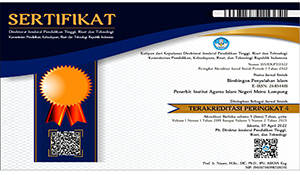
Nationally Accredited Journal |


This work is licensed under a Creative Commons Attribution-ShareAlike 4.0 International License.
Jurnal Bimbingan Penyuluhan Islam
Fakultas Ushuluddin Adab Dan Dakwah UIN Jurai Siwo Lampung
Alamat Kantor: Jl. Ki Hajar Dewantara No.15A, Iringmulyo, Kec. Metro Timur., Kota Metro, Lampung 34112
Email : [email protected]
CP: 0813-7921-8826 ( Alfiyana Y )
