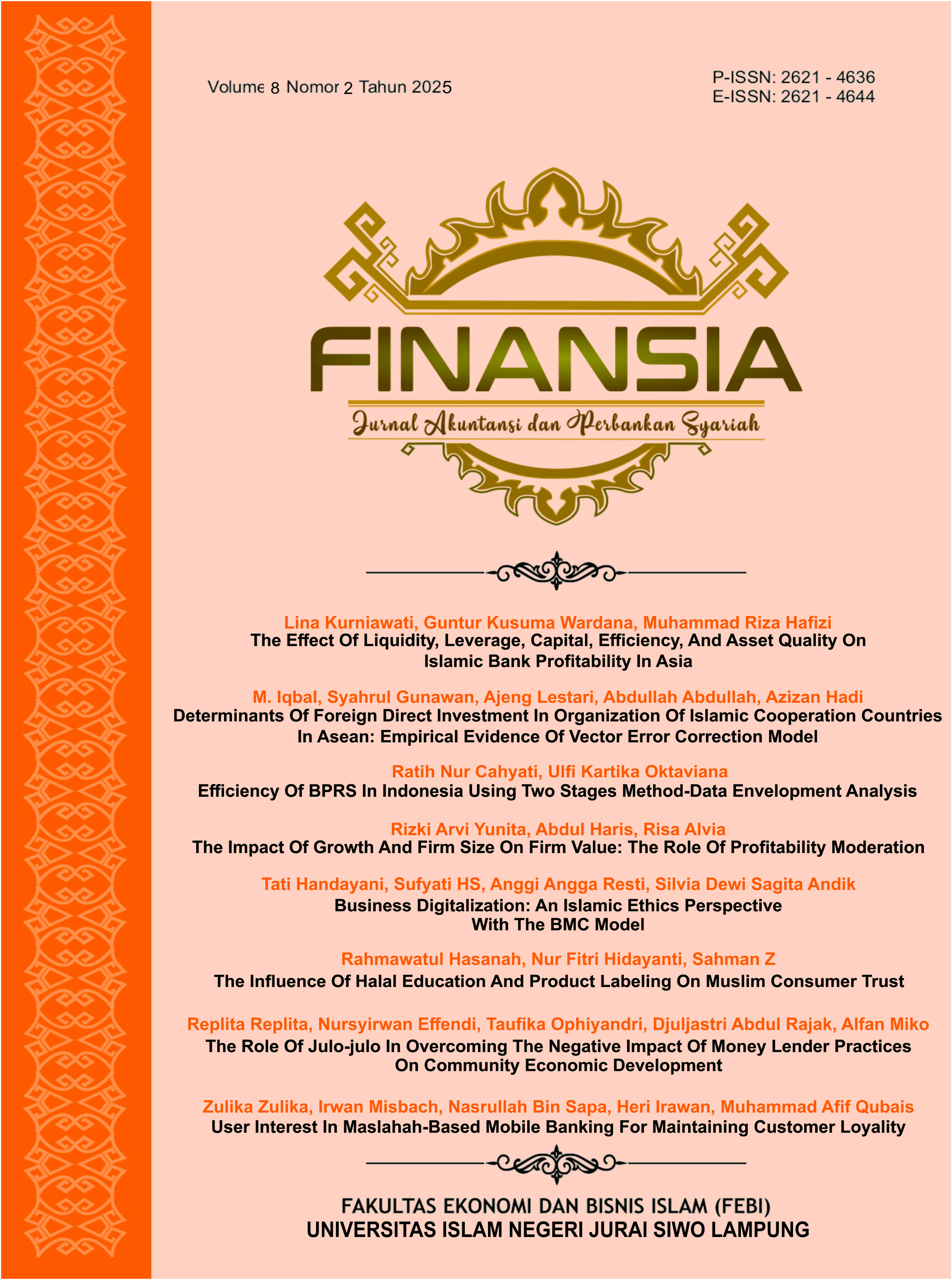
USER INTEREST IN MASLAHAH-BASED MOBILE BANKING FOR MAINTAINING CUSTOMER LOYALTY
DOI:
https://doi.org/10.32332/finansia.v8i2.10256Keywords:
Mobile Banking, Maslahah, Customer Loyalty, Maqashid al-ShariahAbstract
The development of digital services in Islamic banking demands alignment between technological convenience and the values of maqashid al-shariah. This study aims to identify user interest in the Muamalat DIN Mobile Banking application based on maslahah and to analyze the role of its features in building customer loyalty. The research uses a qualitative approach with a case study design grounded in Islamic consumer behavior theory and the concept of maqashid al-shariah. The results show that interest in using the Muamalat DIN application is influenced by the need for Islamic banking services, religious trust, social demands, and institutional regulatory support. The main features that drive customer loyalty include security, ease of transactions, service benefits, and the function of distributing social funds. All of these features reflect the values of maqashid al-shariah in preserving religion, wealth, and social welfare. These findings confirm that applying the principle of maslahah in mobile banking can enhance the trust and loyalty of Islamic banking customers.
Downloads
References
Abdennebi, H. B., And Al-Mamun, M. “M-Banking Adoption From The Developing Countries Perspective: Case Of Tunisia.” Journal Of Islamic Marketing, Vol. 14, No. 4, 2023. https://doi.org/10.1108/JIMA-01-2022-0298.
Abdurrahman, A. “Examining Factors Affecting The Acceptance Of Islamic Mobile Banking Services In Indonesia.” International Journal Of Islamic Finance And Sustainable Development, 2025. https://digilib.uinsgd.ac.id/114224/1/IJIFSD%20Maret%202025.pdf.
Adhi Purba, I., And Kholik, J. A. “Penggunaan Mobile Banking Dalam Pandangan Maqashid Syariah Serta Problematika Atas Kejahatan Cyber.” Jurnal Asy-Syarikah: Jurnal Lembaga Keuangan, Ekonomi Dan Bisnis Islam, Vol. 5, No. 2, 2023. https://doi.org/10.47435/asy-syarikah.v5i2.2035.
Ahmed, H., And Hassan, K. “Maqasid Al-Shariah And The Sustainability Of Islamic Finance Innovation.” Journal Of Islamic Accounting And Business Research, Vol. 11, No. 4, 2020. https://doi.org/10.xxxx/jiabr.2020.889.
Ajzen, I. “The Theory Of Planned Behavior.” Organizational Behavior And Human Decision Processes, Vol. 50, No.2, 1991. https://doi.org/10.1016/0749-5978(91)90020-T.
Alam, M. K., And Miah, M. S. “Do Islamic Banks Use Institutional Theory In The Light Of Shariah Governance? Empirical Evidence From A Muslim¬doman ¬Ant Country.” Heliyon, Vol. 10, No. 2, 2024. https://doi.org/10.1016/j.heliyon.2024.e24252.
Alam, M. S. “Institutional Pressures And Behavioral Intentions Affecting Mobile Banking Adoption: The Moderating Role Of Perceived Risk.” Journal Of Financial Services Marketing, Vol. 29, No. 1, 2024. https://doi.org/10.1057/s41264-024-00124-2.
Ali, M., Hassan, R., And Ahmad, N. “The Role Of Shariah Compliance And Digital Innovation In Enhancing Customer Trust And Loyalty In Islamic Banking.” Journal Of Islamic Marketing, Vol. 14, No. 6, 2023. https://doi.org/10.1108/JIMA-11-2022-0417.
Ali, S., Khan, M., And Abdullah, R. “Religiosity And Adoption Of Islamic Mobile Banking: The Mediating Role Of Perceived Trust.” International Journal Of Bank Marketing, Vol. 41, No. 6, 2023. https://doi.org/10.1108/IJBM-09-2022-0435.
Alimuddin, Agus., And Alvia, R. “Pengelolaan Keuangan Publik Dalam Pandang Maqasid Syariah Islam Pada Masa Harun Ar-Rasyid.” Amal: Jurnal Ekonomi Syariah, Vol. 3, No. 1, 2021. https://doi.org/10.33477/eksy.v3i01.2388.
Arita, D., Santoso, I., And Rahman, F. “Kepercayaan Agama Sebagai Determinan Minat Nasabah Dalam Memilih Bank Syariah Di Indonesia.” Jurnal Ekonomi Syariah, Vol. 10, No. 2, 2022. https://doi.org/10.20885/jes.vol10.iss2.art4.
Febriandika, N. R., Harun, Harun., Hakimi, F., And Masrizal. “Determinants Of Consumer Adoption Of Islamic Mobile Banking Services In Indonesia.” Banks And Bank Systems, Vol. 18, No. 4, 2023. https://doi.org/10.21511/bbs.18(4).2023.04.
Fitrah, M. Metodologi Penelitian: Penelitian Kualitatif, Tindakan Kelas & Studi Kasus. Jawa Barat: CV Jejak (Jejak Publisher), 2018.
Faadilah, I., And Ilham, A. “Prospek Pengembangan Perbankan Syariah Di Indonesia.” Jurnal Kajian Dan Pengembangan Umat, Vol. 7, No. 1, 2024. https://doi.org/10.1234/jkpu.v7i1.1205.
Fianto, B. A., Rahmawati, C. K., And Supriani, I. “Mobile Banking Service Quality And Its Impact On Customer Satisfaction Of Indonesian Islamic Banks.” Jurnal Ekonomi & Keuangan Islam (JEKI), Vol. 9, No. 2, 2023. https://doi.org/10.20885/JEKI.vol9.iss2.art2.
Fianto, B. A., Rahmawati, R., And Supriani, I. “Digital Banking Adoption And Customer Satisfaction In Indonesian Islamic Banks: The Role Of Service Quality And Trust.” International Journal Of Islamic And Middle Eastern Finance And Management, Vol. 16, No. 4, 2023. https://doi.org/10.1108/IMEFM-05-2022-0219.
Firmansyah, I. A. “The Influence Of Efficacy, Credibility, And Normative Pressure On M-Banking Adoption Level In Indonesia.” Procedia Computer Science, Vol. 179, 2022. https://doi.org/10.1016/j.procs.2021.12.117
Fauzi, R. “Maslahah-based ethics and digital transformation in Islamic financial services.” International Journal of Islamic Economics and Management, Vol. 5, No. 2, 2024.
Hidayat, M., Rahmawati, S., And Yusuf, I. “Religious Value Perception And Customer Loyalty In Islamic E-Banking: An Empirical Study.” Asian Journal Of Islamic Management, Vol. 4, No. 3, 2022.
Hasan, A., And Omar, N. “Privacy And Security Challenges In Islamic Mobile Banking Adoption.” Journal Of Islamic Finance, Vol. 10, No. 2, 2021. https://doi.org/10.1234/jif.v10i2.567.
Hassan, A., And Rashid, N. “Social Influence, Religiosity, And Mobile Banking Adoption In Muslim-Majority Societies.” Journal Of Islamic Marketing, Vol. 15, No. 1, 2024. https://doi.org/10.1108/JIMA-02-2023-0512.
Hertika, E., Saiful, S., And Suranta, E. “Determinan Minat Nasabah Dalam Memilih Pembiayaan Syariah.” Jurnal Fairness, Vol. 6, No. 3, 2016. https://doi.org/10.33369/fairness.v6i3.15134.
Khomariyah, N., And Hasan, A. “Competition Of Mobile Banking Service Quality Of Syariah Banking In The Digital Era.” International Journal Of Islamic Studies And Education, Vol. 3, No. 2, . 2022. https://www.e-journal.uac.ac.id/index.php/iijse/article/view/4493.
Lee, C., And Chen, H. “Consumer Trust And Risk Perception In Mobile Banking Adoption.” International Journal Of Bank Marketing, Vol. 37, No. 3, 2019. https://doi.org/10.1108/IJBM-11-2017-0243.
Lubis, M., Fadlan, N., And Ramli, S. “Determinants Of Customer Loyalty In Islamic Banking: A Maslahah And Service Quality Perspective.” Journal Of Islamic Marketing, Vol. 14, No. 2, 2023.
Maslikah, A., And Siswahyudianto, Siswahyudianto. “Optimalisasi Layanan Digital Islamic Network Dalam Meningkatkan Transaksi Nasabah Bank Muamalat.” Idarotuna: Journal Of Administrative Science, Vol 4 No 1, 2023. https://doi.org/10.54471/idarotuna.v4i1.44.
Muamalat, Bank. “Internet banking bank.” https://www.bankmuamalat.co.id/index.php/e-banking/internet-banking-muamalat, Retrieved December 13, 2024.
Neves, P., And Oliveira, T. “Mobile Banking Adoption: A Multi-Factorial Study On Social Influence, Compatibility, Digital Self-Efficacy, And Perceived Cost Among Generation Z Consumers In The United States.” Journal Of Retailing And Consumer Services, Vol. 60, 2023. https://doi.org/10.1016/j.jretconser.2021.102462.
Nurwahida, Nurwnahida. Personal Interview, September 13, 2024.
Puspitasari, A., Febiyanti, A. I., Pramesti, L. D., And Prastiti, M. G. “User Experience Analysis Of Mobile Banking In Indonesia: Usability Testing & UEQ Case Study Of Bank Jago Syariah.” Journal Of Information Systems And Engineering, Vol. 3, No. 1, 2025. https://journal.presscience.org/index.php/jise/article/view/38
Putri, Y., Nasution, J., And Yanti, N. “Analysis Of The Effectiveness Of Using Mobile Banking Services In Increasing Customer Satisfaction Of Bank Syariah Indonesia.” Iqtisaduna: Jurnal Ilmiah Ekonomi Kita, Vol. 11, No. 1, 2022. https://journal.uin-alauddin.ac.id/index.php/Iqtisaduna/article/view/60235.
Rahman, F., And Rusli, A. “Trust And Perceived Usefulness In The Adoption Of Islamic Digital Banking Services.” Jurnal Ekonomi Dan Bisnis Islam, Vol. 7, No. 2, 2021.
Safrina, R., Rahmawati, A., And Abdullah, H. “Sharia Compliance And Digital Trust In Islamic Banking Adoption In Indonesia.” FINANSIA: Jurnal Keuangan Dan Perbankan Syariah, Vol. 6, No. 1, 2025. https://doi.org/10.1234/finansia.v6i1.321.
Salam, Salam. Personal Interview. April 25, 2024
Student, Student. Personal Interview. September 10, 2024.
Sebayang, T. E., And Siregar, S. “The Investigation Of Preference Attributes Of Indonesian Consumers Towards Islamic Mobile Banking.” Journal Of Islamic Finance, Vol. 17, No. 3, 2024. https://doi.org/10.1108/JIF-03-2024-009.
Suswanto, R. E. “Bridging Faith And Innovation: A Systematic Literature Review Of Islamic Fintech Adoption Patterns And Regulatory Frameworks (2020–2024).” Muamalatuna: Jurnal Kajian Hukum Ekonomi Syariah, Vol. 16, No. 2, 2024. https://www.journal.uinsgd.ac.id/index.php/mua/article/view/41417.
Syakir, Syakir. Personal Interview. September 10, 2024.
Wahyuningsih, Wahyuningsih. Personal Interview. September 25, 2024.
Yusoff, R., And Wahid, M. “Maslahah-Driven Design In Islamic Digital Banking: Building Long-Term Customer Engagement.” Journal Of Islamic Financial Innovation, Vol. 3, No. 1, 2025.
Downloads
Published
Issue
Section
License
Copyright (c) 2025 Zulika Zulika, Irwan Misbach, Nasrullah Bin Sapa, Heri Irawan, Muhammad Afif Qubais, M.Hsc- Authors retain copyright and grant the journal right of first publication with the work simultaneously licensed under a Creative Commons Attribution-ShareAlike 4.0 License that allows others to share the work with an acknowledgement of the work's authorship and initial publication in this journal.
- Authors are able to enter into separate, additional contractual arrangements for the non-exclusive distribution of the journal's published version of the work (e.g., post it to an institutional repository or publish it in a book), with an acknowledgement of its initial publication in this journal.
- Authors are permitted and encouraged to post their work online (e.g., in institutional repositories or on their website) prior to and during the submission process, as it can lead to productive exchanges, as well as earlier and greater citation of published work.