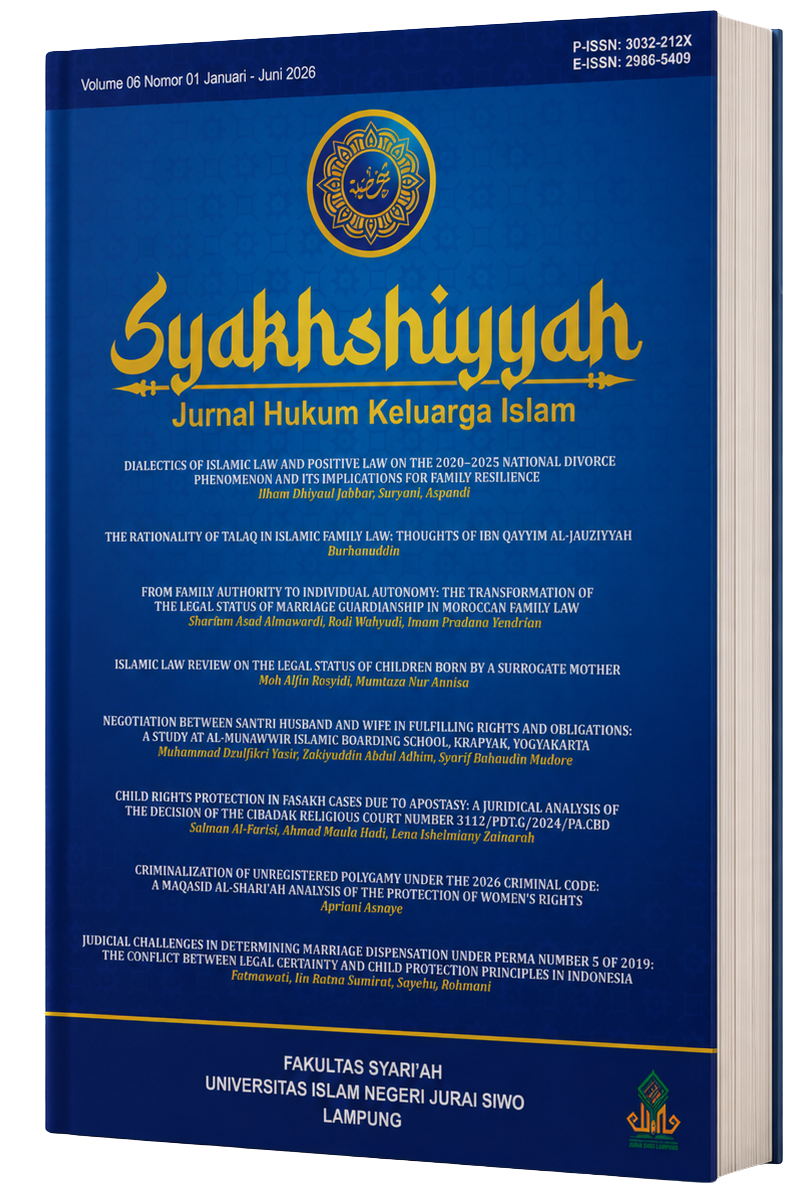
From Family Authority to Individual Autonomy: The Transformation of the Legal Status of Marriage Guardianship in Moroccan Family Law
DOI:
https://doi.org/10.32332/ms7mh997Keywords:
Marriage Guardianship, Moroccan Family Law, Al-Muwaṭṭa’Abstract
This article examines the transformation of marriage guardianship (wali nikah) in Moroccan family law from a family-based authority model toward individual legal autonomy. Focusing on the transformation of legal authority from classical Mālikī jurisprudence to the 2004 Mudawwanah al-Usrah, the study investigates how the position of the guardian shifted from a mandatory pillar of marriage validity into an optional legal institution within contemporary Moroccan family law. Positioned within the discourse of Islamic legal reform, this research argues that the transformation of guardianship in Morocco reflects not merely a legislative change, but a broader epistemological shift in the structure of legal authority in Islamic family law. Using a qualitative library-based method with historical-normative, normative-analytical, and limited maqāṣid al-sharī‘ah approaches, this study analyzes classical fiqh doctrines, hadith traditions, and statutory provisions related to marriage guardianship. The findings reveal that classical Mālikī law constructed guardianship as a representation of patriarchal family authority and social protection, whereas the Mudawwanah reconstructs legal legitimacy around women’s independent legal capacity. This transformation demonstrates a hybrid model of Islamic legal reform that preserves symbolic continuity with fiqh tradition while simultaneously integrating modern principles of gender equality and individual autonomy
References
Abbas, Rafid. “Ijtihad Umar Bin Khattab Tentang Hukum Perkawinan Perspektif Kompilasi Hukum Islam.” AL-HUKAMA: The Indonesian Journal of Islamic Family Law 04, no. 2 (2014). https://doi.org/10.15642/al-hukama.2014.4.2.474-499. DOI: https://doi.org/10.15642/al-hukama.2014.4.2.474-499
Abu Bakar, Abd.Hannan, Hazem Mofid. “Pendapat Empat Imam Madzhab Tentang Wali Nikah.” AS-Sakinah : Jurnal Hukum Keluarga Islam 1, no. 1 (2023): 1–8. https://doi.org/10.55210/jhki.v1i1.278. DOI: https://doi.org/10.55210/jhki.v1i1.278
Ade Risfal Hudal, Ahmad Rezy Meidina. “Kodifikasi Dan Reformasi Hukum Keluarga Di Maroko.” As-Syar’i: Jurnal Bimbingan & Konseling Keluarga 5, no. 3 (2023): 996–1009. https://doi.org/10.47476/assyari.v5i3.3799. DOI: https://doi.org/10.47467/as.v5i3.3799
Aidi Alfin, Asasriwarni, Zulfan. “Transformasi Hukum Keluarga Islam Dalam Sistem Peradilan Maroko.” El-Hayah: Jurnal Studi Islam 12, no. 2 (2022): 58. https://doi.org/10.22515/elha.v12i2.7743. DOI: https://doi.org/10.22515/elha.v12i2.7743
Anas, Mālik bin. Muwaththa’ Imam Malik - Riwayat Abu Mush‘ab Az-Zuhri. Edited by Bashshār ‘Awwād Ma‘rūf dan Maḥmūd Muḥammad Khalīl. Mu’assasah Al-Risālah. Jilid 1. Beirut: Mu’assasah al-Risālah, 1991.
Anas, Mālik ibn. Al-Muwaṭṭa’ Mālik Bin Anas – Riwayat Yaḥyā. Edited by Muḥammad Muṣṭafā Al-A‘ẓamī. Mu’assasah Zāyid Bin Sulṭān Āl Nahyān Li Al-A‘māl Al-Khairiyyah Wa Al-Insāniyyah. Jilid 3. Abu Dhabi: Mu’assasah Zāyid bin Sulṭān Āl Nahyān li al-A‘māl al-Khairiyyah wa al-Insāniyyah, 2004.
Apriyanita, Triana, Oyo Sunaryo, and Tatang Astarudin. “Argumen Keagamaan Dalam Perdebatan Reformasi Hukum Keluarga Di Maroko (Mudawwanah Tahun 1957-1958 Ke Mudawwanah Tahun 2004).” Socio Historica: Journal of Islamic History 3, no. 1 (2024): 17–30. https://doi.org/10.15408/sh.v3i1.38393. DOI: https://doi.org/10.15408/sh.v3i1.38393
Awaliyah, Nur Aini. “Pembaruan Hukum Keluarga Islam Di Maroko Tentang Wali Nikah.” INSTITUT AGAMA ISLAM NEGERI JEMBER. Digilib IAIN Jember, 2020.
Buskens, Léon. “Recent Debates On Family Law Reform In Morocco: Islamic Law As Politics In An Emerging Public Sphere.” Islamic Law and Society 10, no. 1 (2003): 70–131. https://doi.org/10.1163/15685190360560924. DOI: https://doi.org/10.1163/15685190360560924
Desi Rosalina, Musbih, Lilik Andaryuni. “Reformasi Dan Dinamika Hukum Keluarga Di Maroko: Analisis Mudawwanah Al-Usrah.” Jurnal Tana Mana 6, no. 2 (2025). https://doi.org/10.33648/jtm.v6i2.1318.
Ijtihadul Umam, Luq Yana Chaerunnisa. “Gender Equality in Family Law in Morocco.” Al-Mabsut : Jurnal Studi Islam Dan Sosial 17, no. 1 (2023): 15–29. https://doi.org/10.56997/almabsutjurnalstudiislamdansosial.v17i1.875. DOI: https://doi.org/10.56997/almabsutjurnalstudiislamdansosial.v17i1.875
Ilgi Ghoswanul Muzakka, Imanuddin Abil Fida. “Kedudukan Wali Dalam Pernikahan Studi Komparasi Empat Madzhab.” USRAH: Jurnal Hukum Keluarga Islam 4, no. 1 (2023): 38–51. https://doi.org/10.46773/usrah.v4i1. DOI: https://doi.org/10.46773/usrah.v4i1.663
Imam, Pandangan, Malik Ibn, and Kitab Al-muwatta. “Amal Ahlu Al-Madinah Sebagai Sumber Hukum Islam (Pandangan Imam Malik Ibn Anas Dalam Kitab Al-Muwatta`).” Al-Mazaahib: Jurnal Perbandingan Hukum 1, no. 2 (2012): 187–202. https://doi.org/10.14421/al-mazaahib.v1i2.1354. DOI: https://doi.org/10.14421/al-mazaahib.v1i2.1354
Irsyad Al Fikri Ys, Asep Fu’ad. “Peran Maslahah Mursalah Dalam Legislasi Islam Kontemporer: Analisis Mazhab Dan Implikasi Kebijakan.” Equality: Journal of Islamic Law (EJIL) 3, no. 2 (2025): 31–46. https://doi.org/10.15575/ejil.v3i2.1936. DOI: https://doi.org/10.15575/ejil.v3i2.1936
Jihad Arrosyad, Oom Mukarromah, Sayehu. “Urgensi Wali Dalam Pernikahan (Kritik Terhadap Undang-Undang Perwalian Maroko).” YUSTISI: Jurnal Hukum & Hukum Islam 10, no. 2 (2023): 112–18. https://doi.org/10.32832/yustisi.v10i2.14329. DOI: https://doi.org/10.32832/yustisi.v10i2.14329
Khasanah, Uswatul. “Pembaharuan Hukum Keluarga Di Era Modern.” Opinia De Jurnal 5, no. 1 (2025): 88–104. https://doi.org/10.35888/opiniadejournal.v5i1.138. DOI: https://doi.org/10.35888/opiniadejournal.v5i1.138
Lukito, Ratno. “Wali as an Agent of Women in Islamic Marriage Law: Maliki School as a Basis for Reinterpretation.” Musawa: Jurnal Studi Gender Dan Islam 5, no. 2 (2007). https://doi.org/10.14421/musawa.2007.52.191-209. DOI: https://doi.org/10.14421/musawa.2007.52.191-209
Maroko, Kementerian Kehakiman Kerajaan. Mudawwanah Al-Usrah. Matba‘ah Al-Najāḥ Al-Jadīdah. Casablanca: Matba‘ah al-Najāḥ al-Jadīdah, 2004.
Muannif Ridwan, Ahmad Syukri Saleh, Abdul Ghaffar. “Islamic Law in Morocco : Study on The Government System and The Development of Islamic Law.” ARRUS: Journal of Social Sciences and Humanities 1, no. 1 (2021): 13–22. https://doi.org/10.35877/soshum539. DOI: https://doi.org/10.35877/soshum539
Nasiri. “Marriage in Morocco: A Practices of The Mudawwanatul Usrah Law in The Land of Guardians.” International Journal of Islamic Thought and Humanities 1, no. 1 (2022): 27–39. https://doi.org/10.54298/ijith.v1i1.13. DOI: https://doi.org/10.54298/ijith.v1i1.13
Nurhidayah, Rifani, Dina Salma, Nor Farikhah, and Fenolia Intan Saputri. “Sistem Ketatanegaraan Maroko Sebagai Negara Islam.” Verfassung: Jurnal Hukum Tata Negara 3 (2024): 25–52. https://doi.org/10.30762/vjhtn.v3i1.425. DOI: https://doi.org/10.30762/vjhtn.v3i1.425
Qodariah Barkah, Muhammad Royhan, Ari Azhari. “Kedudukan Wali Nikah Dalam The Moroccan Family Code/Moudawana.” Journal of Sharia and Legal Science 2, no. 1 (2024): 1–14. https://doi.org/10.61994/jsls.v2i1.421. DOI: https://doi.org/10.61994/jsls.v2i1.421
Rahayu, Desvita Dwinanti, Dinna Salma Nabila, Iin Ilma, and Titis Dwi Wasono. “Perlindungan Hak Asasi Manusia Dalam Hukum Internasioal.” Jurnal Lentera Ilmu (JLI) 1, no. 2 (2024): 87–93. DOI: https://doi.org/10.59971/li.v1i2.56
Rahma Yana, and Tiswarni. “Pembaruan Hukum Keluarga Islam Di Maroko Tentang Wali Nikah.” Minhaj: Jurnal Ilmu Syariah 7, no. 1 (2004): 110–23. https://doi.org/10.52431/minhaj.v7i1.4097. DOI: https://doi.org/10.52431/minhaj.v7i1.4097
Rahmawati, Theadora, and Zakiyuddin Abdul Adhim. “Kontekstualisasi Hadis Hak Ijbar Dalam Perjodohan Di Indonesia.” Al-Manhaj: Journal of Indonesian Islamic Family Law 5, no. 2 (2023): 182–201. https://doi.org/10.19105/al-manhaj.v5i2.12106. DOI: https://doi.org/10.19105/al-manhaj.v5i2.12106
Ramadhan Syahrul , Sutisna, Mulyad. “Nikah Tanpa Wali Dalam Perspektif Ulama Mazhab Dan Kompilasi Hukum Islam.” MIZAN: Journal of Islamic Law 6, no. 3 (2022): 463–70. https://doi.org/10.32507/mizan.v6i3.1356. DOI: https://doi.org/10.32507/mizan.v6i3.1356
Rosidah, Penulis Ayu, Ummu Hanah, Yusuf Saumin, and Ahmad Nur Hanafi. “Berlakunya Ijbar Pada Perempuan (Perspektif Empat Mazhab).” Muqarin Review: Jurnal Hukum Islam 1, no. 1 (2023). https://doi.org/10.15408/mr.v1i1.31228.
Sofyan, Nur Baety. “Fiqih Al-Hadits Lil-Imam Malik Fi Kitabihi ‘Al-Muwatta’: Syarah Hadits ‘Fiman Adraka Rak’atan’ Namuzajan.” EL-SUNAN: JOURNAL OF HADITH AND RELIGIOUS STUDIES 2, no. April (2024): 25–45. https://doi.org/10.22373/el-sunan.v2i1.5358. DOI: https://doi.org/10.22373/el-sunan.v2i1.5358
Somadi, Saiq. “Analisis Yuridis Keterlibatan Wali Dalam Perkawinan Khitbah Modern : Antara Otentisitas Dan Perlindungan Hak Perempuan.” Nusantara Journal of Islamic Studies Vol. 06, no. 02 (2025). https://doi.org/10.64506/fwjr1746. DOI: https://doi.org/10.64506/fwjr1746
Syahrul Gunawan, Abdul Rahman R, Kurniati. “Eksistensi Wali Nikah Menurut Mazhab Hanafi Dan Al- Syafi’i ; Relevansinya Terhadap UU No . 1 Tahun 1974 Tentang Perkawinan.” SHAUTUNA: Jurnal Ilmiah Mahasiswa Perbandingan Mazhab 03, no. 3 (2022): 479–88. https://doi.org/10.24252/shautuna.vi.26907. DOI: https://doi.org/10.24252/shautuna.vi.26907
Tohari, Chamim. “Kedudukan Wali Sebagai Syarat Sahnya Perkawinan Dalam Hukum Islam: Perspektif Historis Dan Ushul Fiqh.” Al-Maslahah: Jurnal Ilmu Syari’ah 17, no. 1 (2021): 1–27. https://doi.org/10.24260/al-maslahah.v17i1.1894. DOI: https://doi.org/10.24260/al-maslahah.v17i1.1894
Trigiyatno, Ali, Siti Qomariyah, Eko Yuni, and Salafudin Yusuf- Amat Sulaiman. “Pergeseran Hukum Keluarga Di Maroko Dari Mudawwanah Tahun 1957-1958 Ke Mudawwanah Tahun 2004.” Al-Qānūn: Jurnal Pemikiran Dan Pembaharuan Hukum Islam 25, no. 2 (2022). https://doi.org/10.15642/alqanun.2022.25.2.233-247. DOI: https://doi.org/10.15642/alqanun.2022.25.2.233-247
Downloads
Published
Issue
Section
License
Copyright (c) 2026 Sharhan Asad Almawarid, Rodi Wahyudi, Imam Pratama Yendrian

This work is licensed under a Creative Commons Attribution-ShareAlike 4.0 International License.