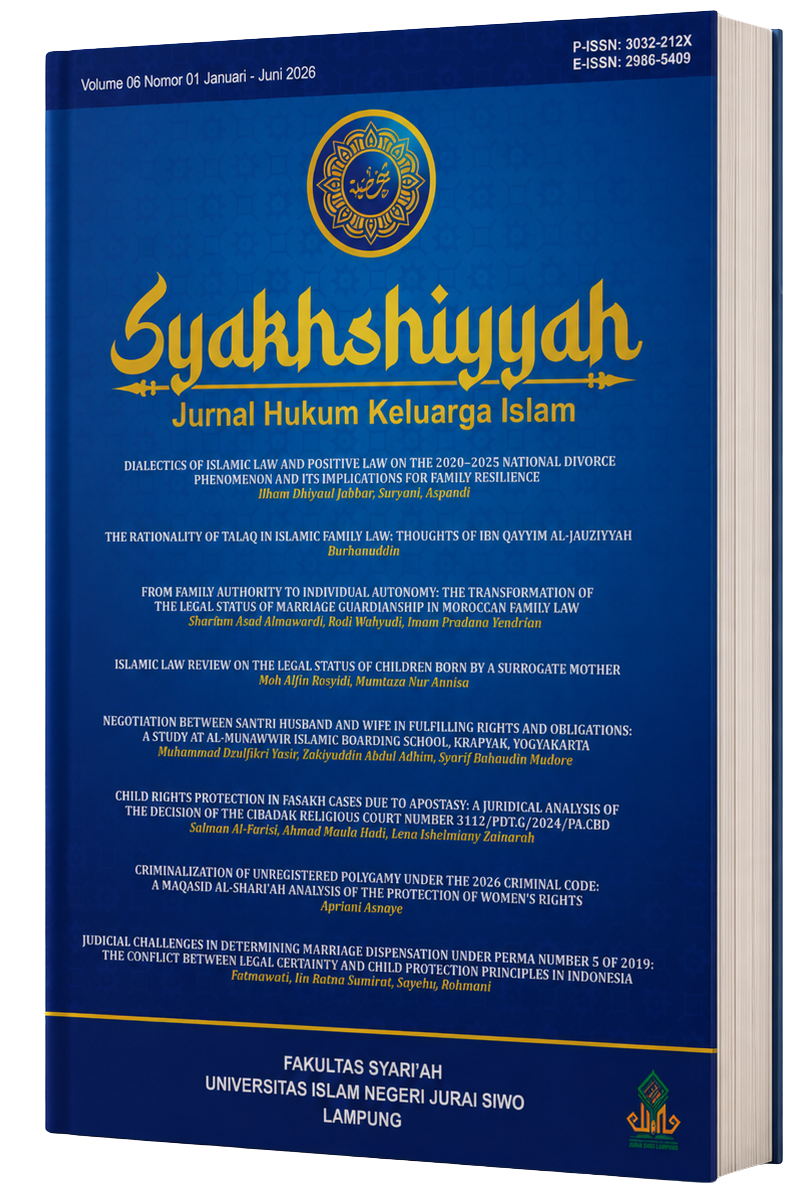
Child Rights Protection in Fasakh Cases Due to Apostasy: A Juridical Analysis of the Decision of the Cibadak Religious Court Number 3112/Pdt.G/2024/PA.Cbd
DOI:
https://doi.org/10.32332/sjfh9705Keywords:
Fasakh, apostasy, child protection, hadhanah, maqasid al-shariaAbstract
This study examines child protection in fasakh cases due to apostasy based on the Decision of the Cibadak Religious Court Number 3112/Pdt.G/2024/PA.Cbd, focusing on the tension between the application of the ultra petita principle and the best interests of the child principle in resolving such cases. This research employs a normative juridical method with a descriptive-analytical nature through literature review and judicial decision analysis, supported by interviews with judges. The findings reveal that the fasakh decision fulfilled both formal and substantive legal requirements, as evidenced by the proven element of apostasy as grounds for fasakh and the granting of the marriage validation (itsbat nikah) petition. However, the ruling did not explicitly regulate child custody (hadanah) or child support obligations because the judges were bound by the ultra petita principle. This condition reflects a normative-procedural gap regarding judges’ authority to provide child protection measures ex officio, potentially overlooking the best interests of the child due to the absence of legal certainty concerning post-fasakh custody, maintenance, and education. From the perspective of maqāṣid al-sharī‘ah, this situation relates to the protection of hifz al-nafs and hifz al-nasl as objectives of Islamic law in ensuring the welfare, continuity, and upbringing of children. The novelty of this study lies in its analysis of the relationship between the limitation of judicial authority under the ultra petita principle and the need for child protection in fasakh cases due to apostasy. The findings indicate the need for regulatory reinforcement granting judges ex officio authority to determine hadanah in fasakh cases in order to better safeguard the best interests of the child in judicial practice
References
Abū Dāwūd, Sulaimān bin al-Asy‘ats bin Isḥāq bin Basyīr bin Syaddād bin ‘Amr al-Azdī al-Sijistānī. Sunan Abī Dāwūd. Beirut: al-Maktabah al-‘Aṣriyyah, 2010.
Al-Māwardī, Abū al-Ḥasan ‘Alī bin Muḥammad bin Ḥabīb. Al-Ḥāwī Al-Kabīr Fī Fiqh Madhhab Al-Imām Al-Shāfi‘ī Wa Huwa Sharḥ Mukhtaṣar Al-Muzanī. Beirut: Dār al-Kutub al-‘Ilmiyyah, 1999.
Al-Syāṭibī, Abū Isḥāq Ibrāhīm bin Mūsā. Al-Muwāfaqāt Fī Uṣūl Al-Syarī‘Ah. Saudi Arabia: Dār Ibn ‘Affān, 1997.
Auda, Jasser. Maqasid Al-Shariah as Philosophy of Islamic Law: A Systems Approach. London: International Institute of Islamic Thought (IIIT), 2008. DOI: https://doi.org/10.2307/j.ctvkc67tg
Bukhari, Muhammad ibn Isma’il. Shahih Al-Bukhari. Edited by Muhammad Zuhayr Al-Nāṣir. 9 vols., Ṭ. Beirut: Dār Ṭawq al-Najāh, 2001.
Cahyani, Tinuk Dwi. Hukum Perkawinan. Malang: Universitas Muhammadiyah Malang, 2020.
Fakhria, Sheila. “Penerapan Asas Kepentingan Terbaik Anak: Telaah Ijtihad Hakim Pengadilan Agama Dalam Putusan Hak Asuh Anak.” JISRAH: Jurnal Integrasi Ilmu Syariah 3, no. 3 (2022): 363–72. https://doi.org/10.31958/jisrah.v3i3.7227. DOI: https://doi.org/10.31958/jisrah.v3i3.7227
Fawzi, Ramdan. “Hak Hadhanah Dalam Perceraian Karena Pindah Agama Perspektif Hukum Islam.” Tahkim (Jurnal Peradaban Dan Hukum Islam) 1, no. 2 (2018). DOI: https://doi.org/10.29313/tahkim.v1i2.4106
Gunawan, Edi, and Budi Rahmat Hakim. “Pelaksanaan Itsbat Nikah Pasca Berlakunya Uu No. 1 Tahun 1974 Tentang Perkawinan Di Pengadilan Agama.” Syariah: Jurnal Hukum Dan Pemikiran 18, no. 2 (2018): 258–83. https://doi.org/https://doi.org/10.18592/sy.v18i2.2319. DOI: https://doi.org/10.18592/sy.v18i2.2319
Harahap, M Yahya. Hukum Acara Perdata: Tentang Gugatan, Persidangan, Penyitaan, Pembuktian, Dan Putusan Pengadilan. Sinar Grafika, 2017.
Harahap, Nurhotia. “Perwalian Anak Dalam Tinjauan Kompilasi Hukum Islam.” Jurnal El-Qanuny 4, no. 1 (2018): 116–29. https://doi.org/10.24952/el-qonuniy.v4i1.1831. DOI: https://doi.org/10.24952/el-qonuniy.v4i1.1831
Hasanah, Uswatun, and Bagus Ramadi. “TINJAUAN KRIMINOLOGIS TERHADAP PRAKTEK PERCERAIAN DI LUAR PENGADILAN AGAMA DI KOTA MEDAN.” Familia: Jurnal Hukum Keluarga 6, no. 1 (2025): 85–107. DOI: https://doi.org/10.24239/familia.v6i1.290
Hasibuan, Zuhdi. “For the Sake of Protecting Physcal Needs: Maqasid Sharia Perspective Toward Judges Consideration on Child Custody.” Al-Hukama’: The Indonesian Journal of Islamic Family Law 13, no. 1 (2023): 76–92. https://doi.org/10.15642/alhukama.2023.13.1.76-92. DOI: https://doi.org/10.15642/alhukama.2023.13.1.76-92
Ibn Qudamah, Muwaffaq al-Din ‘Abd Allah ibn Ahmad. Al-Mughni. Jilid 9. Beirut: Dar al-Fikr, 1985.
Indonesia, Kementrian Agama Republik. Al-Qur’an Al-Karim Tajwid Warna. Solo: Medina Qur’an, 2019.
Instruksi Presiden Nomor 1 Tahun 1991 tentang Penyebarluasan Kompilasi Hukum Islam (1991).
Marzuki, Mahmud. Penelitian Hukum: Edisi Revisi. Prenada Media, 2017.
Maulidhiya, Nazwatika, Najla Amali, and Akhmad Zubair. “Analisis Unsur Kepastian Dalam Alat Bukti Sumpah Pada Perkara Di Peradilan Islam.” Interdisciplinary Explorations in Research Journal 2, no. 2 (2024): 704–11. https://doi.org/10.62976/ierj.v2i2.530. DOI: https://doi.org/10.62976/ierj.v2i2.530
Mera, Nasaruddin, Marzuki Marzuki, Sapruddin Sapruddin, and Andi Intan Cahyani. “Child Custody Rights for Mothers of Different Religions: Maqāṣid Al-Sharī’ah Perspective on Islamic Family Law in Indonesia.” Samarah: Jurnal Hukum Keluarga Dan Hukum Islam 8, no. 3 (2024): 1645–68. https://doi.org/10.22373/sjhk.v8i3.23809. DOI: https://doi.org/10.22373/sjhk.v8i3.23809
Mesele, Abreha, and Mekonnen Nigussie. “Comment: The Role of Courts in Safeguarding the Best Interest of the Child (Amharic).” Mizan Law Review 13, no. 1 (2019): 179–90. https://doi.org/10.4314/mlr.v13i1.8. DOI: https://doi.org/10.4314/mlr.v13i1.8
Muizzudin, Ahmad Haris, and M Willian Anwar. “Tinjauan Yuridis Relevansi Pasal 41 Huruf a Undang-Undang Nomor 1 Tahun 1974 Dan Pasal 105 Kompilasi Hukum Islam Tentang Hak Asuh Anak Pasca Perceraian.” Al-Akmal: Jurnal Studi Islam 2, no. 1 (2023): 50–62.
Mushayli, Abdul Fattah bin Muhammad. Jāmi‘ Al-Masā’Il Wa Al-Qawā‘id Fī ‘Ilm Al-Uṣūl Wa Al-Maqāṣid. Cairo: Dar al-Lu’lu’ah li al-Nashr wa al-Tawzi’, 2022.
Mustafa, Wahbah bin Al-Zuhaili. Al-Fiqh Al-Islami Wa Adillatuhu. Damascus: Dar al-Fikr, 2011.
Puspitasari, Niken Sylvia, Muhammad Giri Herlambang, Alwan Abidin, and Riyanmar Fayat Zabihullah. “Tinjauan Yuridis Normatif Perlindungan Anak Dalam Perspektif Konsep Hadhanah Dan Undang-Undang Nomor 35 Tahun 2014.” BUSTANUL FUQAHA: Jurnal Bidang Hukum Islam 5, no. 2 (2024): 309–21. https://doi.org/10.36701/bustanul.v5i2.1377. DOI: https://doi.org/10.36701/bustanul.v5i2.1377
Rusydi, Bustanul Arifien. “Problem Kehadiran Dan Upaya Hukum Tergugat Dalam Putusan Verstek Perkara Perceraian Pada Pengadilan Agama Bandung.” Muslim Heritage 5, no. 2 (2020): 393. https://doi.org/10.21154/muslimheritage.v5i2.2362. DOI: https://doi.org/10.21154/muslimheritage.v5i2.2362
Sirojudin, Muhammad Ramdan, Siska Lis Sulistiani, and Fahmi Fatwa Rosyadi Satria Hamdani. “Analisis Putusan Hakim Nomor 4260/Pdt. G/2020/Pa. Bdg Tentang Cerai Talak Terhadap Pemberlakuan Hak Ex Officio Hakim Menurut Sema Nomor 3 Tahun 2015 Poin 10.” Bandung Conference Series: Islamic Family Law 5, no. 1 (2025): 25–32. https://doi.org/doi.org/10.29313/bcsifl.v5i1.17802. DOI: https://doi.org/10.29313/bcsifl.v5i1.17802
Sukirman, Asrianti, Oyo Sunaryo Mukhlas, and Aden Rosadi. “Islamic Judicial Activism in Determining Child Maintenance: Ex Officio Authority and Peaceful Settlement in Indonesian Religious Courts.” Al-Istinbath: Jurnal Hukum Islam 10, no. 2 (2025): 671–99. https://doi.org/doi.org/10.29240/jhi.v10i2.12755. DOI: https://doi.org/10.29240/jhi.v10i2.12755
Surat Edaran Mahkamah Agung Nomor 1 Tahun 2025 tentang Pemberlakuan Rumusan Hasil Rapat Pleno Kamar Mahkamah Agung Tahun 2025 sebagai Pedoman Pelaksanaan Tugas bagi Pengadilan (n.d.).
Surat Edaran Mahkamah Agung Nomor 3 Tahun 2015 tentang Pemberlakuan Rumusan Hasil Rapat Pleno Kamar Mahkamah Agung Tahun 2015 sebagai Pedoman Pelaksanaan Tugas bagi Pengadilan. (n.d.).
Sutherland, Elaine E. “Prioritising the Child’s Best Interests: Mixed Messages in the International Human Rights Arena.” Child Protection and the European Court of Human Rights, 2025, 135–52. https://doi.org/doi.org/10.51952/9781447371496.ch008. DOI: https://doi.org/10.2307/jj.25941115.15
Syrif, Muhammad. “Dampak Perceraian Terhadap Psikologis, Emosional Dan Mental Anak Dalam Perspektif Hukum Islam.” SYARIAH: Journal of Islamic Law 4, no. 2 (2022): 21–33. https://doi.org/10.55721/3erp0b85. DOI: https://doi.org/10.22373/sy.v4i2.580
Undang-Undang Nomor 1 Tahun 1974 tentang Perkawinan (1974).
Undang-Undang Nomor 35 Tahun 2014 tentang Perubahan atas Undang-Undang Nomor 23 Tahun 2002 tentang Perlindungan Anak (2014).
Undang-Undang Nomor 7 Tahun 1989 Diubah dengan Undang-Undang Nomor 3 Tahun 2006 dan Undang-Undang Nomor 50 Tahun 2009. tentang Peradilan Agama (1989).
Widyastuti, Anggita, M Mustahal, and Najih Abqori. “Perlindungan Hak Anak Dalam Perceraian: Perspektif Kompilasi Hukum Islam Dan Implementasinya Di Pengadilan Agama Purworejo Nomor Perkara 122/Pdt. G./2022/PA. Pwr.” Kartika: Jurnal Studi Keislaman 6, no. 1 (2026): 1021–32. https://doi.org/10.59240/kjsk.v6i1.404.
Downloads
Published
Issue
Section
License
Copyright (c) 2026 Salman Al-Farisi, Ahmad Maula Hadi, Lena Ishelmiany Ziaharah

This work is licensed under a Creative Commons Attribution-ShareAlike 4.0 International License.