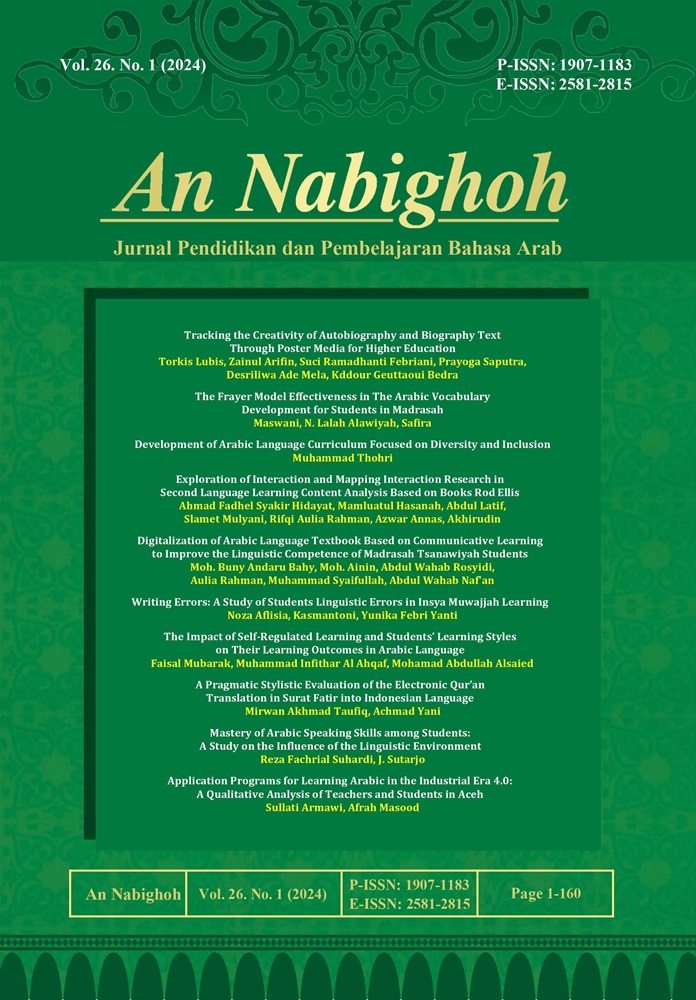
Mastery of Arabic Speaking Skills among Students: A Study on the Influence of the Linguistic Environment
DOI:
https://doi.org/10.32332/an-nabighoh.v26i1.133-142Keywords:
Language Environment, Speaking Skills, Second Language AcquisitionAbstract
This study aims to determine the relationship between the language environment and the Arabic speaking skills of the eighth-grade students at the Modern Islamic Boarding School Insan Mulia Batanghari for for the 2022/2023 academic year. This research design uses a quantitative approach with correlation research methods. The data collection instruments in this study are tests, questionnaires, and documentation. The data analysis technique used in this study is the Pearson correlation analysis technique with the moment product formula. This study found that the language environment plays a vital role in acquiring, training, and mastering Arabic speaking skills. That is based on research results that show a positive, significant, and strong correlation between the language environment and the Arabic speaking skills of the eighth-grade students at the Modern Islamic Boarding School Insan Mulia Batanghari for the 2022/2023 academic year.
Downloads
References
Aji, Irvan Maulana, Widi Astuti, and Cahya Edi Setyawan. “Penerapan Biah Lughawiyah Dalam Pembiasaan Maharah Kalam Di Pondok Pesantren Ibnul Qayyim Putra Yogyakarta.” Jurnal Ihtimam 3, no. 1 (2021). https://doi.org/10.36668/jih.v3i1.222. DOI: https://doi.org/10.36668/jih.v3i1.222
Alfaini, Sania. “Kurikulum Muatan Lokal Berbasis Pesantren Dengan Bī’ah Luġowiyyah ‘Arabiyyah.” Taqdir 8, no. 1 (2022): 111. https://doi.org/10.19109/taqdir.v8i1.11673. DOI: https://doi.org/10.19109/taqdir.v8i1.11673
Astuti, Rini, Akla Akla, and Albarra Sarbaini. “Strategi Pembentukan Lingkungan Berbahasa Arab Di Madrasah Aliyah.” An Nabighoh: Jurnal Pendidikan Dan Pembelajaran Bahasa Arab 22, no. 01 (2020): 17. https://doi.org/10.32332/an-nabighoh.v22i01.2075. DOI: https://doi.org/10.32332/an-nabighoh.v22i01.2075
Basith, Abdul, and Yusuf Setiawan. “Implementasi Biah Lughowiyyah Dalam Meningkatkan Maharah Kalam.” TADRIS AL-ARABIYAT: Jurnal Kajian Ilmu Pendidikan Bahasa Arab 2, no. 1 (2022): 140. https://doi.org/10.30739/arabiyat.v2i1.1428. DOI: https://doi.org/10.30739/arabiyat.v2i1.1428
Faridah, Siti Nurul, and Ahmad Fajar. “Peningkatan Hafalan Mufradat Bahasa Arab Dengan Metode Bernyanyi Pada Santri Di Pondok Pesantren Fajrul Islam Karang Hegar Subang.” Satwika : Jurnal Pengabdian Kepada Masyarakat 2, no. 1 (2022): 29–40. https://doi.org/10.21009/satwika.020105. DOI: https://doi.org/10.21009/satwika.020105
Fikri, Ahmad, Abdul Muid, Rosita Ilhami, Norhidayah Norhidayah, Aulia Mustika Ilmiani, and Muhammad Ikhlas. “Arabic Learning in Industrial Revolution 4.0: Problems, Opportunities, and Roles.” Izdihar : Journal of Arabic Language Teaching, Linguistics, and Literature 4, no. 2 (2021): 165. https://doi.org/10.22219/jiz.v4i2.17069. DOI: https://doi.org/10.22219/jiz.v4i2.17069
Henry, Alastair. “Learner–Environment Adaptations in Multiple Language Learning: Casing the Ideal Multilingual Self as a System Functioning in Context.” International Journal of Multilingualism 20, no. 2 (2023): 97. https://doi.org/10.1080/14790718.2020.1798969. DOI: https://doi.org/10.1080/14790718.2020.1798969
’Izza, Hilda Khoiril, Nanin Sumiarni, and Sopwan Mulyawan. “Efektivitas Pembiasaan Berbicara Bahasa Arab Dan Lingkungan Bahasa Arab Yang Kondusif Dalam Meningkatkan Keterampilan Berbicara.” EL-IBTIKAR: Jurnal Pendidikan Bahasa Arab 9, no. 2 (2021): 153. https://doi.org/10.24235/ibtikar.v9i2.7232. DOI: https://doi.org/10.24235/ibtikar.v9i2.7232
Masuram, Jyothi, and Pushpa Nagini Sripada. “Developing Speaking Skills Through Task-Based Materials.” Procedia Computer Science 172 (2020): 60–65. https://doi.org/10.1016/j.procs.2020.05.009. DOI: https://doi.org/10.1016/j.procs.2020.05.009
Mulya Rahmawati, Sri, Kamaluddin Abunawas, and Muhammad Yusuf. “Peran Bi’ah Lughawiyyah Dalam Menunjang Pembelajaran Bahasa Arab Di Pondok Pesantren Darul Huffadh Tuju-Tuju Kab.Bone.” Inspiratif Pendidikan 11, no. 1 (2022): 123. https://doi.org/10.24252/ip.v11i1.29670. DOI: https://doi.org/10.24252/ip.v11i1.29670
Nailil Amalia, Nabila, Himmatul Adzimah, Zakiyah Arifa, and Muhammad Ihsan Mahbub. “Management Implementation of the Bi’ah Lughowiyah Programmes and the Problems in Boarding Based on Madrasah Aliyah.” Izdihar : Journal of Arabic Language Teaching, Linguistics, and Literature 6, no. 2 (2023). https://doi.org/10.22219/jiz.v6i2.24052. DOI: https://doi.org/10.22219/jiz.v6i2.24052
Paradis, Johanne, Adriana Soto-Corominas, Xi Chen, and Alexandra Gottardo. “How Language Environment, Age, and Cognitive Capacity Support the Bilingual Development of Syrian Refugee Children Recently Arrived in Canada.” Applied Psycholinguistics 41, no. 6 (2020). https://doi.org/10.1017/S014271642000017X. DOI: https://doi.org/10.1017/S014271642000017X
Pikri, Faizal. “The Role of the Language Environment in Improving Arabic Learning Abilities.” International Journal of Science and Society 4, no. 2 (2022): 346. https://doi.org/10.54783/ijsoc.v4i2.478. DOI: https://doi.org/10.54783/ijsoc.v4i2.478
Qureshi, Mustapha, Dinnah Mahdiyyah, Yassine Mohamed, and Mounika Ardchir. “Scale For Measuring Arabic Speaking Skills In Early Children’s Education.” Journal International of Lingua and Technology 1, no. 2 (2022): 114. https://doi.org/10.55849/jiltech.v1i2.81. DOI: https://doi.org/10.55849/jiltech.v1i2.81
Rachmawati, Miatin. “Pembentukan Lingkungan Bahasa Arab Berbasis ‘Bi’ah Lughowiyyah’ Mahasiswa PBA (Pendidikan Bahasa Arab) UHAMKA Jakarta (Strategi Dan Implementasi).” Al-Fakkaar 2, no. 2 (2021): 62–81. https://doi.org/10.52166/alf.v2i2.2632. DOI: https://doi.org/10.52166/alf.v2i2.2632
Riadil, Ikrar Genidal. “A Study of Students’ Perception: Identifying EFL Learners’ Problems in Speaking Skill.” International Journal of Education, Language, and Religion 2, no. 1 (2020): 31. https://doi.org/10.35308/ijelr.v2i1.2256. DOI: https://doi.org/10.35308/ijelr.v2i1.2256
Rosyid, M Fairuz. “Pengembangan Bī’ah Lughawiyyah Oleh Himpunan Mahasiswa Jurusan Pendidikan Bahasa Arab Di IAIN Pekalongan.” Ta’lim al-’Arabiyyah: Jurnal Pendidikan Bahasa Arab & Kebahasaaraban 4, no. 1 (2020): 25–40. https://doi.org/10.15575/jpba.v4i1.8185. DOI: https://doi.org/10.15575/jpba.v4i1.8185
Solihati, Septia, Nuril Mufidah, and Abdul Malik Karim Amrullah. “Management of Environmental Programs for the Arabic Language at Arrayah Sukabumi University.” Medina-Te : Jurnal Studi Islam 18, no. 2 (2022): 107. https://doi.org/10.19109/medinate.v18i2.14833. DOI: https://doi.org/10.19109/medinate.v18i2.14833
Sutaman, Sutaman, and Suci Ramadhanti Febriani. “Optimizing Arabic Speaking Skills Based on Integration of Learning Theory Framework in Higher Education.” Arabiyat : Jurnal Pendidikan Bahasa Arab Dan Kebahasaaraban 8, no. 1 (2021): 75–89. https://doi.org/10.15408/a.v8i1.20423. DOI: https://doi.org/10.15408/a.v8i1.20423
Sutarjo, J., Novita Rahmi, Dian Ekawati, and Nawang Wulandari. “Akuisisi Bahasa Arab Santri Pondok Pesantren Madinah Karya Tani Lampung Timur.” An Nabighoh 23, no. 2 (2021): 209. https://doi.org/10.32332/an-nabighoh.v23i2.3667. DOI: https://doi.org/10.32332/an-nabighoh.v23i2.3667
Tulviste, Tiia, and Anni Tamm. “Is Silence Golden? A Pilot Study Exploring Associations between Children’s Language Environment and Their Language Skills in Estonian-Speaking Families.” Journal of Experimental Child Psychology 207 (2021). https://doi.org/10.1016/j.jecp.2021.105096. DOI: https://doi.org/10.1016/j.jecp.2021.105096
Zuhdy, Halimi. Al-Bi’ah Al-Lughawiyah Takwinuha Wa Dauruha Fi Iktisab Al-Arabiyah. Malang: UIN Maliki Press, 2009.
Downloads
Published
Issue
Section
License
Copyright (c) 2024 An Nabighoh

This work is licensed under a Creative Commons Attribution-ShareAlike 4.0 International License.