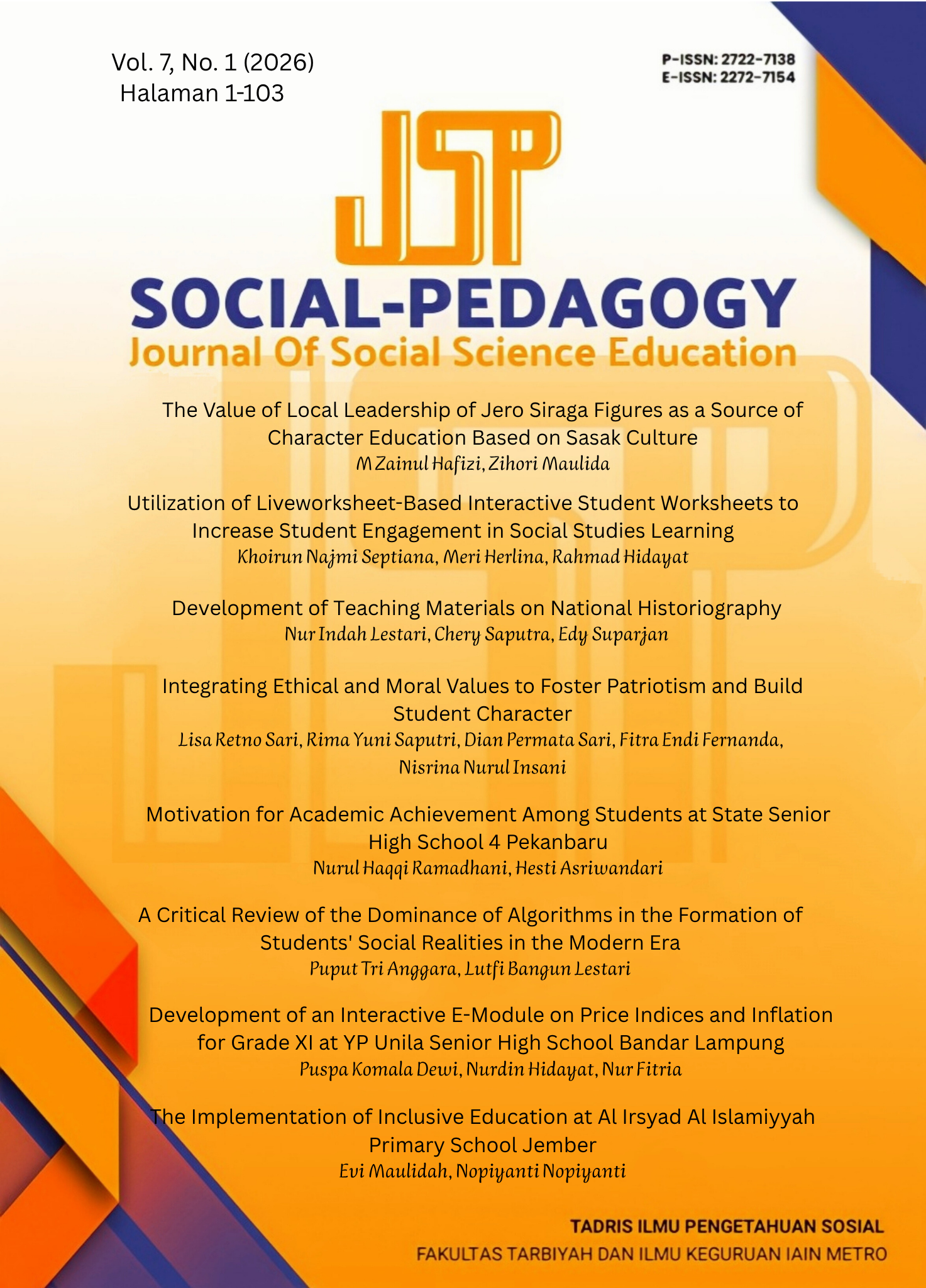
A Critical Review of the Dominance of Algorithms in the Formation of Students' Social Realities in the Modern Era
DOI:
https://doi.org/10.32332//social-pedagogy.v7i1.12104Keywords:
Algorithms, Digital Literacy, Education, Social RealityAbstract
The development of digital technology has transformed social experiences, interactions, and the distribution of knowledge, with algorithms acting as mechanisms of power that shape perceptions, behaviours, and social meanings. Algorithms are not merely technical tools, but rather mediators of experience that influence how humans understand the world, as emphasized by Heidegger as a mode of revealing and Don Ihde as a mediator of experience. Normatively, Amartya Sen emphasizes the importance of individual critical capabilities to assess and negotiate the influence of algorithms for the sake of freedom and justice. This study uses a synthesis of scientific literature to examine the dominance of algorithms and their implications for freedom, human values, and education. The results of the study indicate that the dominance of algorithms has the potential to limit individual freedom by narrowing information choices, eroding human values through dehumanization in digital interactions, and demanding educational transformation in the form of strengthening critical and reflective digital literacy. Therefore, education needs to foster intellectual autonomy, ethical awareness, and evaluative abilities so that individuals can actively participate in the digital ecosystem dominated by algorithms, rather than simply being passive consumers of information.
References
Ahyani, N. (2014). Kemampuan Berfikir Kritis Dalam Pembelajaran Sejarah. Seminar Nasional Teknologi Pendidikan, 94–106.
Akpinar, N.-J., & Fazelpour, S. (2025). Authenticity and exclusion : a simulation study of how social media algorithms shape visibility in epistemic communities. Springer, 1–28. https://doi.org/https://doi.org/10.1007/s11229-025-05293-z
Anyanwu, C. (2019). Digital Divide or Information Divide. Interrogating Telecommunication Penetration Measurements in Communal African Societies. In Mapping the Digital Divide in Africa: A Mediated Analysis, edited by Bruce Mutsvairo and Massimo Ragnedda (pp. 173–194). Amsterdam University Press. https://doi.org/https://doi.org/10.1515/9789048538225-011
Asiyat K., B., & V. Anufrienko., S. (2022). The Digital Phase of the Sociopolitical Development of Society: Basic Characteristics of Digital Media as Information and Communication Technologies of a New Generation. In Digital Education in Russia and Central Asia (pp. 69–77). https://doi.org/10.1007/978-981-16-9069-3_8
Aysolmaz, B., Müller, R., & Meacham, D. (2023). Telematics and Informatics The public perceptions of algorithmic decision-making systems : Results from a large-scale survey. Telematics and Informatics, 79(July 2022), 101954. https://doi.org/10.1016/j.tele.2023.101954
Barbas, Á., & Treré, E. (2024). Digital activism and social movements Educommunication, innovation and participation in civil society media. In The Routledge Handbook of Political Campaigning (1st Editio, p. 15). Routledge.
Berger, P. L., & Luckmann, T. (1966). The Social Construction of Reality: A Treatise in the Sociology of Knowledge. Anchor Books.
Bork-hüffer, T., & Ergler, C. R. (2025). Children’s and Young People’s Digital Geographies: Space, Agency, and Crises in Diverse Societies. Digital Geography and Society, April, 100122. https://doi.org/10.1016/j.diggeo.2025.100122
Chueca, C., & Cerro, D. (2024). The power of social networks and social media ’ s filter bubble in shaping polarisation : an agent ‑ based model. Applied Network Science. https://doi.org/10.1007/s41109-024-00679-3
Cristina, A., Garcia, B., Gomes, M., Garcia, P., & Rigobon, R. (2024). Algorithmic discrimination in the credit domain : what do we know about it ? In AI & SOCIETY (Vol. 39, Issue 4). Springer London. https://doi.org/10.1007/s00146-023-01676-3
Daus, Z. (2024). Socializing the political : rethinking filter bubbles and social media with Hannah Arendt.
Drabowicz, T. (2021). Digital skills inequality in the context of an aging society: the case of Poland. In In Handbook Sociology, Social Policy and Education (pp. 182–193). Elgar Onnline. https://doi.org/https://doi.org/10.4337/9781788116572.00019
Edwards, S., & Straker, L. (2025). Young Children in Digital Society (1st Editio). Routledge. https://doi.org/https://doi.org/10.4324/9781003460930
Flores-López, A., & Flores-Crespo, P. (2024). The Role of Inequality for Digital Learning in Pandemic Times: The Case of Mexico City’s Civil Society. In The Urban Book Series. Springer. https://doi.org/https://doi.org/10.1007/978-3-031-59746-6_8
García, C. S. (2024). Digital expansionism and big tech companies: consequences in democracies of the European Union. Humanities & Social Sciences Communication, 1(8). https://doi.org/10.1057/s41599-024-02924-7
Han, H., Wang, C., Zhao, Y., Shu, M., Wang, W., & Min, Y. (2022). SSLE : A framework for evaluating the “ Filter Bubble ” effect on the news aggregator and recommenders. World Wide Web, 1169–1195. https://doi.org/10.1007/s11280-022-01031-4
Hart, C. (1998). Doing a Literature Review: Releasing the Social Science Research Imagination. SAGE Publications.
Hastuti, H., Maulana, H. F., Lawelai, H., & Suherman, A. (2025). Algorithmic influence and media legitimacy : a systematic review of social media ’ s impact on news production. Frontiers in Communication, October, 1–22. https://doi.org/10.3389/fcomm.2025.1667471
Heidegger, M. (1977). T he Question Concerning Technology. Garland Publishing, Inc.
Ihde, D. (1990). Technology and the Lifeworld (First Publ). Indiana University Press.
Jiménez-Lara, A., Huete-García, A., & Díaz-Velázquez, E. (2021). Students with Disabilities in the Digital Society: Opportunities and Challenges for Inclusive Education. In Identity in a Hyperconnected Society. Springer. https://doi.org/https://doi.org/10.1007/978-3-030-85788-2_9
Jung, J., & Kim, J. N. (2025). Rethinking Media Users in the Age of AI and Algorithmic Mediation. 13, 1–8. https://doi.org/https://doi.org/10.17645/mac.10915
Kar, A. (2024). Mitigating the Digital Suffering: Bolstering the Digital Literacy of Older Adults and Contributing to a More Inclusive Society. https://doi.org/10.4018/979-8-3693-1854-6.ch005
Karipidis, N. (2023). Requirements for the Successful Implementation of Distance Education Programs in the Digital Era: Toward a More Inclusive and Resilient Society (p. 20). IGI Global Scientific Publishing. https://doi.org/10.4018/978-1-6684-5914-0.ch005
Karsiwan, K., Sari, L. R., Lisdiana, A., & Hamer, W. (2023). Penguatan Pendidikan Karakter Melalui Pembelajaran IPS Berbasis Kearifan Lokal di Lampung. Journal of Social Science Education, 4(1), 39–52. https://doi.org/10.32332/social-pedagogy.v4i1
Lamprou, S., & Dekoulou, P. E. (2025). The Critical Impact and Socio-Ethical Implications of AI on Content Generation Practices in Media Organizations. https://doi.org/https://doi.org/10.3390/soc15080214
Lim, F. (2019). Filsafat Teknologi: Don Ihde tentang Manusia dan Alat. Kanisius.
Liu, X., He, D., & Wu, D. (2020). Breaking Social Media Bubbles for Information Globalization : A Cross-Cultural and Cross- Language User-Centered Sense-Making Approach. Data and Information Management, 4(4), 297–305. https://doi.org/10.2478/dim-2020-0020
Micó-Sanz, J.-L., García-Orosa, B., & Campos-Domínguez, E. (2023). Digital Society’s Technological Network. In Information Visualization in The Era of Innovative Journalism (1st Editio, p. 14). Routledge. https://doi.org/10.4324/9780367809638-1
Miles, M. B., Huberman, A. M., & Saldaña, J. (2014). Qualitative Data Analysis: A Methods Sourcebook (3rd ed.). SAGE Publications.
Muthuraman, B. (2021). Education Tools and Technologies in the Digital Age for Society 5.0 (In book: D). https://doi.org/10.1201/9781003203070-2
Orso, D. (2020). Media Education Challenges in a Digital Society : The Case of Chile. In Media Education Challenges in a Digital Society (p. 2020). Wiley. https://doi.org/https://doi.org/10.1002/9781119166900.ch33
Özgür, H. O., & Özkul, M. (2020). A New Form of Violence in the Reality of Risk Society: Digital Violence. In In book: Digitalization and Future of Digital Society (p. pp.209-250). Peter Lang Publishing, Inc.
Project, D.-M. (2024). Digital Progress and Information Society: Evidence From EU Countries and Serbia. Evidence From EU Countries and Serbia.
Reinertsen, A. B. (2020). The fuzzy and the techie : The ontology of education and epistemic justice : Dataphilosophy and transcurricular praxis in the digital society and education. https://doi.org/10.1177/1478210320923107
Rice, R. E., Yates, S. J., & Blejmar, J. (2020). Introduction to the Oxford Handbook of Digital Technology and Society: Terms, Domains, and Themes (pp. 2–35). Oxford Acdemic. https://doi.org/https://doi.org/10.1093/oxfordhb/9780190932596.013.1
Saputra, B. R., & Karsiwan, K. (2024). Analisis Perilaku Sosial Siswa Berlandaskan Perspektif Teori Bandura. Sosial Horizon: Jurnal Pendidikan Sosial, 11(3), 403–415. https://doi.org/10.31571/sosial.v11i3.8145
Sari, M., & Karsiwan, K. (2025). Adok dalam Masyarakat Pepadun Berdasarkan Perspektif Teori Struktural Fungsional. Balale’: Jurnal Antropologi, 6(2), 142–157. https://doi.org/https://doi.org/10.26418/balale.v6i2.98354
Sen, A. (1999). Development as Freedom (1st editio). Alfred A. Knopf, Inc., New York.
Sen, A. (2009). The Idea of Justice amartya sen. Harvard University Press.
Serpa, S., & Jos, M. (2024). Education and Digital Societies for a Sustainable World. 1–7.
Smaldino, Sharon E, D. (2008). Instructional Technologi and Media For Learning (9th ed.). Kencana.
Smit, A., Rebergen, M., Swart, J., & Broersma, M. (2025). Including disadvantaged citizens in smart societies: How learning in formal and informal educational settings fosters digital literacy. In Smart Cities to Smart Societies (pp. 29–50). Taylor and Francis Ltd. https://doi.org/https://doi.org/10.4324/9781003439325_4
Vallvé, M. L.-T. (2022). ICTs, public participation and social inclusion in the European Union. In Digital Transformation and Social Well-Being (1st Editio, p. 24). Routledge. https://doi.org/10.4324/9781003312208-4
Wong Mark. (2022). Digital society, algorithmic harm, and the pandemic response. In 1st Edition (Ed.), Pandemic Response and the Cost of Lockdowns (p. 16). Routledge.
Woods, M., Guma, T., & Yarker, S. (2023). Digital threat or opportunity? Local civil society in an age of global inter-connectivity. In In book: Civil Society in an Age of Uncertainty (p. pp.111-13). https://doi.org/10.1332/policypress/9781447353416.003.0006
Zdjelar, R., & Hrustek, N. Ž. (2021). Digital Divide and E-Inclusion as Challenges of the Information Society – Research Review Robertina Zdjelar. JIOS, 45(2), 601–638. https://doi.org/10.31341/jios.45.2.14
Downloads
Published
Issue
Section
License
Copyright (c) 2026 Puput Tri Anggara, Lutfi Bangun Lestari

This work is licensed under a Creative Commons Attribution-ShareAlike 4.0 International License.