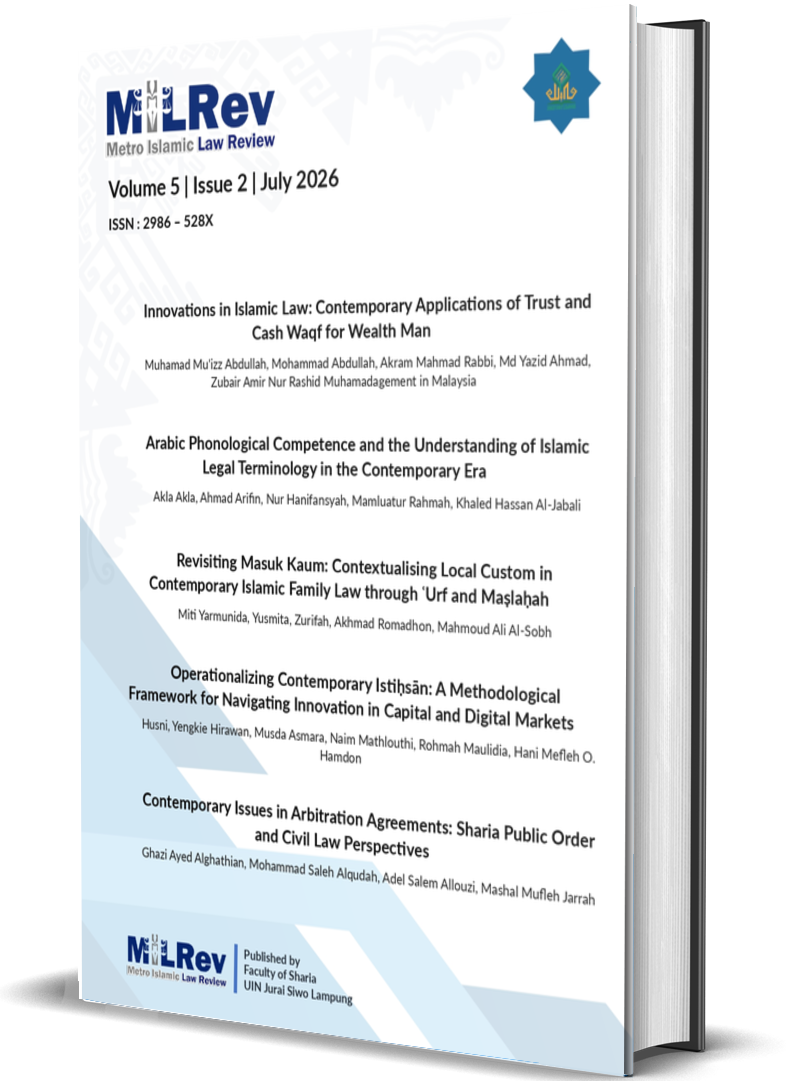
Innovations in Islamic Law: Contemporary Applications of Trust and Cash Waqf for Wealth Management in Malaysia
DOI:
https://doi.org/10.32332/milrev.v5i2.10434Keywords:
Cash Waqf; Socioeconomic; Social Welfare; Trust; Wealth Management.Abstract
Effective wealth management constitutes a fundamental component of Islamic socioeconomic development, particularly in addressing poverty alleviation and promoting sustainable social welfare. Within the contemporary Islamic financial framework, trust instruments and cash waqf have emerged as strategic mechanisms for mobilising and distributing wealth to support both individual financial security and collective social prosperity. This study aims to evaluate the effectiveness of trust instruments and cash waqf in strengthening the socioeconomic conditions of Muslim communities, reducing poverty, and enhancing welfare outcomes, particularly in the education and healthcare sectors. It further examines the contribution of these instruments from the perspective of maqāṣid al-sharī‘ah and public interest (maṣlaḥah). This research employs a qualitative approach, grounded in a systematic literature review and document analysis of scholarly publications, policy reports, legal documents, and institutional records related to trust and cash waqf practices in Malaysia. A comparative analytical framework is utilised to identify similarities, differences, and complementary functions between the two instruments. The collected data are analysed descriptively to assess their socioeconomic impact and institutional effectiveness. The findings reveal that both trust instruments and cash waqf play a significant role in improving the socioeconomic well-being of Muslim communities through structured asset management, sustainable wealth distribution, and support for public welfare programs. These instruments contribute to educational development, healthcare accessibility, and poverty reduction while promoting long-term financial resilience. Although differing in their legal origins, governance structures, and operational mechanisms, both instruments exhibit comparable strengths in flexibility, tax incentives, and socioeconomic impact. From a maqāṣid al-sharī‘ah perspective, they effectively support the preservation of wealth and the realisation of public welfare. This study contributes to the growing literature on Islamic social finance by offering a comparative understanding of trust and cash waqf as complementary wealth management instruments. The findings provide practical insights for policymakers, financial institutions, and waqf organisations seeking to strengthen Islamic wealth management frameworks in Malaysia and other Muslim-majority contexts.
References
Abdul Shukor, Syadiyah, Fuadah Johari, Kalsom Abd Wahab, et al. ‘Trust on Awqaf Institutions: Evidence from Malaysia’. Journal of Islamic Marketing 10, no. 2 (2019): 511–524. https://doi.org/10.1108/JIMA-05-2017-0054. DOI: https://doi.org/10.1108/JIMA-05-2017-0054
Abdullah, Mohammad. ‘Application of Discretion and Certainties in Waqf Vis-à-Vis Trust’. Trusts & Trustees 21, no. 5 (2015): 520–529. https://doi.org/10.1093/tandt/ttv011. DOI: https://doi.org/10.1093/tandt/ttv011
Abdullah, Mohammad. ‘Waqf and Trust: The Nature, Structures and Socioeconomic Impacts’. Journal of Islamic Accounting and Business Research 10, no. 4 (2019): 512–527. https://doi.org/10.1108/JIABR-10-2016-0124. DOI: https://doi.org/10.1108/JIABR-10-2016-0124
Abdullah, Mohammad. ‘Waqf, Social Responsibility, and Real Economy’. In Https://Services.Igi-Global.Com/Resolvedoi/Resolve.Aspx?Doi=10.4018/978-1-7998-1245-6.Ch002. IGI Global Scientific Publishing, 2019. https://doi.org/10.4018/978-1-7998-1245-6.ch002. DOI: https://doi.org/10.4018/978-1-7998-1245-6.ch002
Abdullah, Muhamad Mu izz, Abdul Bari Awang, and Mohamad Sabri Zakaria. ‘Analysis of Trust Instrument in Islamic Estate Planning: A Case Study at Amanah Raya Berhad, Malaysia’. Journal of Islamic Accounting and Business Research 14, no. 8 (2023): 1404–1425. https://doi.org/10.1108/JIABR-02-2022-0057. DOI: https://doi.org/10.1108/JIABR-02-2022-0057
Al-Daihani, Meshari, Khadar Ahmed Dirie, Md Mahmudul Alam, and Ahmad Sufian Abdullah. ‘Business Process Model for “Crowdfunding Cash Waqf Model”’. Journal of Islamic Accounting and Business Research 16, no. 1 (2025): 147–169. https://doi.org/10.1108/JIABR-02-2023-0046. DOI: https://doi.org/10.1108/JIABR-02-2023-0046
Al-Khateeb, Abdulqader, and Yusuff Jelili Amuda. ‘Application of Legal Principles of Islamic Objectives on the Regulation and Management of Islamic Endowment (Waqf): Drawing Lessons from Different Contexts’. Journal of Infrastructure Policy and Development 8, no. 14 (2024): 9638. https://doi.org/10.24294/jipd9638. DOI: https://doi.org/10.24294/jipd9638
Ascarya, Ascarya, Muhamad Nadratuzzaman Hosen, and Siti Rahmawati. ‘Designing Simple Productive Waqf Models for Indonesia’. International Journal of Ethics and Systems 38, no. 3 (2022): 380–401. https://doi.org/10.1108/IJOES-07-2020-0101. DOI: https://doi.org/10.1108/IJOES-07-2020-0101
Ascarya, Ascarya, and Atika Rukminastiti Masrifah. ‘Strategies Implementing Cash Waqf System for Baitul Maal Wat Tamwil to Improve Its Commercial and Social Activities’. International Journal of Islamic and Middle Eastern Finance and Management 16, no. 1 (2023): 130–153. https://doi.org/10.1108/IMEFM-10-2020-0504. DOI: https://doi.org/10.1108/IMEFM-10-2020-0504
Asni, Fathullah, Afiffudin Mohammed Noor, and Muhamad Husni Hasbulah. ‘Management of Cash Waqf Fund Generation through the Implementation of Istibdal in Kedah’. Qualitative Research in Financial Markets 16, no. 1 (2024): 60–86. https://doi.org/10.1108/QRFM-03-2022-0048. DOI: https://doi.org/10.1108/QRFM-03-2022-0048
Azrak, Tawfik. ‘The Roles of Cash Waqf in Improving the Economic Welfare: Case Study of Turkey’. The Journal of Management Theory and Practice (JMTP) 3, no. 1 (2022): 42–47. https://doi.org/10.37231/jmtp.2022.3.1.200. DOI: https://doi.org/10.37231/jmtp.2022.3.1.200
Bill & Melinda Gates Foundation. ‘Annual Report 2022’. Bill & Melinda Gates Foundation, 2022.
Che, Siti Nur Asmad Hassan, and Asmak Ab Rahman. ‘The Potential of Cash Waqf in the Socioeconomic Development of Society in Kelantan: A Stakeholder’s Perspective’. New Developments in Islamic Economics: Examples from Southeast Asia, 2018, 67–82. https://doi.org/10.1108/978-1-78756-283-720181005. DOI: https://doi.org/10.1108/978-1-78756-283-720181005
Cizakca, Murat. ‘Ottoman Cash Waqfs Revisited : The Case of Bursa 1555- 1823’. Foundation for Science Technology, and Civilisation, January 1 2004, 1–20.
Coulson, Noel J. (Noel James). A History of Islamic Law. In Edinburgh : University Press. Edinburgh University Press, 1964.
Dallh, Minlib. ‘Accumulate but Distribute: Islamic Emphasis on the Establishment of Waqf (Pious Endowment)’. Religion and Development 2, no. 1 (2023): 21–40. https://doi.org/10.30965/27507955-20230014. DOI: https://doi.org/10.30965/27507955-20230014
Daud, Norizah Mohamed @. Haji, and Noorfazreen Mohd Aris. ‘Pelaksanaan Wakaf Kesihatan Oleh Majlis Agama Islam Negeri (MAIN)’. Jurnal Pengajian Islam 14, no. 2 (2021): 109–120.
Department of Statistics. Department of Statistics Malaysia. Department of Statistics Malaysia Official Portal, 2024, 1.
Fakhrudin and Ahmad Sidi Pratomo. ‘Bank Wakaf Mikro Dan Pemberdayaan Usaha Mikro Kecil Dan Menengah Di Indonesia Perspektif Maqashid Syariah’. De Jure: Jurnal Hukum Dan Syar’iah 13, no. 2 (2021): 323–336. https://doi.org/10.18860/j-fsh.v13i2.15485. DOI: https://doi.org/10.18860/j-fsh.v13i2.15485
Gaudiosi, Monica M. ‘The Influence of the Islamic Law of Waqf on the Development of the Trust in England: The Case of Merton College’. University of Pennsylvania Law Review 136, no. 4 (1988): 1231. https://doi.org/10.2307/3312162. DOI: https://doi.org/10.2307/3312162
Ghazali, Nasrun Mohamad, and Norazlina Mamat. ‘Discrepancy of Cash Waqf Meaning: A Critical Review with Special Focus on Selected Shariah Resolutions’. International Journal of Academic Research in Business and Social Sciences 13, no. 7 (2023): 19–37. https://doi.org/10.6007/ijarbss/v13-i7/17670. DOI: https://doi.org/10.6007/IJARBSS/v13-i7/17670
Gvelesiani, Irina. ‘The Trust and the Waqf (Comparative Analysis)’. Trusts & Trustees 26, nos 8–9 (2021): 737–745. https://doi.org/10.1093/tandt/ttaa075. DOI: https://doi.org/10.1093/tandt/ttaa075
Halim, Akmal Hidayah. ‘The Legality Of A Living Trust As An Instrument For Islamic Wealth Management: A Malaysian Perspective’. IIUM Law Journal 19, no. 1 (2012): https://doi.org/10.31436/iiumlj.v19i1.2. DOI: https://doi.org/10.31436/iiumlj.v19i1.2
Harisah, Harisah, Mitra Sami Gultom, Muhammad Nadratuzzaman Hosen, Ah. Kusairi, and Azlin Alisa Ahmad. ‘Response Of Madura’s Nahdlatul Ulama Scholars To The Indonesian Ulama Council’s Fatwa On Cash Wakaf’. Ekonomi Islam 15, no. 2 (2024): 249–267. https://doi.org/10.22236/jei.v15i2.14564. DOI: https://doi.org/10.22236/jei.v15i2.14564
Harrington, Brooke. ‘Trust and Estate Planning: The Emergence of a Profession and Its Contribution to Socioeconomic Inequality’. Sociological Forum 27, no. 4 (2012): 825–846. https://doi.org/10.1111/j.1573-7861.2012.01358.x. DOI: https://doi.org/10.1111/j.1573-7861.2012.01358.x
Hermawan, Wawan. ‘Pandangan Ulama Garut Tentang Wakaf Uang Dan Wakaf Mu‘aqqat’. Ijtihad : Jurnal Wacana Hukum Islam Dan Kemanusiaan 13, no. 1 (2013): 49. https://doi.org/10.18326/ijtihad.v13i1.49-64. DOI: https://doi.org/10.18326/ijtihad.v13i1.49-64
Huda, Miftahul, Lia Noviana, and Lukman Santoso. ‘Pengembangan Tata Kelola Wakaf Berbasis Korporasi Di Asia Tenggara’. De Jure: Jurnal Hukum Dan Syar’iah 12, no. 2 (2020): 120–139. https://doi.org/10.18860/j-fsh.v12i2.3908. DOI: https://doi.org/10.18860/j-fsh.v12i2.3908
Hyndman, Noel, and Danielle McConville. ‘Trust and Accountability in UK Charities: Exploring the Virtuous Circle’. British Accounting Review 50, no. 2 (2018): 227–237. https://doi.org/10.1016/j.bar.2017.09.004. DOI: https://doi.org/10.1016/j.bar.2017.09.004
Jabatan Ketua Menteri Melaka. ‘Tabung Amanah Pendidikan Negeri Melaka’. Jabatan Ketua Menteri Melaka, 2024. https://tapem.melaka.gov.my/.
James Penner. The Law of Trusts. In Oxford University Press, 10th Edition. Oxford University Press, 2016.
Kamarubahrin, Aimi Fadzirul, Abdullah Mohammed, Ahmed Ayedh, and Khairil Faizal Khairi. ‘Accountability Practices of Waqf Institution in Selected States in Malaysia: A Critical Analysis’. International Journal of Economics, Management and Accounting 27, no. 2 (2019): 331–352. https://doi.org/10.31436/IJEMA.V27I2.664.
Kencana, U. (Ulya), and A. (Abdul) Hadi. ‘Wakaf Uang Dalam Perspektif Hukum Dan Politik’. Nurani: Jurnal Kajian Syari`ah Dan Masyarakat 16, no. 2 (2016): 141–170. https://doi.org/10.19109/NURANI.V16I2.938.
Khan, Abidullah, Muhammad Hakimi Muhammad, Muhammad Shaique, and Shabeer Khan. ‘Demographic Determinants of Charity Donors and Their Implications for Cash Waqf Institutions in Malaysia’. Journal of Islamic Marketing 13, no. 2 (2022): 508–525. https://doi.org/10.1108/JIMA-10-2019-0211. DOI: https://doi.org/10.1108/JIMA-10-2019-0211
Kuswanto, Didik Heri, Yayuk Ngesti Rahayu, and Taufiq Noor Rohman. ‘The Influence Of Knowledge, Religiosity On Cash Waqf Interest In Trust Mediation’. Jesya 7, no. 2 (2024): 1789–1799. https://doi.org/10.36778/jesya.v7i2.1710. DOI: https://doi.org/10.36778/jesya.v7i2.1710
Mahmudi, and Danang Wahyu Muhammad. ‘Collaborative Governance In The Jogja Berwakaf Movement (Law, Model, and Transformation of Socioeconomic Empowerment)’. Justicia Islamica 19, no. 1 (2022): 171–192. https://doi.org/10.21154/justicia.v19i1.3759. DOI: https://doi.org/10.21154/justicia.v19i1.3759
Malaysia, Amanah Ikhtiar. ‘Amanah Ikhtiar Malaysia’. Preprint, 2024.
Marwah, Hisham, and Anja K. Bolz. ‘Waqfs and Trusts: A Comparative Study’. Trusts & Trustees 15, no. 10 (2009): 811–816. https://doi.org/10.1093/tandt/ttp107. DOI: https://doi.org/10.1093/tandt/ttp107
Masdar, Masdar. ‘Penerapan Hukum Wakaf Uang Di Indonesia Perspektif Legal System Theory’. Al-Manahij: Jurnal Kajian Hukum Islam 11, no. 1 (2018): 79–92. https://doi.org/10.24090/mnh.v11i1.1269. DOI: https://doi.org/10.24090/mnh.v11i1.1269
Mohd Thas Thaker, Mohamed Asmy Bin, Mustafa Omar Mohammed, Jarita Duasa, and Moha Asri Abdullah. ‘Developing Cash Waqf Model as an Alternative Source of Financing for Micro Enterprises in Malaysia’. Journal of Islamic Accounting and Business Research 7, no. 4 (2016): 254–267. https://doi.org/10.1108/JIABR-09-2014-0029. DOI: https://doi.org/10.1108/JIABR-09-2014-0029
Mohd Yusof, Yusnita, and Akmal Hidayah Halim. ‘The Creation Of Islamic Trust Under The Civil Requirements In Malaysia’. Al-Qanatir: International Journal of Islamic Studies 33, no. 1 (2024): 79–88.
Muhamad Asni, Fathullah Al Haq, and Jasni Sulong. ‘Wakaf Tunai Dan Aplikasinya Dalam Undang-Undang Di Negara Asean’. Jurnal Syariah 25, no. 2 (2017): 217–246. https://doi.org/10.22452/js.vol25no2.3. DOI: https://doi.org/10.22452/js.vol25no2.3
Mu’in, Fathul, Faisal, Relit Nur Edy, Gandhi Liyorba Indra, and Rudi Santoso. ‘Strengthening the National Waqf Ecosystem through Legal Reform: An Analysis of Waqf Issues in the Provinces of Lampung and South Sumatra’. Al-Istinbath: Jurnal Hukum Islam 9, no. 1 (2024): 81–100. https://doi.org/10.29240/jhi.v9i1.9320. DOI: https://doi.org/10.29240/jhi.v9i1.9320
Musthafa, Luqman Bin Hj Abdullah, and Nurhidayah Binti Pauzi. ‘The Reasons For the Permission of Replacement of Wakaf Assets (Istibdal Waqf) in Indonesian Regulations: An Interpretative Study’. Al-’Adalah 19, no. 2 (2022): 373–400. https://doi.org/10.24042/adalah.v19i2.14423. DOI: https://doi.org/10.24042/adalah.v19i2.14423
Nasir, Amalin A. Ishah Mohd, Suhaibah Azri, and Uznir Ujang. ‘Asset Management in Malaysia: Current Status’. IOP Conference Series: Earth and Environmental Science 1064, no. 1 (2022): 1–15. https://doi.org/10.1088/1755-1315/1064/1/012035. DOI: https://doi.org/10.1088/1755-1315/1064/1/012035
Noordin, Nazrul Hazizi, Muhammad Issyam Ismail, Muhammad Abd Hadi Abd Rahman, Siti Nurah Haron, and Adam Abdullah. ‘Re-Evaluating the Practice of Hibah Trust in Malaysia’. Humanomics 32, no. 4 (2016): 418–436. https://doi.org/10.1108/H-05-2016-0044. DOI: https://doi.org/10.1108/H-05-2016-0044
‘Our Strategy to 2035 | National Trust’. Accessed February 7 2026. https://www.nationaltrust.org.uk/who-we-are/our-strategy.
Pennell, Jeffrey N., and Alan. Newman. Estate and Trust Planning. American Bar Association, 2005.
Platt, Harvey J. Your Living Trust and Estate Plan: How to Maximise Your Family’s Assets and Protect Your Loved Ones. Alloworth Press, 2013.
Raisuni, Ahmad. ‘Madkhal Ila {Maqashid} Asy-{Syari}’ah’. Kairo: Dar al-Kalimah, 2013, 1–85.
Rasiam, Umiyati, Habibullah, Dimas Kenn Syahrir, and Muhammad Said. ‘Integration of New Media and Prophetic Communication Enhanced for Zakah, Infāq, Ṣadaqah, and Waqf Fundraising: A Case Study of Baitulmaal Munzalan Indonesia’. Journal of Islamic Law 4, no. 1 (2023): 28–46. https://doi.org/10.24260/jil.v4i1.1167. DOI: https://doi.org/10.24260/jil.v4i1.1167
Rahman, Tunis Abu Bakr, Widad Mahdi Jasim, and Nooruldeen Mustafa Al-Gburi. ‘Legal and Sharia Analysis of Commercial Paper Discounting and Islamic Banking Finance Alternatives’. Nusantara: Journal of Law Studies 5, no. 1 (February 2026): 84–101. https://doi.org/10.5281/zenodo.18676735.
Sakinah Abdul Samad. ‘Application of Al-Wilayah in Waqf Ahli: Case Study in Selected State Islamic Religious Councils (SIRCS) in Malaysia’. Akademi Pengajian Islam Universiti Malaya, n.d.
Santoso, Dri, and M. Amin Musthofa. ‘The Role of Wakaf In Establishing People’s Welfare’. MILRev: Metro Islamic Law Review 1, no. 2 (2022): 269–281. https://doi.org/10.32332/milrev.v1i2.6214. DOI: https://doi.org/10.32332/milrev.v1i2.6214
Sanusi, Soliha, and Muhammad Hakimi Mohd Shafiai. ‘The Management of Cash Waqf: Toward Socioeconomic Development of Muslims in Malaysia’. Jurnal Pengurusan 43 (2015): 3–12. https://doi.org/10.17576/2015-43-01. DOI: https://doi.org/10.17576/pengurusan-2015-43-01
Shahimi, Shahida, Mohd Umar Mohd Marzuki, and Zaini Embong. ‘Potential of Cash Waqf for Poverty Alleviation in Malaysia: A System Dynamics Approach’. In Jurnal Ekonomi Malaysia, vol. 47, no. 2. Preprint, 2013.
Shahimi, Shahida, Mohd Umar Mohd Marzuki, and Zaini Embong. ‘Potential of Cash Waqf for Poverty Alleviation in Malaysia: A System Dynamics Approach’. Jurnal Ekonomi Malaysia 47, no. 2 (2013): 149–63.
Siddiq, Achmad, Hariyanto, Ismatul Maula, Ahmad Rezy Meidina, and Siti Arafah. ‘Reconstructing Waqf Share Policies: A Maqashid Sharia Approach with Insights from Indonesia’. El-Mashlahah 15, no. 1 (2025): 79–100. https://doi.org/10.23971/el-mashlahah.v15i1.9029. DOI: https://doi.org/10.23971/el-mashlahah.v15i1.9029
Singer, Amy. Charity in Islamic Societies. In Cambridge University Press. Cambridge University Press, 2008.
Sitkoff, Robert H., and Jesse. Dukeminier. Wills, Trusts, and Estates. 10th Editi. Wolters Kluwer, 2017.
SkillsFuture Singapore. ‘Building Strategic Skills for the New Economy: Annual Report 2020/2021’. Preprint, 2021.
‘Study: For Every Dollar Contributed to Community Foundation DAFs in 2019, Donors Granted $1.08 in 2020 — Community Foundation Awareness Initiative’. Accessed February 7 2026. https://www.commfoundations.com/blog/2021/3/2/grants-from-community-foundation-donor-advised-funds-soar-as-covid-19-inspires-wave-of-giving.
Suhairi, Afriyan Arya Saputra, Agus Alimuddin, and Mutsalim Khareng. ‘Regulatory and Economic Challenges in Contemporary Crowdfunding-Based Cash Waqf’. MILRev: Metro Islamic Law Review 4, no. 2 (2025): 822–867. https://doi.org/10.32332/milrev.v4i2.10343. DOI: https://doi.org/10.32332/milrev.v4i2.10343
Thomas, Geraint W., and Alastair. Hudson. The Law of Trusts. 2010, 1681.
Tuyll, Frederik van. ‘The Emergence of the Islamic Trust’. Trusts & Trustees 12, no. 9 (2006): 7–9. https://doi.org/10.1093/tandt/ttl009. DOI: https://doi.org/10.1093/tandt/ttl009
‘Wakaf Selangor Muamalat | Wakaf Muamalat’. Accessed February 7 2026. https://www.muamalat.com.my/wakafmuamalat/wakaf-selangor-muamalat/#laporan.
Wu, Tang Hang. ‘From WAQF, Ancestor Worship to the Rise of the Global Trust: A History of the Use of the Trust as a Vehicle for Wealth Transfer in Singapore’. Iowa Law Review 103, no. 5 (2018): 2263–2292.
Yayasan Waqaf Malaysia. ‘Portal Rasmi Yayasan Waqaf Malaysia’. 2024. https://ywm.gov.my/skim-wakaf-tunai#wakaftunai.
Yumna, Aimatul, Atika Rukminastiti Masrifah, Dadang Muljawan, Feri Noor, and Joan Marta. ‘The Impacts of Cash Waqf Linked Sukuk Empowerment Programs: Empirical Evidence From Indonesia’. Journal of Islamic Monetary Economics and Finance 10, no. 1 (2024): 5–34. https://doi.org/10.21098/jimf.v10i1.1940. DOI: https://doi.org/10.21098/jimf.v10i1.1940
Downloads
Published
Issue
Section
License
Copyright (c) 2026 Muhamad Mu'izz Abdullah, Mohammad Abdullah, Akram Mahmad Rabbi, Md Yazid Ahmad, Zubair Amir Nur Rashid Muhamad

This work is licensed under a Creative Commons Attribution-ShareAlike 4.0 International License.