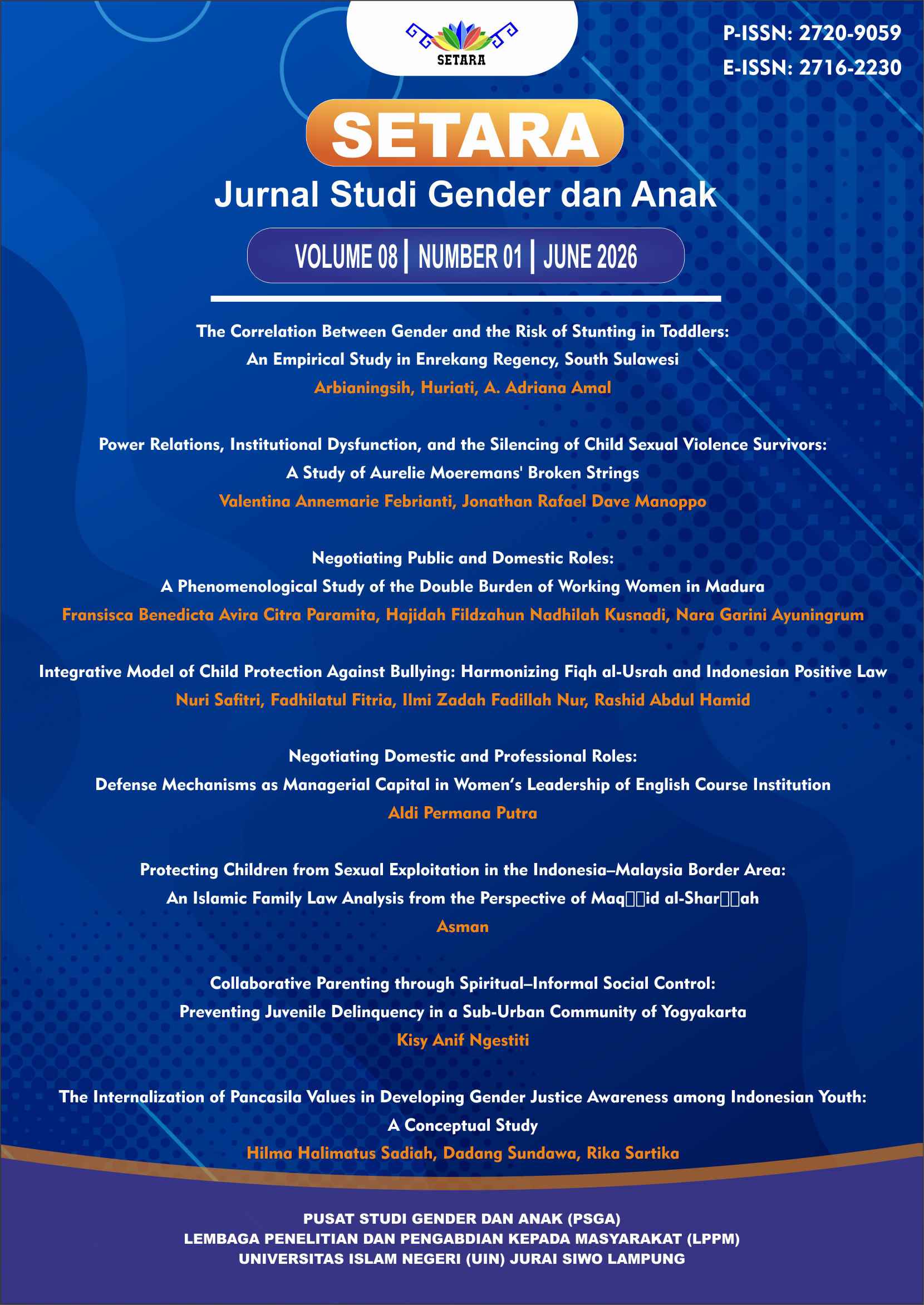
Negotiating Public and Domestic Roles: A Phenomenological Study of the Double Burden of Working Women in Madura
DOI:
https://doi.org/10.32332/10.32332/jsga.v8i01.10809Keywords:
Working Women, Double Burden, Patriarchal Habitus, Phenomenology, MaduraAbstract
This article examines the lived experiences of working women in Paberasan, Madura, focusing on the gender-based double burden and reproduction of patriarchal habitus in everyday life. It explores how women negotiate paid employment, domestic responsibilities, family expectations, and local cultural norms that continue to position them as primary caregivers. This study employed a qualitative phenomenological approach. Data were collected through in-depth interviews, observations, and documentation. The findings reveal that women’s participation in paid work does not reduce their domestic responsibilities, but instead expands their workload across productive and reproductive spheres. Female farmworkers engage in income-generating activities primarily due to economic necessity while continuing to shoulder childcare and household duties. In contrast, women in professional occupations enjoy greater flexibility in balancing public and domestic roles but remain constrained by cultural expectations that assign them primary responsibility for family care. These findings demonstrate that increased female labor force participation has not automatically transformed patriarchal relations in rural communities.
[Artikel ini mengkaji pengalaman hidup perempuan pekerja di Paberasan, Madura, dengan fokus pada beban ganda berbasis gender dan reproduksi habitus patriarki dalam kehidupan sehari-hari. Penelitian ini menganalisis bagaimana perempuan menegosiasikan pekerjaan produktif, tanggung jawab domestik, harapan keluarga, dan norma budaya lokal yang masih menempatkan perempuan sebagai penanggung jawab utama urusan rumah tangga. Penelitian menggunakan pendekatan kualitatif dengan metode fenomenologi. Data dikumpulkan melalui wawancara mendalam, observasi, dan dokumentasi. Hasil penelitian menunjukkan bahwa keterlibatan perempuan dalam pekerjaan publik tidak mengurangi tanggung jawab domestik, tetapi justru memperluas beban kerja mereka pada ranah produktif dan reproduktif. Buruh tani perempuan bekerja terutama karena tuntutan ekonomi, namun tetap memikul tanggung jawab pengasuhan anak dan pekerjaan rumah tangga. Sementara itu, perempuan dengan profesi yang lebih mapan memiliki ruang yang lebih besar dalam mengelola peran publik dan domestik, meskipun tetap menghadapi ekspektasi budaya sebagai penanggung jawab utama keluarga. Temuan ini memperlihatkan bahwa peningkatan partisipasi kerja perempuan belum secara otomatis mengubah relasi patriarki dalam masyarakat pedesaan].
References
Adib, Mohammad. “Agents and Structures in Pierre Bourdieu’s Perspective.” 1(2). 91–110.
Azizi, Achmad., Hikmah., & Pranowo, Sapto. (2017). The Role of Gender in Decision-Making Among Fishing Households in North Semarang City, Central Java Province. J. Sosek KP. 7(1), 113–125.
Baudrillard, Jean. (2010). The Agony of Power. Basa Basi: Yogyakarta.
Farida, Nuke. (2013). Patriarchal Hegemony in the Mass Media. UG Journal. 7(8), 28–33. Witono, Banu. (2022). Regulatory Hegemony and the Discourse on Local Government Financial Accountability. Peneleh: Malang.
Hariati, Sri. (2016). Modern Feminist Schools of Thought and Feminism According to Islam. JATISWA Law Journal.
Ministry of Women’s Empowerment and Child Protection (Kemenpppa), (2023). Report on the Synergy of the Database on Violence Against Women Among Three Institutions (Kemenpppa, National Commission on Violence Against Women, and FPL) for the 2022 Data Period. Accessed October 31, 2023: https://www.kemenpppa.go.id/index.php/page/read/29/4626/laporan-sinergi-basis-data-kekerasan-terhadap-perempuan-tiga-lembaga-kemenpppa-komnas-perempuan-dan-fpl-periode-data-tahun-.
Mudji Sutrisno & Hendar Putranto. (2005). Theories of Culture. Kanisius: Yogyakarta.
Mulyadi, Achmad. (2011). Madurese Coastal Women Challenging the Patriarchal Mode of Production. Karsa: 19(2), 199–213. https://doi.org/10.19105/karsa.v19i2.66
Rofiah, Khusniati. (2021). Women’s Economic Productivity in Islamic and Gender Studies. Q-Media: Yogyakarta.
Rokhmansyah, Alfian. (2016). Introduction to Gender and Feminism: A Primer on Feminist Literary Criticism. Garudhawaca: Yogyakarta.
Sakina, Ade., & Siti, Dessy. (2017). Highlighting Patriarchal Culture in Indonesia. 118SHARE: SOCIAL WORK JOURNAL. 7(1), 1-29.
Sari, Karen., & Hatyono, Cosmas. (2018). The Hegemony of Patriarchal Culture in Film. Jurnal Semiotika. 12(1), 36–61. http://dx.doi.org/10.30813/s:jk.v12i1.1542
Sari, Nagita Rahma., Gunawan, Ade., & Rahmawati, Ferida. (2025). Analysis of Gender Inequality Regarding Women’s Participation in the Workforce. 4(2), 313–321.
Saadiyah, Halimah. (2021). 6 Forms of Discrimination Often Experienced by Women in Indonesia. Accessed October 31, 2023: https://gensindo.sindonews.com/read/356296/700/6-diskriminasi-yang-sering-dialami-perempuan-di-indonesia-1615014208.
(2021). Religio-Patriarchal Hegemony Over Women in the Sociocultural Dynamics of Madurese Society. Raheema: Journal of Gender and Children’s Studies. 8(2), 21–45.
Suharti. (2022). Domestic Violence as a Consequence of Patriarchal Hegemonic Behavior within the Family. Al-Ittihad 8(2), 47–63. https://doi.org/10.61817/ittihad.v8i2.73
Surachman, Akhmad. (2021). Mass Media and Its Ideology in the Process of Hegemony. Media Nusantara. 18(1), 71–78. https://doi.org/10.30999/medinus.v18i1.1235
Putri, Dyah., & Lestari, Sri. (2015). Division of Roles in the Household Among Javanese Married Couples. Jurnal Penelitian Humaniora. 16(1), 72-85.
Tatik Hidayati, “Madura Women Between Tradition and Industrialization,” KARSA: Journal of Social and Islamic Culture 16, no. 2 (April 21, 2012): 64, https://doi.org/10.19105/karsa.v16i2.106.http://ejournal.iainmadura.ac.id/index.php/karsa/article/view/106/97
Tuwu, Darmin. (2018). The Role of Female Workers in Supporting the Family Economy:
From Domestic Roles to the Public Sector. Al Izzah. 13(1), 63–76.
Utomo, Udi. (2006). Gender and Music: A Study of the Construction of Male and Female Roles in the Music Education Process. Harmonia 7(1), 1–13.
Utami, Retno., Boeriswati, Endry., & Zuriyati. (2018). Public Patriarchal Hegemony Over Female Characters in Junichi Watanabe’s Novel “Hanauzumi.” ILE&L. 4(1), 62–74. DOI: 10.24235/ileal.v4i1.2571.
Ulumuddin, Naufalul., Mawlana, Akbar., Septian, Audea., Legowo., Martinus. (2022). Unraveling Madurese Patriarchal Culture: A Phenomenological Study of the Traditional Market in Labang Village as a Public Space for Madurese Women. Student Journal of Reasoning and Research. 6(2), 142–157.
Yanuarius. (2021). Patriarchy, Gender Inequality, and Violence Against Women. Nusamedia: Bandung.
Downloads
Published
Issue
Section
License
Copyright (c) 2026 Fransisca Benedicta Avira Citra Paramita, Hajidah Fildzahun Nadhilah Kusnadi, Nara Garini Ayuningrum

This work is licensed under a Creative Commons Attribution-ShareAlike 4.0 International License.