
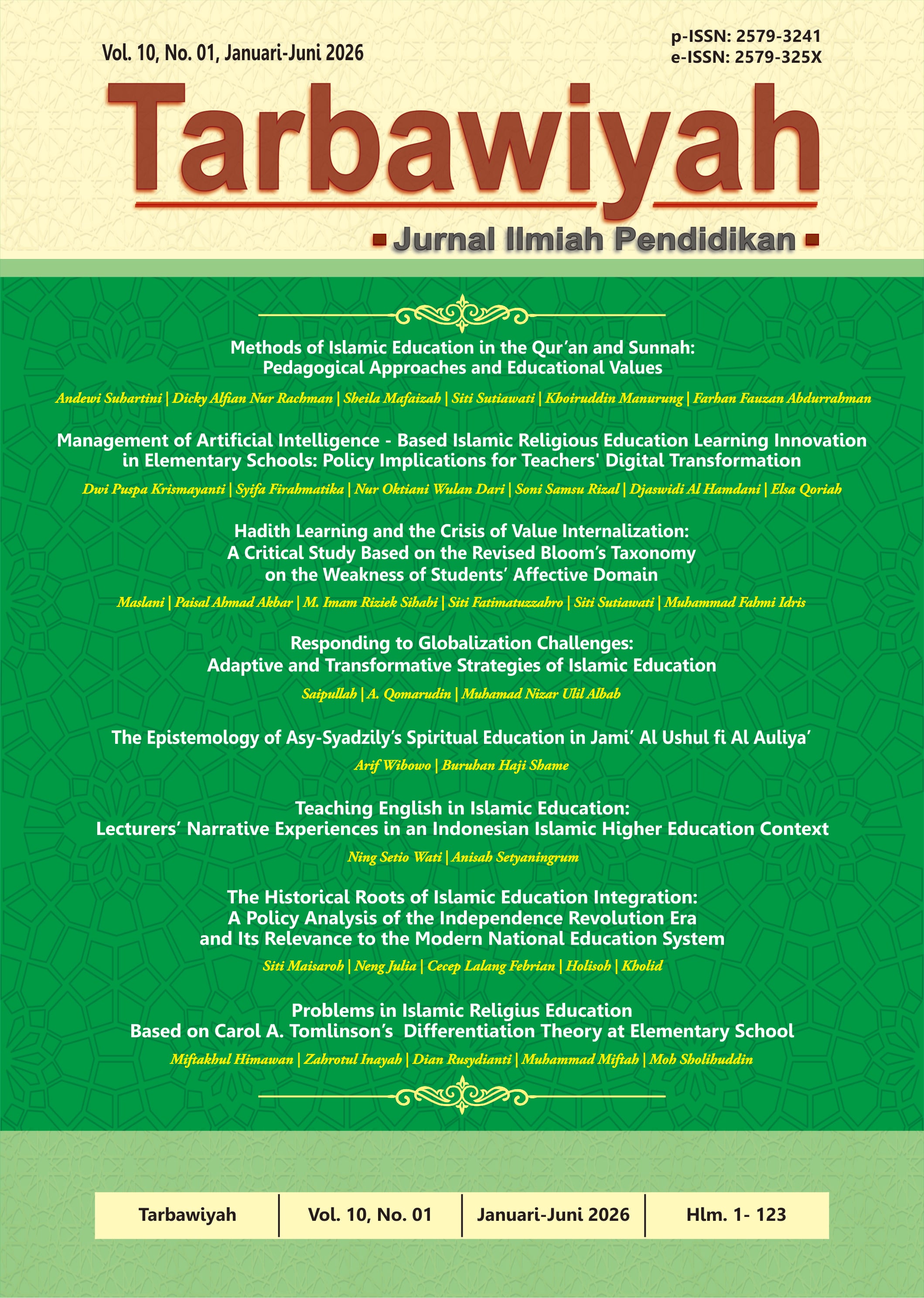
Teaching English in Islamic Education: Lecturers’ Narrative Experiences in an Indonesian Islamic Higher Education Context
DOI:
https://doi.org/10.32332/tarbawiyah.v10i1.14033Keywords:
EFL Teaching, Islamic Education, EFL lecturers, Narrative Inquiry, Islamic Higher EducationAbstract
English teaching in Islamic Education programs requires more than the transmission of general language skills because it needs to respond to students’ religious identities, disciplinary orientations, and future roles as Islamic educators. However, English courses in Islamic higher education are often positioned as compulsory general subjects, with limited attention to how lecturers construct their relevance to Islamic scholarship, academic communication, and professional preparation. This study explored EFL lecturers’ narratives of teaching English to students majoring in Islamic Education and examined the pedagogical, cultural, and institutional meanings constructed from their experiences. Using a qualitative narrative inquiry design, the study involved two EFL lecturers from a State Islamic University in Lampung, Indonesia, selected through purposive sampling. Data were collected through two rounds of semi-structured narrative interviews and analyzed using narrative thematic analysis. The findings revealed three interrelated narrative themes. First, lecturers negotiated the relevance of English by linking it to Islamic scholarship, academic participation, and students’ future roles as Islamic education teachers or religious educators. Second, lecturers adapted their pedagogy to students’ religious and disciplinary orientations through topic selection, material adaptation, classroom interaction, and contextual support. Third, lecturers constructed professional meaning as language educators, academic facilitators, and cultural mediators within Islamic higher education. These findings suggest that EFL teaching in Islamic Education programs is a contextual, identity-sensitive, and value-responsive pedagogical practice. The study contributes to EFL scholarship by connecting teacher cognition, investment, teacher identity, culturally responsive pedagogy, and narrative inquiry in Islamic higher education contexts.
Downloads
References
Barkhuizen, Gary. 2014. “Narrative Research in Language Teaching and Learning.” Language Teaching 47 (4): 450–66. https://doi.org/10.1017/S0261444814000172.
Basturkmen, Helen. 2010. Developing Courses in English for Specific Purposes. Palgrave Macmillan UK. https://doi.org/10.1057/9780230290518.
Beauchamp, Catherine, and Lynn Thomas. 2009. “Understanding Teacher Identity: An Overview of Issues in the Literature and Implications for Teacher Education.” Cambridge Journal of Education 39 (2): 175–89. https://doi.org/10.1080/03057640902902252.
Borg, S. 2003. “Teacher Cognition in Language Teaching: A Review of Research on What Language Teachers Think, Know, Believe, and Do. Language Teaching.” Language Teaching 36 (2): 81–109.
Burns, Anne, Donald Freeman, and Emily Edwards. 2015. “Theorizing and Studying the Language‐Teaching Mind: Mapping Research on Language Teacher Cognition.” The Modern Language Journal 99 (3): 585–601. https://doi.org/10.1111/modl.12245.
Clandinin, D. J., and F. M. Connelly. 2000. Narrative Inquiry: Experience and Story in Qualitative Research. CA: Jossey-Bass.
Clandinin, D. Jean, and F. Michael Connelly. 1990. “Narrative, Experience and the Study of Curriculum.” Cambridge Journal of Education 20 (3): 241–53. https://doi.org/10.1080/0305764900200304.
Darmayenti, Darmayenti, Besral Besral, and Luli Sari Yustina. 2021. “Developing EFL Religious Characters and Local Wisdom Based EFL Textbook for Islamic Higher Education.” Studies in English Language and Education 8 (1): 157–80. https://doi.org/10.24815/siele.v8i1.18263.
Darvin, Ron, and Bonny Norton. 2015. “Identity and a Model of Investment in Applied Linguistics.” Annual Review of Applied Linguistics 35 (March): 36–56. https://doi.org/10.1017/S0267190514000191.
Gay, Geneva. 2002. “Preparing for Culturally Responsive Teaching.” Journal of Teacher Education 53 (2): 106–16. https://doi.org/10.1177/0022487102053002003.
Gusmuliana, Paidi, Safnil Safnil, Syafryadin Syafryadin, and Kodarni Kodarni. 2023. “English for Religious Purposes: The Specific Purposes of Islamic University Students in Indonesia in Learning English.” Journal of Innovation in Educational and Cultural Research 4 (1): 167–78. https://doi.org/10.46843/jiecr.v4i1.503.
Hyland, K. 2006. English for Academic Purposes: An Advanced Resource Book. Routledge.
Irwansyah, Dedi. 2018. “Teaching English at Indonesian Islamic Higher Education: An Epistemological Perspective.” Dinamika Ilmu 18 (1): 1–13. https://doi.org/10.21093/di.v18i1.1120.
Kanno, Yasuko, and Bonny Norton. 2003. “Imagined Communities and Educational Possibilities: Introduction.” Journal of Language, Identity & Education 2 (4): 241–49. https://doi.org/10.1207/S15327701JLIE0204_1.
Kumaravadivelu, B. 2001. “Toward a Postmethod Pedagogy.” TESOL Quarterly 35 (4): 537. https://doi.org/10.2307/3588427.
Ladson-Billings, Gloria. 1995. “Toward a Theory of Culturally Relevant Pedagogy.” American Educational Research Journal 32 (3): 465–91. https://doi.org/10.3102/00028312032003465.
Moll, Luis C., Cathy Amanti, Deborah Neff, and Norma Gonzalez. 1992. “Funds of Knowledge for Teaching: Using a Qualitative Approach to Connect Homes and Classrooms.” Theory Into Practice 31 (2): 132–41. https://doi.org/10.1080/00405849209543534.
Muhsinin, Muhsinin, Mursid Saleh, Dwi Rukmini, and Ahmad Sofwan. 2017. “The Need to Develop English for Specific Purposes (ESP) Reading Syllabus for Students of Islamic Education Department – Islamic Higher Education Institution.” Journal of Foreign Languages, Cultures and Civilizations, ahead of print. https://doi.org/10.15640/jflcc.v5n1a4.
Peirce, Bonny Norton. 1995. “Social Identity, Investment, and Language Learning.” TESOL Quarterly 29 (1): 9. https://doi.org/10.2307/3587803.
Saez-Zevallos, Nataly Susan, and Danitza Elfi Montalvo-Apolín. 2025. “Strategies for Learning English in Higher Education: A Systematic Mapping.” Frontiers in Education 10 (July): 1570602. https://doi.org/10.3389/feduc.2025.1570602.
Syuhda, Nisa, Dedi Irwansyah, Satria Nugraha Adiwijaya, Trisna Dinillah Harya, Much Deiniatur, and Linda Septiyana. 2024. “Contextualizing Islamic Traditions in English Language Teaching at Indonesian Islamic Higher Education.” Forum for Linguistic Studies 6 (3): 260–73. https://doi.org/10.30564/fls.v6i3.6739.
Tao, Jian, and Xuesong Gao. 2017. “Teacher Agency and Identity Commitment in Curricular Reform.” Teaching and Teacher Education 63 (April): 346–55. https://doi.org/10.1016/j.tate.2017.01.010.
Tsui, Amy B. M. 2007. “Complexities of Identity Formation: A Narrative Inquiry of an EFL Teacher.” TESOL Quarterly 41 (4): 657–80. https://doi.org/10.1002/j.1545-7249.2007.tb00098.x.
Varghese, Manka, Brian Morgan, Bill Johnston, and Kimberly A. Johnson. 2005. “Theorizing Language Teacher Identity: Three Perspectives and Beyond.” Journal of Language, Identity & Education 4 (1): 21–44. https://doi.org/10.1207/s15327701jlie0401_2.
Downloads
Published
Issue
Section
License
Copyright (c) 2026 Ning Setio Wati, Anisah Setyaningrum

This work is licensed under a Creative Commons Attribution-ShareAlike 4.0 International License.


