
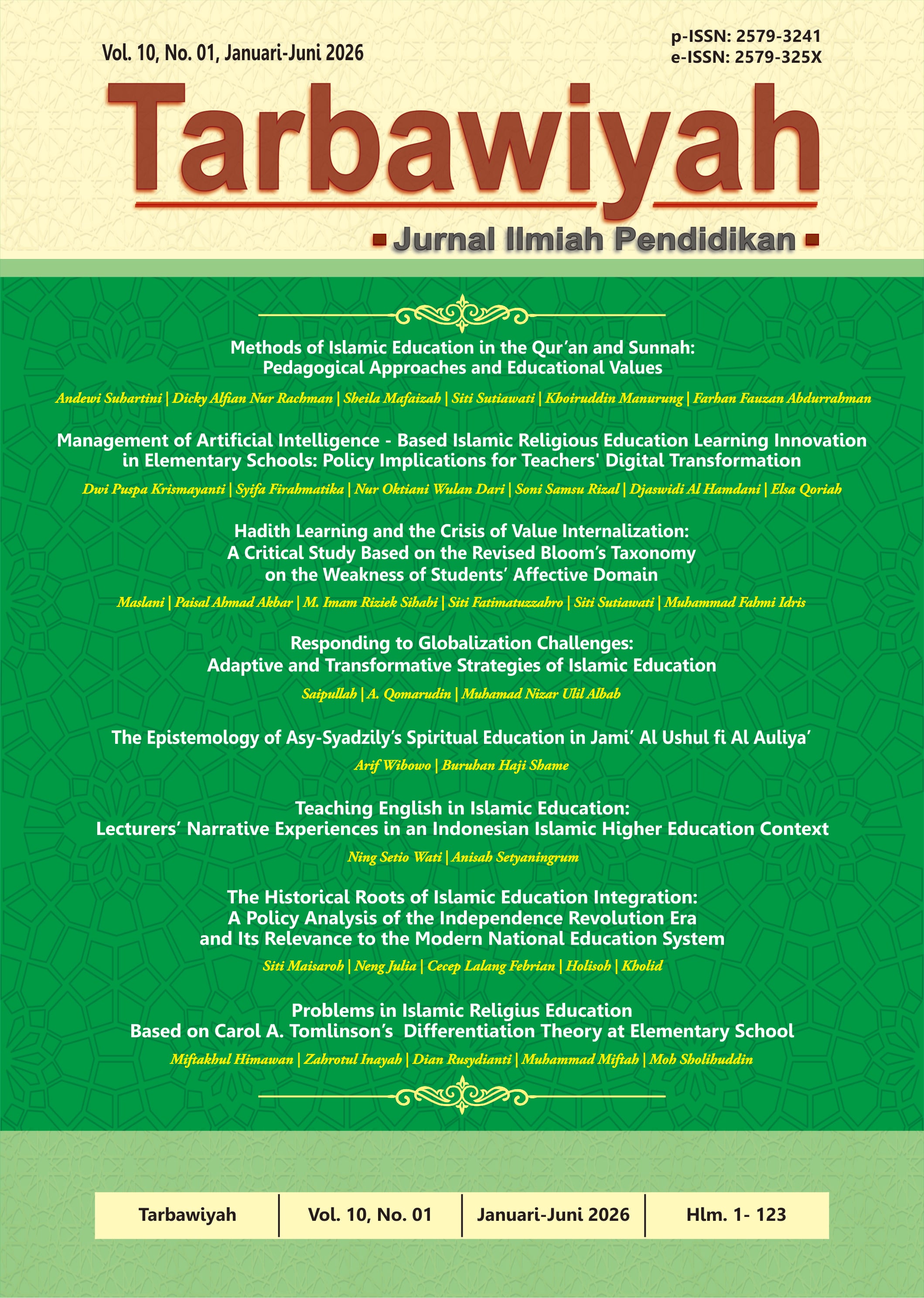
The Epistemology of Asy-Syadzily’s Spiritual Education in Jami’ Al Ushul fi Al Auliya’
DOI:
https://doi.org/10.32332/tarbawiyah.v10i1.12948Keywords:
The Epistemology of Spiritual Education, Asy-Syadzili, Jami‘ al-Uṣul fi al-Awliya’, Sufism, Islamic EducationAbstract
Spiritual education is one of the fundamental dimensions of the Islamic educational tradition, which is oriented not only toward the transmission of religious knowledge but also toward inner transformation, character building, and the strengthening of the relationship between human beings and Allah. This research aims to analyze the epistemology of spiritual education from the perspective of Abu al-Ḥasan Asy Syadzily as presented in his work Jami‘ al-Uṣul fi al-Awliya’. This research employs a qualitative method using a library research approach and hermeneutic analysis of primary texts as well as literature related to Sufi thought and Islamic education. This study finds that al-Syadzili’s epistemology of spiritual education is built upon the integration of three main dimensions: al-‘ilm (spiritual knowledge), al-ḥal (transformation of the inner state), and al-‘amal (the actualization of spiritual values in action). Knowledge, from Asy Syadziyy’s perspective, does not stop at intellectual understanding but must lead to a transformation of spiritual consciousness through the process of purification of the soul (tazkiyat al-nafs) and closeness to Allah. This concept of spiritual education demonstrates that the process of forming the ideal human being (insan kamil) occurs through a dialectical relationship between the mastery of knowledge, spiritual experience, and ethical practice in social life. This research presents the perspective that the thought of Asy Syadzily can serve as an epistemological foundation for the development of Islamic education that balances cognitive, affective, and practical aspects, particularly in the context of nonformal Islamic education. This finding expands the discourse on Islamic education by highlighting the contribution of the Sufi tradition as a source of a spiritual educational paradigm relevant to contemporary educational needs.
Downloads
References
Abdurrahman. (2024). Metode Penelitian Kepustakaan dalam Pendidikan Islam. Adabuna: Jurnal Pendidikan Dan Pemikiran, 3(2), 102–113. https://ejournal.uiidalwa.ac.id/index.php/adabuna/article/view/1563/709
Ansori, M. R. (2019). Konsep Pendidikan Sufistik Menurut Syekh Abul Hasan Asy Syadzily (Telaah Kitab Risalatul Amin fi WushuliLi Robbil Alamin). Muaddib:Islamic Education Journal, 2(1).
Ansori, M. R. (2023). Kontribusi Pemikiran Sufistik Syekh Abu Hasan Asy Syadzily Bagi Pengembangan Pendidikan Karakter di Indonesia. Innovative: Juornal of Social Science Research, 3(5).
Balkis, L. H., Saputra, A., Nurhamidah, W. I., Haqiah, N. A., & Arifi, A. (2024). Pendekatan Hermeneutik dalam Pengkajian Islam: Perspektif Pendidikan Agama Islam Kontekstual. Jurnal Riset Rumpun Ilmu Sosial, Politik Dan Humaniora, 8(1).
Buchori, P. (2017). Perjalanan Sang Pendekar. Pondok PETA.
Chanifah, N., Hanafi, Y., Mahfud, C., & Samsudin, A. (2021). Designing a spirituality-based Islamic education framework for young Muslim generations: A case study from two Indonesian universities. Higher Education Pedagogies, 6(1), 195–211. https://doi.org/https://doi.org/10.1080/23752696.2021.1960879
Firmanto, E. R., & Anam, H. (2022). Kajian Hermeneutik dalam Dunia Pendidikan Islam. J-CEKI: Jurnal Cendekia Ilmiah, 6(1).
Haeri, S. F. (2000). Jenjang-jenjang Sufi. Pustaka Pelajar.
Haryono, E., Suprihatiningsih, S., Septian, D., Widodo, J., & Ashar, A. (2024). New Paradigm Metode Penelitian Kepustakaan (Library Research) di Perguruan Tinggi. An-Nuur: Jurnal Studi Islam, 5(1).
Karlina Putri, Nurul Azizah, Karima, dan G. (2024). Majelis Ta’lim sebagai Lembaga Pendidikan Islam Non Formal di Indonesia. Jurnal Manajemen Dan Pendidikan Agama Islam, 2(2), 1–12. https://journal.aripafi.or.id/index.php/jmpai/article/view/173/215
Khoiruddin, M. A., & Masrukin, A. (2022). Character education based on the Qadiriyah Naqsyabandiyah tharīqah in Islamic vocational high school. Psikis: Jurnal Psikologi Islami, 8(1), 1–12. https://doi.org/https://doi.org/10.19109/psikis.v8i1.10696
Munandir. (2001). Ensiklopedia Pendidikan. UM Press.
Munjin, M., & Kusumawanti, W. D. (2023). The educational character based on Islamic spirituality. Khazanah Pendidikan Islam, 8(1), 1–12.
Musthofa, S. D. A. (2021). Jami’ Al Ushul fi Auliya’. Lirboyo Press.
Nasrullah, M. (2020). Tarekat Syadziliyyah dan Pengaruh Ideologi Aswaja di Indonesia. Jurnal Islam Nusantara, 4(2).
Rizak, M. T. (2019). Konsep Ma’rifat Syekh Abu Hasan Asy Syadzily dalam Buku Risalatul Amin fi Al Wushul Li Robbil Alamin. Esoterik: Jurnal Akhlak Tasawuf, 5(2).
Ruth, D. (2023). How marketizing and technologizing education undermines spirituality. Journal for the Study of Spirituality, 13(2), 163–179. https://doi.org/10.1080/20440243.2023.2238181
Tight, M. (2021). Understanding Lifelong Learning. Routledge.
Widiandari, F. (2022). Analisis Peranan Lembaga Pendidikan Islam Nonformal (Majelis Taklim) di Indonesia. An-Nahdlah: Jurnal Pendidikan Islam, 2(2), 124–135.
Tim Penulis, (2020), Ensiklopedia Ulama Terpilih indonesia, Jakarta, yayasan Amanah Kita.
Yazid, Epistemologi Iluminationis dalam Filsafat Islam: Menghadirkan Cahaya Tuhan, Bandung, Mizan: 2003
Zainuddin Muhibbin, Penguatan Spiritualitas untuk Menghadapi Fenomena Dehumanisasi Akibat Teknologi Maju dan Industrialisasi, Prosiding, ITS Surabaya, 2019
Downloads
Published
Issue
Section
License
Copyright (c) 2026 Arif Wibowo, Buruhan Haji Shame

This work is licensed under a Creative Commons Attribution-ShareAlike 4.0 International License.


