
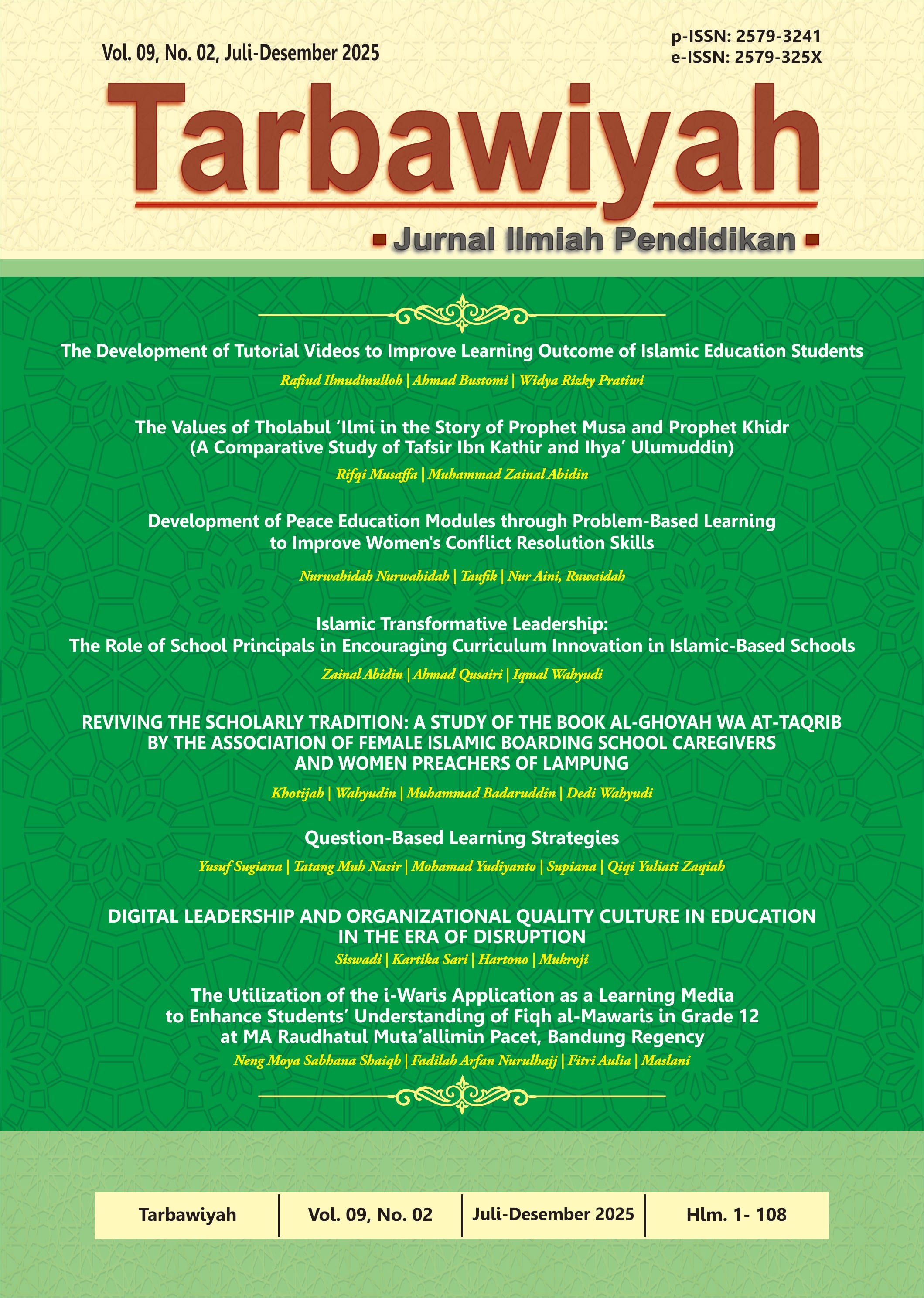
Development of Peace Education Modules through Problem-Based Learning to Improve Women's Conflict Resolution Skills
DOI:
https://doi.org/10.32332/tarbawiyah.v9.i2.11578Keywords:
Module, Peace Education, Problem-Based Learning, Conflict Resolution, Moderate IslamAbstract
This study aimed to develop a peace education module based on Problem-Based Learning (PBL) to strengthen students’ conflict-resolution skills, particularly female students, at STKIP Taman Siswa Bima. The research employed the ADDIE model of Research and Development (R&D). The participants consisted of 90 students for the needs analysis and 30 purposively selected students for a limited trial. Data were collected through needs questionnaires, expert validation, practicality tests, classroom observations, authentic assessments, and pre-/post-tests of conflict-resolution skills. The findings revealed that the module achieved an average expert validation score of 4.45 (very valid) and a practicality score of 4.4 (very practical). Classroom observations resulted in an average score of 4.34 (very good), while authentic assessments of conflict-resolution skills reached an average of 4.34 (87%), categorized as very good. Effectiveness testing showed a significant improvement in conflict-resolution skills, increasing from M = 65.9 (SD = 8.7) at the pre-test to M = 78.8 (SD = 7.8) at the post-test, *t*(29) ≈ 6.5, *p* < 0.001, Cohen’s *d* ≈ 1.1 (large effect size). In conclusion, the PBL-based peace education module, which integrates the local cultural values of *Maja Labo Dahu* and moderate Islam, is valid, practical, and effective in enhancing students’ conflict-resolution skills. The module is recommended for broader implementation across study programs and community service activities as a tangible contribution to strengthening peace education in higher education.
Keywords: Module; Peace Education; Problem-Based Learning; Conflict Resolution; Moderate Islam.
Downloads
References
Ahlan, A., Nurwahidah, N., Rahman, R., & Nafisah, L. (2024). Islamic Perspective Gender Concept and Its Relevance to Social Resilience. JURNAL PENDIDIKAN IPS, 14(1), 197–204.
Annisa, N. (2025). Implementasi Pembelajaran Berdiferensiasi Dengan Model Problem Based Learning (PBL) Pada Pelajaran Pendidikan Agama Islam Dan Budi Pekerti Di SMAN 4 Palu. Universitas Islam Negeri Datokarama Palu.
Aririguzoh, S. (2022). Communication competencies, culture and SDGs: effective processes to cross-cultural communication. Humanities and Social Sciences Communications, 9(1), 1–11.
Bar-Tal, D. (2002). The elusive nature of peace education. Peace Education: The Concept, Principles, and Practices around the World, 27–36.
Barrows, H. S. (1986). A taxonomy of problem‐based learning methods. Medical Education, 20(6), 481–486.
Branch, R. M., & Varank, İ. (2009). Instructional design: The ADDIE approach (Vol. 722). Springer.
Creswell, J. W. (2014). Research desing: qualitative, quantitative and mixed methods approaches (Vol. 54). United State of America: Sage Publications.
do Amaral, J. A. A., & Fregni, F. (2021). Fostering System Thinking Learning by Combining Problem-Based Learning and Simulation-Based Learning Approaches. International Journal of Instruction, 14(3), 1–16.
Esteves, A. M. (2020). Peace education for the Anthropocene? The contribution of regenerative ecology and the ecovillages movement. Journal of Peace Education, 17(1), 26–47.
Freire, P. (1970). Pedagogy of the oppressed. Continuum. New York.
Gustafson, K. L. (1991). Survey of instructional development models. ERIC Clearinghouse on Information & Technology.
Harris, I. M., & Morrison, M. L. (2012). Peace education. McFarland.
Hmelo-Silver, C. E. (2004). Problem-based learning: What and how do students learn? Educational Psychology Review, 16(3), 235–266.
Hmelo-Silver, C. E., & Ertmer, P. A. (2015). Essential Readings in Problem-based Learning.
Hukom, J., Prihatmojo, A., Manaf, A., Suciati, I., & Ratau, A. (2023). Integration of Blended Learning and Project-Based Learning (BPjBL) on Achievement of Students’ Learning Goals: A Meta-Analysis Study. Pegem Journal of Education and Instruction, 13(4), 274–281.
Istianti, T., Maryani, E., Maftuh, B., Gunawan, A., Janah, W. N., & Nurkholiq, A. (2022). Conflict resolution education in building social skills of elementary school students. Harmoni Sosial: Jurnal Pendidikan IPS, 9(2).
Johnson, D. W., & Johnson, R. T. (2006). Conflict Resolution, Peer Mediation, and Peacemaking.
Krampe, F., Hegazi, F., & VanDeveer, S. D. (2021). Sustaining peace through better resource governance: Three potential mechanisms for environmental peacebuilding. World Development, 144, 105508.
Mustahiqurrahman, M., Nurwahidah, N., Rahmawati, R., & Adnia, R. M. (2023). Implementation and Strengthening of Multicultural Islamic Education in Public Schools. JURNAL PENDIDIKAN IPS, 13(1), 158–168.
Nadhirah, N. A., & Adiputra, S. (2023). The Peace Education Model in Developing a Peaceful Classroom Climate: Lesson-learned from Indonesia. Pegem Journal of Education and Instruction, 13(4), 25–35.
Nasution, E. B., & Tambunan, E. M. B. (2021). Penyusunan Modul Pembiasaan/Integrasi Keterampilan Perdamaian Dan Resolusi Konflik Untuk Sekolah Erenos, Tangerang Selatan. Prosiding Konferensi Nasional Pengabdian Kepada Masyarakat Dan Corporate Social Responsibility (PKM-CSR), 4, 780–788.
Nations, U. (2016). Sustainable development goals knowledge platform. Academic Press.
Nurkhin, A., & Pramusinto, H. (2020). Problem-Based Learning Strategy: Its Impact on Students’ Critical and Creative Thinking Skills. European Journal of Educational Research, 9(3), 1141–1150.
Purwoko, B., Sartinah, E. P., Saroinsong, W. P., & Boonroungrut, C. (2023). Enhanced Conflict Resolution Skills among Indonesian Students based on Biblioeducational and Sociodrama Guidance. The Journal of Behavioral Science, 18(2), 101–115.
Rahman, N. F., & Na’ima, M. (2024). Pengaruh Problem Based Learning (PBL) Terhadap Keterampilan Berpikir Kritis dan Kolaboratif dalam Pembelajaran Biologi Terintegrasi Nilai Islam. Al-Alam: Islamic Natural Science Education Journal, 3(2), 52–68.
Rambe, P., & Nurwahidah, N. (2023). The impact of Problem-Based Learning learning methods on the development of islamic education learning. Journal of Insan Mulia Education, 1(1), 25–30.
Rarasati, I., Rosyida, D. A., & Putri, R. O. (2024). Pengembangan Modul Program 4 Anti (Anti Kekerasan Seksual, Anti Perundingan, Anti Intoleransi dan Anti Korupsi) Untuk Siswa Sekolah Dasar. BADA’A: Jurnal Ilmiah Pendidikan Dasar, 6(2), 547–561.
Rentika, K. D., Lusy Liany, S. H., & Mahmud, A. (2023). IMPLEMENTASI TUGAS KOMISI NASIONAL ANTI KEKERASAN TERHADAP PEREMPUAN (KOMNAS PEREMPUAN). ADIL: Jurnal Hukum, 14(2), 1–24.
Sistermans, I. J. (2020). Integrating competency-based education with a case-based or problem-based learning approach in online health sciences. Asia Pacific Education Review, 21(4), 683–696.
Suharso, P., Zulianto, M., Sumardi, S., Sedyati, R. N., & Yushardi, Y. (n.d.). Development Of Conflict Resolution Education Model In Banyuwangi District Senior High School. Jurnal Pendidikan Ilmu Sosial, 32(1), 23–28.
Tilaar, H. A. R. (2002). Perubahan sosial dan pendidikan: Pengantar pedagogik transformatif untuk Indonesia. Penerbit PT. Gramedia Widiasarana Indonesia bekerja sama dengan Center for ….
Downloads
Published
Issue
Section
License
Copyright (c) 2025 nurwahidah, Taufik, Nur Aini, Ruwaidah

This work is licensed under a Creative Commons Attribution-ShareAlike 4.0 International License.


